
Hyra 2.0 – AI Research Agent Launched by Tencent Huyan
Executive Summary:
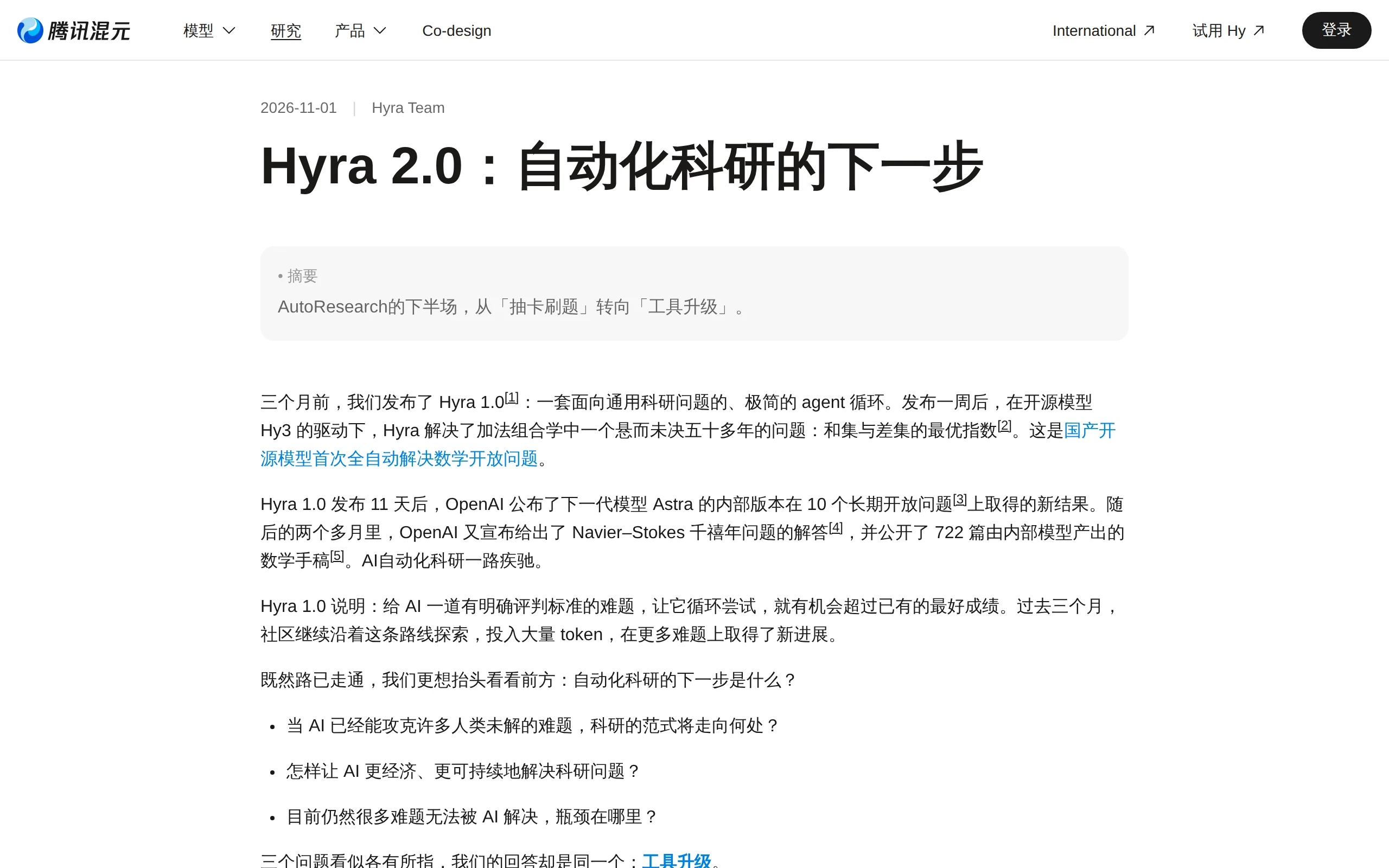
Hyra 2.0 is an AI research agent launched by Tencent Huyan, an upgraded version of Hyra 1.0. Its core positioning has shifted from automatic problem-solving to research tool development. This agent ca...
1. What is Hyra 2.0
Hyra 2.0 is an AI research agent launched by Tencent Huyan, an upgraded version of Hyra 1.0. Its core positioning has shifted from automatic problem-solving to research tool development. This agent can autonomously train scientific models over the long term, optimize research workflows, and accumulate research experience into reusable assets, achieving practical results in fields such as protein design, molecular simulation, mathematical proof, and quantum error correction. Its long-term goal is to enable tool upgrades and model enhancements to drive each other, forming a recursive self-improvement loop.
Technical positioning and domain: Hyra 2.0 belongs to the AI for Science domain, as a research agent system dedicated to upgrading large language models from "problem-solving tools" to "R&D tools." Unlike conventional AI assistants, it does not merely stop at answering scientific questions, but directly participates in the full process of scientific model design, training, evaluation, and deployment, building a reusable research infrastructure.
Development background: This agent was developed by the Tencent Huyan large model team. It represents a paradigm shift from Hyra 1.0, moving from automatic problem-solving to the development of scientific research tools. Tencent Huyan continues to invest in fundamental research, introducing large model capabilities into the scientific discovery process through the Hyra series. It has now covered multiple high-difficulty areas, including protein design, molecular simulation, mathematical proof, and quantum error correction.
Core value: The core value of Hyra 2.0 lies in achieving "intelligent compounding" — every R&D outcome can be repeatedly used in subsequent research. Compared to one-time problem-solving, tool upgrades benefit all downstream tasks, forming a sustainable accumulation of scientific research assets. At the same time, its asynchronous collaboration and independent review mechanisms significantly enhance the credibility of AI research conclusions.
Technical features: Technically, it employs a three-tier organizational structure consisting of Overall, Mission, and Worker, combined with a persistent task queue and scheduling system, supporting long-cycle, multi-project parallel research spanning several days to weeks. Its proprietary Review Worker independent review mechanism and three-tier Books knowledge base for credibility provide a differentiated advantage in AI research agents.
2. Key Features
End-to-end Tool Development: The agent completes the entire process of scientific model design, training, evaluation, and deployment end-to-end. Models such as HyInv and HyPLM are newly developed from scratch, including pre-training, fine-tuning, reinforcement learning, and inference optimization, rather than simply calling existing models. This demonstrates true development capability rather than mere application capability.
Three-tier Collaborative Development Architecture: Long-term research is organized through a three-tier division of labor: Overall, Mission, and Worker. The Overall tier interfaces with humans and manages priorities and resources; the Mission tier is responsible for a specific research problem and accountable for its conclusions; the Worker tier performs exploration and experiments, capable of independently verifying and challenging the Mission's judgments. This organizational structure ensures coherence in research direction and independence at the execution level.
Persistent Task Scheduling: Once a task enters the persistent queue, the scheduling system initiates it based on priority, dependencies, and resource limits. While one task is waiting for training results or human approval, other tasks continue to progress normally. The agent can set wake-up times to automatically resume work at check nodes, enabling long-term task management spanning several days to weeks.
Independent Review Mechanism: The Review Worker first encounters the original problem and evidence in a new context, performing cross-verification of the executor's conclusions to eliminate any influence from the executor's findings. When a Worker report is completed, it must include the code version, experimental results, logs, or execution trajectory as evidence. Any errors or narrower conclusion ranges identified during the review are retained accurately.
Three-tier Memory Separation and Graded Knowledge Base: The system separately stores project status, agent hierarchical working memory (current understanding, key assumptions, excluded paths, next steps), and the cross-task shared knowledge base called Books. Each entry in Books must explain the approach, rationale, applicable conditions, and include original evidence, managed under three levels of credibility: "Observation," "Verified," and "Agreed."
Multi-domain Practical Outcomes: The initial outputs cover six domains: protein design, molecular simulation, mathematical proof, quantum error correction, robot body design, and chip optimization. Specific achievements include a quantum code [488,123,22] with encoding efficiency surpassing the previous top by approximately 48%, verification of proofs related to the丘成桐 conjecture, and the Shangshan chip optimization equivalent to 2 to 3 months of official iteration.
Participation in Large Model Development: Hyra 2.0 is involved in the pre-training infrastructure, post-training data pipeline, and inference system optimization of the next-generation Hy model, providing research intelligent agents to support the overall capability iteration of hybrid models.
3. Application Scenarios
Drug Design and Enzyme Engineering: Invoke inverse folding models such as HyInv to design 128 protein sequences within 50 milliseconds, enabling efficient screening of candidate molecules. This scenario is suitable for pharmaceutical companies and biotechnology firms, significantly accelerating the candidate molecule discovery process in the early stages of new drug development.
Molecular Dynamics Simulation: Drive large-scale simulations using the HyFF atomic-level force field, tracking molecular motion and reaction processes at the atomic scale. This is applicable in the fields of materials science and drug development, helping researchers understand molecular mechanisms and predict material properties, thereby reducing the number of physical experiments.
Mathematical Theory Research: Utilize the HyProver workflow to organize conjecture formulation, proof construction, and independent verification, assisting mathematicians in tackling open problems. It has already demonstrated practical value in verifying proofs related to the Yau conjecture, capable of handling large-scale logical derivations and verification tasks.
Quantum Error-Correcting Code Development: Use HyQEC to construct new quantum codes and accurately verify code distances, providing tools for optimizing error correction overhead in quantum computers. The discovered quantum code [488,123,22] achieves a coding efficiency 48% higher than the previous top performer, holding significant importance for the practical implementation of quantum computing.
Chip Design and Verification: Conduct performance optimization, fuzz testing, and formal verification similar to the optimization of the Xiangshan processor, shortening the chip iteration cycle. The results are equivalent to 2 to 3 months of official iteration work, applicable to the architecture exploration and verification stages in semiconductor design companies.
4. How to Use
Hyra 2.0 is currently an internal research and development system within Tencent Hunyuan and is not a publicly available SaaS product. The primary method of usage is to stay informed and follow the official development process:
Understand the Project Background: First, obtain technical principles, functional features, and details about the achievements of Hyra 2.0 through the official research page. Reading technical articles can help you understand its three-tier organizational structure, Review Worker mechanism, Books knowledge base, and other core designs.
Access the Official Research Repository: The Hyra 2.0 research repository, hyra-results, has been made public (Apache 2.0 license), and the community can view and use its output, including new models, verification systems, and proof workflows. Specific access methods should follow the guidance provided on the official page.
Follow the Open Plan: Since the system is still in the internal development phase, external users should follow Tencent Hunyuan's official channels for updates on future open plans, API integration, or open-source arrangements. The specific timeline will be determined by official announcements.
Participate in Community Discussions and Applications: For publicly released research assets (such as protein design models and quantum error correction code data), researchers can integrate them into their own workflows under the Apache 2.0 license. Additionally, keep an eye on updates from the Tencent Hunyuan research team in academic conferences and technical blogs.
Confirm Compliance: When redeveloping using publicly available results, you must comply with the requirements of the Apache 2.0 license, retain copyright notices, and document any modifications. For commercial use, be sure to pay attention to the specific restrictions outlined in the license terms.
5. Pros and Cons Analysis
| Pros |
|---|
| Paradigm Upgrade and Intelligent Compounding: Transitioning from agents directly solving problems to developing and upgrading scientific research tools, enabling research outcomes to be repeatedly utilized in subsequent studies, creating a sustainable compounding effect of intelligence. |
| Long-term R&D Capability: The three-tier architecture of Overall, Mission, and Worker, combined with a persistent queue, supports long-cycle, multi-project research spanning several days to weeks, surpassing the short-session limitations of typical AI assistants. |
| High Reliability of Conclusions: The Review Worker independently verifies conclusions in new contexts, requiring evidence such as code versions and logs, reducing the risk of agent errors and enhancing the reliability of research outcomes. |
| Experience Can Be Accumulated: The separation of project status, agent memory, and shared knowledge base, with Books categorized into observed, verified, and agreed levels, allows skills to be reused across tasks, building an organizational-level research memory. |
| Broad Domain Coverage: The initial results span six highly challenging fields—protein design, molecular simulation, mathematical proof, quantum error correction, robot body design, and chip optimization—demonstrating general scientific research capabilities. |
6. Comparative Analysis with Similar Tools
| Comparison Dimension | Tencent Hun Yuan Hyra 2.0 | Google DeepMind AlphaEvolve | Sakana AI AI Scientist |
|---|---|---|---|
| Core Positioning | General-purpose agent for R&D and upgrading scientific tools and models, building reusable R&D systems | Gemini-powered coding agent, focused on designing advanced algorithms | Automated scientific pipeline, covering the full process from idea to paper |
| Work Object | Emphasizes both parameterized tools (scientific models) and symbolic tools (workflows, verification systems) | Primarily symbolic output: algorithm code and optimization strategies | Primarily symbolic output: research papers and experimental code |
| Domain Scope | Six domains: proteins, molecular simulations, mathematics, quantum error correction, robotics, and chips | Algorithm design and optimization (matrix multiplication, data scheduling, etc.) | Primarily focused on machine learning algorithm research |
| Outcome Form | Reusable assets: new models, verification systems, proof workflows, skill systems | Algorithm solutions: e.g., discovered matrix multiplication algorithm | Complete papers, experimental code, charts |
| R&D Organization | Three-tier Harness: persistent queue, asynchronous collaboration, independent verification by Review Worker, and manual approval | Centered on evolutionary loops + LLM proposals | Single-agent pipeline + iterative feedback loop |
| Knowledge Accumulation | Books three-tier credibility knowledge base + skill reuse across tasks | Systematic knowledge accumulation mechanism | Reusable paper generation and experimental workflows |
| Self-Improvement Loop | RSI: tools for upgrading the training of Hy models, with next-generation models feeding back into itself | No clear self-improvement mechanism | Limited self-iteration |
| Representative Achievements | Quantum code [488,123,22] encoding efficiency exceeds the original top by about 48%; verification of the丘成桐 conjecture; Xiangshan chip optimization | 4×4 complex matrix multiplication requires only 48 multiplications; saves 0.7% resources in Google data centers | Automatically generates multiple machine learning papers and passes review |
Selection Recommendations: For teams requiring a comprehensive scientific research infrastructure—especially those aiming to cover multiple disciplines, build a reusable scientific asset ecosystem, and possess the ability to self-evolve at the tool level—Hyra 2.0's three-tier architecture and persistent queue design are worth in-depth reference. Although its RSI self-improvement loop is not yet fully open to the public, the design philosophy offers significant insights for intelligent scientific research construction. For algorithm optimization and code generation scenarios, Google DeepMind AlphaEvolve has been sufficiently validated in symbolic algorithm discovery. Teams looking to build an automated scientific paper pipeline from scratch can refer to Sakana AI AI Scientist's pipeline design. For fundamental research teams in physics, chemistry, and biology, Microsoft AI4Science's open-source toolkits and accumulated research methodologies are more aligned with the practical needs of researchers.
7. Editor's Summary
Hyra 2.0 represents a paradigm shift in AI research agents, moving from "problem-solving" to "tool-building," with its value proposition deeply embedded in the entire architecture design: solving a single problem yields only one answer, whereas upgrading a tool benefits all downstream tasks. This core argument fundamentally distinguishes it from the majority of research AI tools currently available on the market—it doesn't just provide better answers, but builds a tool ecosystem that continues to benefit subsequent research.
From a technological innovation perspective, Hyra 2.0's three-tier organizational structure (Overall, Mission, Worker) draws inspiration from modern software engineering practices, applying them to the management of long-term AI research tasks. Features such as persistent queues, asynchronous collaboration, independent verification mechanisms, and three-tier memory separation collectively form a research AI middleware capable of operating for weeks and supporting parallel multi-project execution. The Review Worker's mechanism of independently engaging with the original problem and evidence in new contexts is an effective attempt to address the challenge of credibility in AI research conclusions—requiring Workers to report with code versions and logs as evidence also ensures traceability at the engineering level.
In terms of practical value, the initial results of Hyra 2.0 span six highly challenging domains, achieving a 48% increase in quantum code construction efficiency and chip optimization equivalent to 2 to 3 months of manual iteration. These outcomes validate the effective output of AI research agents in real-world scientific scenarios. Its approach of distilling experience into skills and managing the knowledge base by credibility levels provides a viable path for the continuous accumulation of AI research assets—offering valuable insights for long-term capability building within research teams.
In terms of target users, the design philosophy of Hyra 2.0 holds significant reference value for builders of AI research infrastructure, large model development teams, and institutions aiming to establish automated research pipelines. Although the system itself is not yet publicly available, its open成果仓库 (Apache 2.0) provides the research community with reusable foundational models and validation tools. Looking ahead, its RSI design direction—where tool upgrades and model enhancements drive each other—could, if sustained, create a positive flywheel for AI research capabilities. As results are gradually made public and potential open-source plans progress, its model is likely to be adopted by more research institutions, driving an overall upgrade in the infrastructure for AI for Science. This also addresses a long-standing issue in the AI research field: current methods still primarily focus on "problem-solving," while Hyra 2.0 has chosen a more difficult but more sustainable path.
8. FAQ
Q: What differentiates Hyra 2.0 from regular AI research assistants?
A: Regular AI research assistants typically focus on answering questions and providing suggestions, producing single answers or solutions. Hyra 2.0, however, shifts its positioning from automated problem-solving to a research development tool. It can autonomously train scientific models over the long term, optimize research workflows, and accumulate experience into reusable assets. Its core outputs are new models, verification systems, proof workflows, and skill frameworks, not one-time answers, thereby creating a sustainable intelligent compounding effect.
Q: How does the Review Worker mechanism in Hyra 2.0 ensure the credibility of conclusions?
A: The Review Worker first encounters the original question and evidence in a new context, independently verifying the executor's conclusion to avoid bias from the executor's reasoning process. At the same time, when a Worker completes its report, it must include the code version, experimental results, logs, or execution trajectory as evidence. Any errors or narrower conclusion ranges identified during review are retained truthfully, without being concealed or corrected.
Q: Is Hyra 2.0 currently available to the public? Can external users use it?
A: Currently, Hyra 2.0 is an internal research and development system within Tencent HunYuan and is not an open SaaS product. However, the results repository, hyra-results, has been made public (Apache 2.0 license), and the community can reuse its outputs such as new models and verification systems. Specific plans and timelines for future openness should be followed through Tencent HunYuan's official announcements.
Q: How does the credibility grading mechanism in the Books knowledge base work in detail?
A: Each record in the Books knowledge base must specify the method, rationale, applicable conditions, and include original evidence. It is managed under a three-tier credibility system: the "Observation" level indicates preliminary observations; the "Verified" level denotes conclusions that have been validated; and the "Agreement" level represents team consensus. Existing records can be revised or upgraded when new evidence emerges.
Q: How does Hyra 2.0 achieve its long-term autonomous research capabilities?
A: This is achieved through a three-tier organizational structure and persistent scheduling: Overall manages human interaction, priority, and resources; Mission is responsible for a long-term research question and its conclusion; Worker performs exploration and experiments. Once tasks are added to the persistent queue, they are scheduled based on priority, dependencies, and resource limits. While one task is waiting for training results or human approval, other tasks continue to progress normally. Agents can set wake-up times to resume work at check points.
Q: What representative achievements has Hyra 2.0 produced so far?
A: Representative achievements include: the quantum code [488,123,22] achieving approximately 48% higher coding efficiency than the original top performer; verification of proofs related to the Shing-Tung Yau conjecture; optimization of the Xiangshan chip equivalent to 2–3 months of official iteration; the HyInv inverse folding model completing the design of 128 protein sequences within 50 milliseconds; and the development of new models such as the molecular simulation force field HyFF.
9. Project Links
- Project Website: https://hy.tencent.com/research/hyra2?langVersion=zh
Related
SenseNova 6.8 Flash Review: Active Office Automation and Multimodal Design Generation Practices in SenseTime's Daily New Multimodal Agent Model
SenseNova 6.8 Flash is the flagship multimodal agent model launched by SenseTime's Daily New large model system. Its core positioning focuses on two main directions: active office automation and compr...
DeepSeek Super-agent In-Depth Review: A System Architecture Leap from Passive Dialogue to Continuous Online Collaborator
Super-agent is a continuous online Agent system architecture introduced by the DeepSeek Harness team. Through a dual-layer design, event-driven mechanism, asynchronous multi-channel interaction, stora...
LongCat-2.5 – In-Depth Evaluation of Meituan's Native Multimodal Model
LongCat-2.5 is a native multimodal model introduced by Meituan's LongCat team, featuring a total of 1.6 trillion parameters, with approximately 480 billion parameters activated per token. Designed for...
Canva Brush – In-depth Review of Canva's Vision-Language Design Editing Model
Canva Brush is the first self-developed Vision-Language Model (VLM) officially released by the Canva Research team on October 29, 2026, specifically designed for design editing scenarios. This model c...
© All Rights Reserved. Some content on this site is partially generated by AI with human review.