
LongCat-2.5 – In-Depth Evaluation of Meituan's Native Multimodal Model
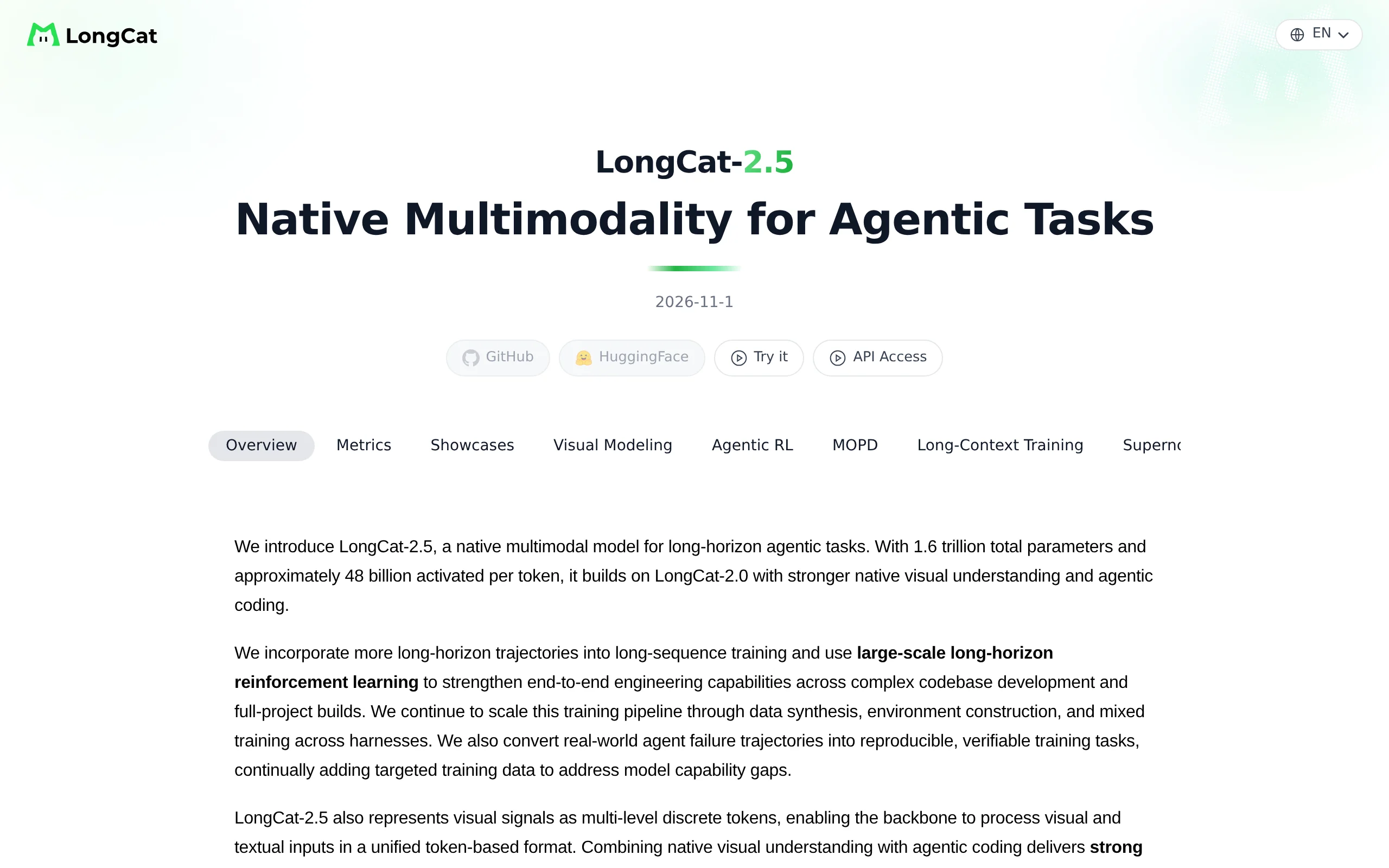
Executive Summary:
LongCat-2.5 is a native multimodal model introduced by Meituan's LongCat team, featuring a total of 1.6 trillion parameters, with approximately 480 billion parameters activated per token. Designed for...
1. What is LongCat-2.5
LongCat-2.5 is a native multimodal model introduced by Meituan's LongCat team, featuring a total of 1.6 trillion parameters, with approximately 480 billion parameters activated per token. Designed for long-range agent tasks, this model discretizes visual signals into multi-level tokens for unified processing with text, significantly enhancing its visual coding capabilities. Leveraging large-scale agentic reinforcement learning, a data synthesis pipeline, long-context training on domestic computing power, and W4A4 quantization optimization, LongCat-2.5 ranks among the top in multiple benchmarks alongside GPT-5.5 and Claude-Opus-5, in areas such as terminal programming, browsing and retrieval, and visual understanding. This marks a significant advancement in the field of multimodal agents for domestic large models.
Technical Positioning and Domain: This model belongs to the intersection of multimodal large language models (Multimodal LLM) and agents (Agent), focusing on end-to-end automation for long-range complex tasks. It covers areas such as terminal programming, web page generation, visual understanding, and professional office analysis. Its core innovation lies in unifying the modeling of visual signals and text within the same token space, enabling genuine native multimodal understanding and generation.
Development Background: Developed by Meituan's LongCat team, which has accumulated substantial technical expertise through the LongCat series of models—from LongCat-Next to LongCat-2.0, and now to LongCat-2.5. The team has continuously iterated on visual representation modeling, reinforcement learning training, and distributed system engineering capabilities. This release comes at a time when competition among domestic large models is intensifying, and LongCat-2.5's focus on agent capabilities as a breakthrough represents a differentiated technical approach.
Core Value: LongCat-2.5 addresses the shortcomings of existing models in long-range multimodal agent tasks—most models struggle to maintain stable performance in complex scenarios requiring multi-step reasoning, tool calling, and visual interaction. By employing native multimodal token unification, large-scale agent reinforcement learning, and training-inference consistency engineering optimization, LongCat-2.5 achieves a leap from simple dialogue to complex codebase development, and from static image understanding to high-frame-rate dynamic web page generation, providing the technical foundation for AI's evolution from a "dialogue tool" to a "productivity platform."
Technical Features: The model uses a MoE (Mixture of Experts) architecture, combining 1.6 trillion total parameters with a design that activates only 480 billion parameters per token, ensuring strong performance while controlling inference costs. It supports efficient training and inference on domestic AI accelerators (such as Huawei Ascend) using W4A4 quantization. System engineering optimizations, including FSDP/EP parallelism alignment with super-node card counts, dual-sharding FSDP, and zero-copy communication, have achieved bitwise consistency in token-level log probabilities between training and inference, laying the groundwork for stable large-scale long-range reinforcement learning.
2. Key Features
End-to-end Agent Programming: Capable of fully automating the entire process from requirement understanding to code implementation, test case generation, and codebase-level modifications. Achieves 58.3 on SWE Atlas-Codebase QnA, 55.2 on Refactoring, and 47.8 on Test Writing, all significantly surpassing GPT-5.5 (45.4, 44.8, 42.6 respectively), demonstrating strong engineering capabilities in real codebase environments. The model can complete full project construction, not just generate code snippets.
Native Multimodal Visual Understanding: Visual signals are encoded into multi-level discrete tokens via residual vector quantization, and processed uniformly with text tokens in the same semantic space, without requiring an additional visual encoder as a bridge. This design enables the model to naturally perform tasks involving cross-modal reasoning between images and text (Visual Coding), achieving 85.2 on VideoMME and 78.6 on Vision2Web, proving its capabilities in dynamic video understanding and visual-to-web generation.
Large-Scale Agent Reinforcement Learning: A scalable data synthesis pipeline has been built, capable of automatically generating tasks, simulating environments, and verifiable test cases, while continuously supplementing training data with failure trajectories from real agents. During training, partial rollout asynchronous strategies are used to mitigate long-tail issues, logprob clipping suppresses gradient bias caused by sample staleness, and a combination of disconnection, cache clearing, and LLM judge strategies defend against reward hacking. Cross-task and cross-Harness mixed training significantly enhances the model's generalization ability.
Long Context Rollout Optimization: Under the PD-separated deployment architecture, effective KV cache is expanded through QCP/KVP and HiCache mechanisms. Cross-layer KV prefetching is achieved via inter-layer indexing in the LSA, nearly doubling the effective cache during the Decode phase. Capacity-aware scheduling strategies prevent recalculation avalanches caused by alternating long trajectories, ensuring efficiency and stability in large-scale long-horizon RL training.
Domestic Compute Power Adaptation and Training-Inference Consistency: FSDP/EP parallelism is aligned with the number of cards in the super node, concentrating communication within high-bandwidth domains. Mixed vocabulary parallelism reduces memory usage. Dual sharding of FSDP shards FP32 main weights and optimizer states across domains, combined with zero-copy communication and overlapping computation, increases SFT single-card throughput by 86% compared to DDP. Unified batch-invariant operators are extended with TP and DCP support, ensuring bitwise consistency of per-token logprob across the training, Prefill, and Decode phases.
Multi-Expert Online Distillation (MOPD): Domain expert models train student models using full-vocabulary KL divergence derived from online sampling of the student model. Teacher responses are split into fixed-length per-cut prefixes, and student sampling length is restricted to effectively control distribution shift. Combined with Tree Attention, training is completed in a single forward and backward pass, significantly reducing computational and storage costs, making knowledge distillation for 1.6T-level models feasible and efficient in engineering practice.
Creative and 3D Content Generation: Supports complex web generation tasks such as real-time fluid simulation, 3D digital exhibitions, urban sandboxes, and miniature scenes. It can directly generate interactive high-frame-rate dynamic web pages based on natural language descriptions, integrating visual understanding and programming capabilities into a practical creative tool.
3. Application Scenarios
Software Development and Codebase Maintenance: Development teams can integrate LongCat-2.5 into their CI/CD workflows to automatically complete Issue fixes, functional module development, codebase refactoring, and test case augmentation. Scoring 64.6 on the DeepSWE v1.1 benchmark, the model is capable of end-to-end understanding of large codebase structures and business logic. It is suitable as an auxiliary development tool for handling repetitive coding tasks and can also participate in architecture-level refactoring under human review.
Vision-Driven Web and Application Generation: Product managers or designers can provide sketches, reference images, and natural language descriptions, and LongCat-2.5 can directly generate corresponding dynamic web pages or application prototypes. Scoring 78.6 on the Vision2Web benchmark, the model can translate visual design intent into high-fidelity interactive pages, supporting advanced visual effects such as real-time fluid simulation and 3D interactive displays, significantly shortening the prototype validation cycle from design to implementation.
Professional Office and Business Analysis: Business analysts can input multi-channel operational data (sales, marketing, inventory, customer feedback, etc.) into the model, which automatically generates structured reports such as profit calculations, factor analysis, and marketing and inventory recommendations. The model can integrate unstructured data sources and output interactive HTML analysis reports, making it ideal for high-frequency analysis scenarios such as management weekly reports and quarterly business reviews.
Intelligent Processing of Customer Feedback: Customer service and user research teams can connect LongCat-2.5 to process massive volumes of customer feedback. The model can automatically identify duplicate feedback, sort it by severity, extract core pain points, and generate interactive HTML visualization reports. Scoring 65.4 on the JobBench, it demonstrates the model's ability to understand, summarize, and present unstructured information.
Event Operations and Marketing Material Generation: Operations personnel can upload venue photos and combine them with natural language requirements (e.g., "tech feel," "accommodate 50 people," "set up a registration area"), and the model can generate a registrable event invitation webpage with support for list exports. Scoring 51.8 on the AutomationBench, this scenario validates the model's multi-step operational capabilities within real business toolchains, making it suitable for market and event teams to quickly produce high-quality operational materials.
4. How to Use
Environment Setup: LongCat-2.5 offers two integration methods. For quick experience, users need no environment configuration and can directly access the online demo page via a browser to use the chat interface. Developers requiring API integration should prepare a connected development environment and register for a LongCat platform account to apply for an API key.
Quick Experience: Visit the online demo page at https://longcat.chat, and upon entering the chat interface, describe your requirements in natural language. For example, upload an image and ask, "Analyze the display issues in this store photo," or input, "Help me generate a brand promotion page with real-time fluid simulation effects." The demo environment supports mixed input of text and images, making it ideal for feature verification and effect evaluation.
API Integration: Developers can apply for an API key by visiting https://longcat.chat/platform/product. Once the application is approved, they will receive access credentials. Configure the key in the request Header of your own application and send chat requests according to the official documentation's API specifications. The API supports multimodal input (text + image) and long context tasks, making it suitable for integrating the model's capabilities into existing business systems.
Model Deployment (Enterprise-level): For data-sensitive enterprises or those requiring local deployment, LongCat provides a private deployment solution. It is recommended to use domestic AI accelerator clusters (such as Huawei Ascend) for the deployment environment, leveraging the model's built-in W4A4 quantization optimization to reduce memory requirements. The MoE model with a total of 1.6T parameters requires a multi-node distributed inference architecture, and deployment should follow the FSDP/EP parallelism alignment recommendations provided by the official documentation.
Key Configuration Notes: When using long-range agent tasks, it is recommended to set a reasonable maximum generation length and timeout based on the task's complexity. In API calls, you can control the sampling temperature via parameters (for programming tasks, a low temperature of 0.2–0.4 is recommended; for creative generation tasks, it can be adjusted to 0.8–1.0). For long context task scenarios, it is advised to enable the official context caching mechanism to reduce the cost of repeated requests.
Notes and Best Practices: The online demo environment is suitable for feature verification, while production environments should use API integration. When calling programming-related tasks, it is recommended to provide clear repository structure descriptions and acceptance criteria. In visual understanding tasks, image resolution affects token consumption and response speed. For tasks involving sensitive data, prioritize the private deployment solution and follow the official data security guidelines.
5. Pros and Cons Analysis
| Pros |
|---|
| Native Multimodal Unified Architecture: Visual signals are encoded into multi-level discrete tokens via residual vector quantization, unified with text in the same semantic space without requiring additional bridging modules. The Visual Coding capability is outstanding, achieving a score of 85.2 on VideoMME. |
| Outstanding Long-range Agent Capabilities: Trained using large-scale Agentic RL and data synthesis pipelines, it leads GPT-5.5 by approximately 10 points across the entire SWE Atlas benchmark suite, achieving 91.9 points on BrowseComp. It can reliably execute complex multi-step tasks with high success rates. |
| Domestically Developed Computing Power with Autonomous Control: It supports efficient training and inference on domestic AI accelerators such as Ascend. Optimizations like W4A4 quantization and FSDP/EP parallel alignment make it possible to train a 1.6T-level model on domestic hardware, with SFT single-card throughput improved by 86% compared to DDP. |
| Solid Engineering Implementation: The training and inference processes are bitwise consistent for per-token logprob. Long context Rollout optimization under PD separation nearly doubles the decoding cache, and capacity-aware scheduling prevents recalculation avalanches, providing reliable support for the stable operation of large-scale long-range RL. |
| Leading Data Synthesis and Distillation Technologies: The pipeline for automatically generating tasks, environments, and verifiable test cases, combined with multi-expert online distillation (MOPD) and Tree Attention technologies, significantly reduces the cost of acquiring high-quality training data and the computational overhead of knowledge distillation. |
6. Comparative Analysis with Similar Tools
| Comparison Dimension | LongCat-2.5 | GPT-5.5 |
|---|---|---|
| Core Architecture | MoE architecture, total parameters 1.6 trillion, approximately 480 billion parameters activated per token, native multimodal (visual discrete tokens and text are processed uniformly) | Parameters scale and architectural details not fully disclosed, confirmed as a multimodal model |
| Multimodal Capabilities | Native unified token space, VideoMME 85.2, Vision2Web 78.6, visual coding capability is a core design | Supports multimodal input, specific architecture not disclosed, no publicly available benchmark data for video understanding |
| Agent Evaluation Performance | SWE Atlas-Refactoring 55.2, Test Writing 47.8, Codebase QnA 58.3; BrowseComp 91.9; HLE with tools 63.1 | SWE Atlas-Refactoring 44.8, Test Writing 42.6, Codebase QnA 45.4; BrowseComp 84.4; HLE with tools 52.2 |
| Terminal Programming Ability | Terminal Bench v2.1 88.4, Terminal Bench v4.0 38.5 | Terminal Bench v2.1 83.2, v4.0 not participated |
| Deployment Method | Supports private deployment with domestic accelerators (e.g., Ascend), W4A4 quantization optimization, also provides API access | Only official cloud API, no support for local deployment |
| Open Source License | Model weights not open-sourced, only API and private deployment solutions are provided | Closed-source commercial model |
| Cost-Effectiveness | W4A4 quantization reduces inference resource requirements, domestic computing power deployment costs are controllable | Token-based billing, higher costs for long-context tasks |
| Community Ecosystem | Backed by Meituan's technical system, platform and documentation are continuously improving, ecosystem is still under construction | Largest global AI developer ecosystem, most comprehensive plugin/tutorial/integration resources |
Selection Recommendations: In research and development team scenarios requiring long-range agent automation programming and integrated visual understanding, LongCat-2.5 demonstrates clear advantages on SWE Atlas and BrowseComp. It is particularly suitable for enterprises that have already adopted domestic AI computing infrastructure — its deep compatibility with W4A4 quantization and Ascend optimization is something closed-source international models cannot provide. However, note that its evaluation data is mainly based on official self-testing, and it is recommended to first conduct small-scale verification before full-scale integration for critical tasks.
For teams with high ecosystem dependency, needing rapid integration into existing toolchains, and not involving data compliance issues, GPT-5.5 and Claude-Opus-5 remain more reliable choices — they offer mature API documentation, rich third-party integration options, and predictable performance. If the task focuses on deep code reasoning (such as DeepSWE scenarios) and budget is sufficient, Claude-Opus-5's 67.0 score is slightly higher than LongCat-2.5's 64.6 score, making it a preferred option.
7. Editor's Summary
LongCat-2.5 represents a significant technical implementation of domestic multimodal large models in the direction of intelligent agents. In terms of technological innovation, the model employs a multi-level discrete token scheme based on residual vector quantization at the visual representation level, achieving a truly native unified modeling of vision and text—from the design of the underlying token, not merely a simple interface concatenation. At the same time, its large-scale intelligent agent reinforcement learning framework includes several noteworthy engineering innovations: the partial rollout asynchronous training strategy alleviates long-tail efficiency issues, logprob clipping suppresses gradient bias from outdated samples, offline and cache-clearing mechanisms combined with LLM judge defend against reward hacking, and cross-task and cross-Harness hybrid training improves generalization—these combined approaches bring long-term RL training for a 1.6T-level model from theory to practical engineering implementation.
In terms of domestic computing power adaptation, LongCat-2.5 demonstrates system engineering capabilities with practical reference value: aligning FSDP/EP parallelism with the number of cards on super nodes keeps communication within high-bandwidth domains, dual sharding of FSDP shards FP32 main weights and optimizer states across domains, zero-copy communication overlapping with computation increases SFT single-card throughput by 86% compared to DDP, and full bitwise consistency in token-level logprob during training and inference is a rare technical guarantee in large-scale reinforcement learning scenarios.
In terms of practical value, LongCat-2.5's performance on real-world business simulation benchmarks such as SWE Atlas, BrowseComp, and JobBench directly points to quantifiable productivity improvement scenarios—programming at the codebase level, information retrieval and aggregation, customer feedback processing, and material generation for event operations are all high-frequency, high-cost needs for enterprises. For companies that have already deployed domestic AI computing infrastructure, LongCat-2.5 provides an opportunity to convert self-controlled computing power into tangible business value. It should be noted objectively that the current evaluation data is mainly based on internal testing by the team, and independent third-party verification has not yet been completed. Some benchmarks have not been evaluated, and the final confirmation of performance advantages awaits broader community validation.
This model is suitable for three types of users: first, enterprise technology decision-makers who need to implement domestic AI infrastructure; second, developers engaged in complex software development and visual content generation; and third, researchers interested in the evolution of multimodal agent technology routes. As the LongCat platform ecosystem continues to improve and third-party evaluations are added, LongCat-2.5's position in the competitive landscape of domestic large models will become even clearer.
8. FAQ
Q: What are the main differences between LongCat-2.5 and LongCat-2.0?
A: LongCat-2.5 has achieved significant iteration over the 2.0 version across multiple dimensions. Key improvements include: expanding the total parameter count from a smaller scale to 1.6 trillion (480 billion parameters per token); introducing large-scale agent reinforcement learning and data synthesis pipelines, enabling the model to complete complex codebase development end-to-end; and incorporating long-sequence training and failure trajectory transformation training tasks, which greatly enhance the model's stability in long-range tasks. According to the official statement, these improvements have led to substantial gains in agent-related benchmarks compared to the 2.0 version.
Q: Does LongCat-2.5 support local deployment? What hardware requirements are needed?
A: Yes, it supports local deployment. LongCat-2.5 has been deeply optimized for domestic AI accelerators (such as Huawei Ascend), including alignment of FSDP/EP parallelism with super-node card counts, W4A4 quantization, and dual-sharding FSDP, enabling the 1.6T-level MoE model to be both trained and inferred on domestic computing power. However, it should be noted that a full deployment of the 1.6 trillion parameter model requires a multi-node distributed cluster. For specific hardware configuration recommendations, please contact the LongCat team at Meituan for the official deployment plan. Individual developers cannot run the full model on consumer-grade hardware and are better suited to use the API for integration.
Q: How can developers apply for LongCat-2.5's API? What interface capabilities does it support?
A: Developers can apply for an API key via the page https://longcat.chat/platform/product. The API supports multimodal input (text + image hybrid), long-context conversations, and streaming output, enabling integration into proprietary applications to achieve capabilities such as agent programming, visual understanding, and report generation. API applications require platform approval, and specific interface documentation and calling standards can be accessed through the LongCat platform.
Q: Are the evaluation results for LongCat-2.5 self-tested by the official team? How credible are they?
A: The publicly available evaluation data (such as Terminal Bench, SWE Atlas, BrowseComp, etc.) are all labeled as self-tested results by the official team and have not yet been independently verified by third-party institutions. The transparency of the evaluation environment, test set division, and assessment process needs to be further improved. It is recommended that developers conduct small-scale validation tests themselves in critical task scenarios to obtain objective evaluations based on their own business data.
Q: Does LongCat-2.5 support Chinese tasks? How does it perform in Chinese scenarios?
A: As a model developed by a domestic team, LongCat-2.5 natively supports Chinese input and output. Currently, the publicly available evaluation benchmarks are primarily focused on English tasks (such as SWE Atlas, BrowseComp, etc.), and evaluation data for Chinese-specific benchmarks have not yet been released. The official team has demonstrated application cases in Chinese business scenarios such as professional office analysis and customer feedback processing, but more empirical data are needed to support specific quantitative performance metrics.
Q: What exactly does the Visual Coding capability of LongCat-2.5 refer to?
A: Visual Coding refers to the model's ability to interpret visual information (such as images and video frames) as actionable code-level semantics—for example, generating corresponding web code directly from a product design diagram or creating interactive visual pages based on a video's content. Since visual signals are encoded into discrete tokens unified with text, the model inherently possesses reasoning capabilities across visual, code, and natural language domains. This is the core differentiating capability that sets it apart from traditional "visual question answering" models.
9. Project Links
- Online Experience Entry: https://longcat.chat
- Project Website (Blog/Release Page): https://longcat.ai/blog/longcat-2.5/
- API Platform: https://longcat.chat/platform/product
Related

Canva Brush – In-depth Review of Canva's Vision-Language Design Editing Model
Canva Brush is the first self-developed Vision-Language Model (VLM) officially released by the Canva Research team on October 29, 2026, specifically designed for design editing scenarios. This model c...
HelixHarness – AI Coding Engineering Framework Open-Sourced by Didi
HelixHarness is an AI Coding engineering framework open-sourced by the Didi Financial Technology team. It operates on top of Codex and Claude Code, positioned as a standardized infrastructure for team...
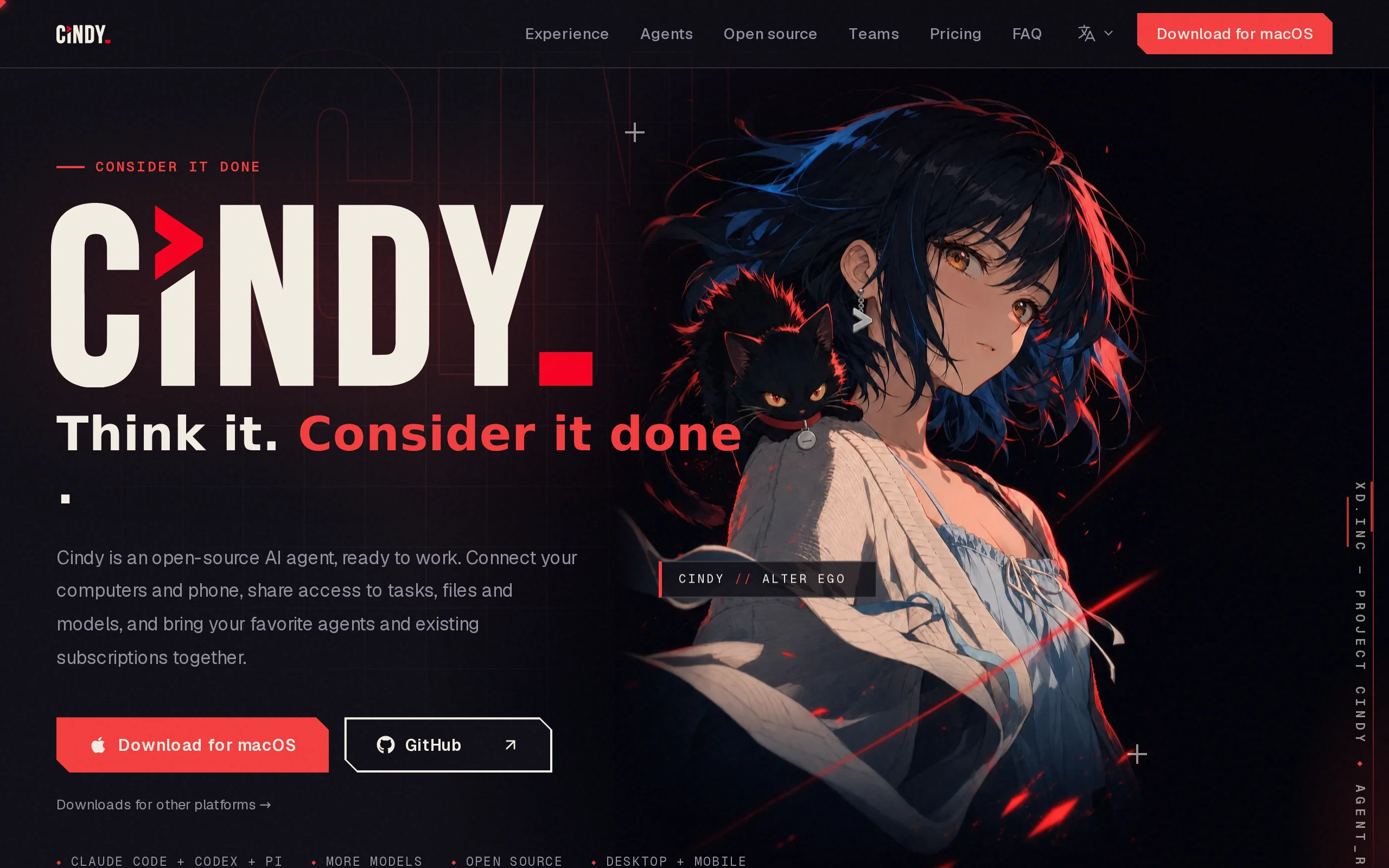
Cindy – Open-Source AI Agent Workbench Review: Multi-Engine Integration and Real Automation with Browser Login State
Cindy is an open-source AI Agent workbench that users can deploy on their own devices. It integrates multiple mainstream Agent engines, such as Claude Code, Codex, and Pi, through a unified graphical ...
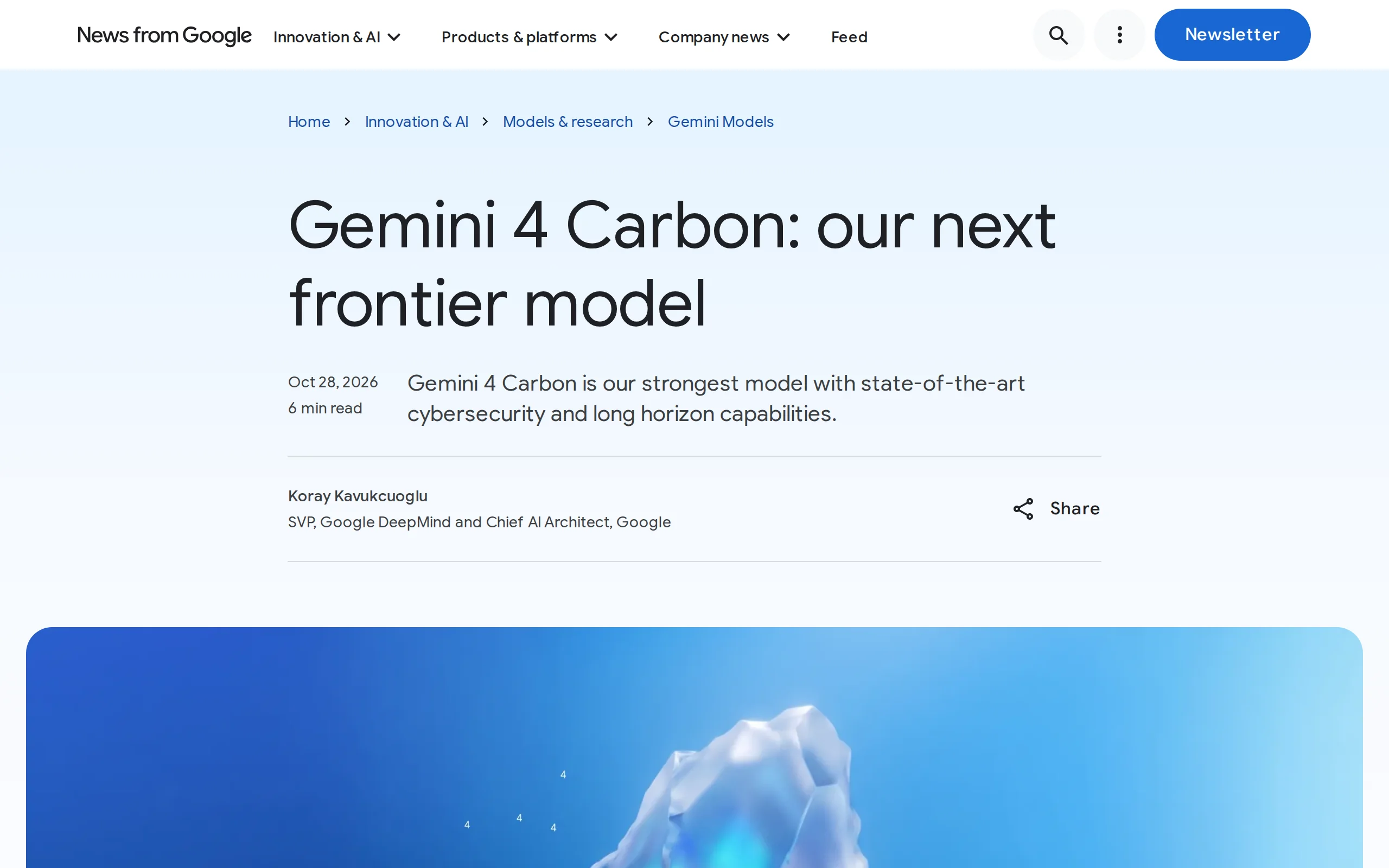
Gemini 4 Carbon – Google DeepMind's Latest Flagship Large Model
Gemini 4 Carbon is the latest flagship large model introduced by Google DeepMind. As the next-generation product of Gemini 4 Argon, it ranks first globally in the Artificial Analysis Smart Index 5.0 w...
© All Rights Reserved. Some content on this site is partially generated by AI with human review.