
Qoduck – The Anonymous Coding Model Launched by Alibaba, Now Available for Free on Qoder
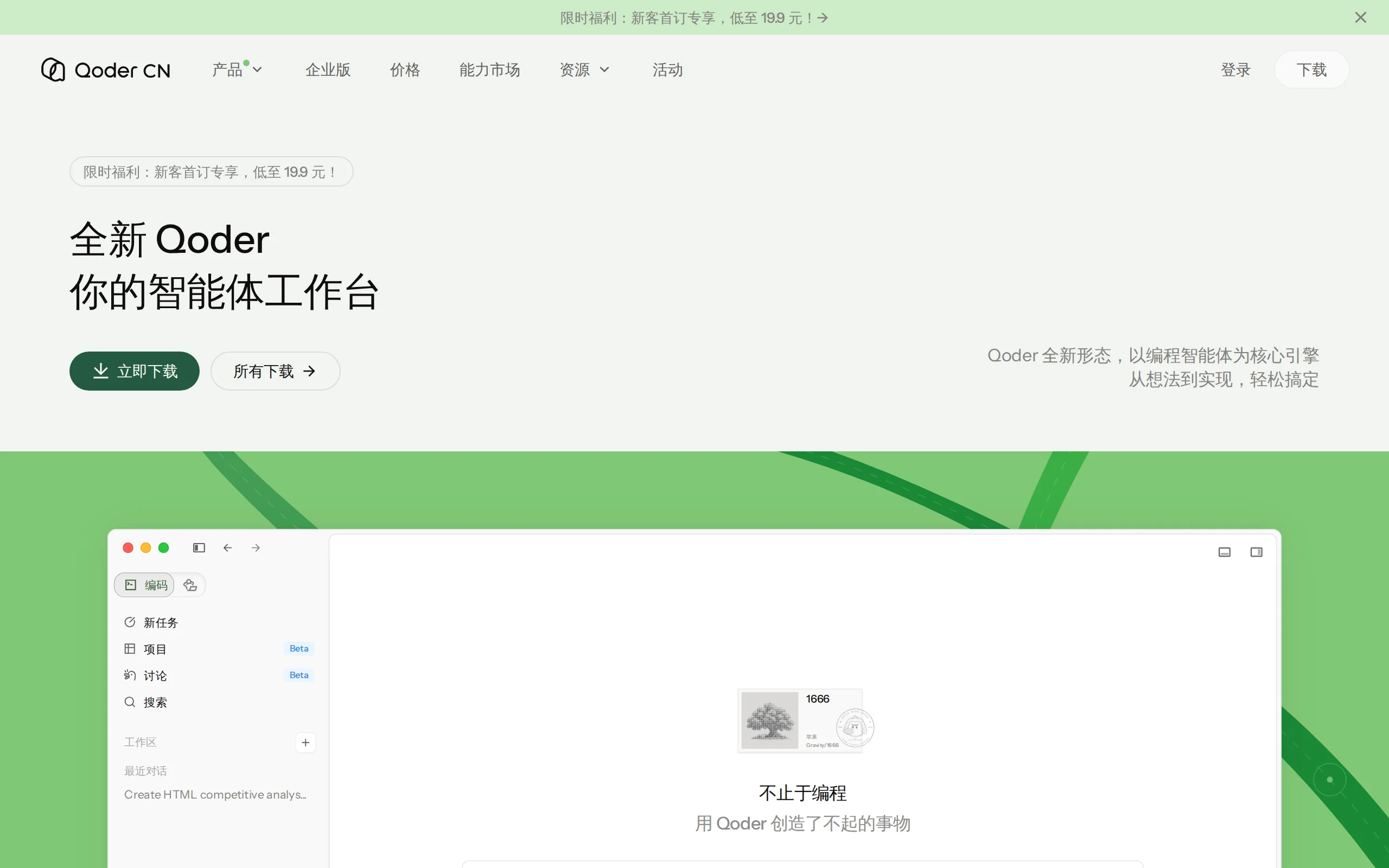
Executive Summary:
Qoduck is an anonymous coding model launched by Alibaba's AI coding platform Qoder on November 7, 2026. The official has not disclosed its identity or parameters, and the community generally speculate...
1. What is Qoduck
Qoduck is an anonymous coding model launched by Alibaba's AI coding platform Qoder on November 7, 2026. The official has not disclosed its identity or parameters, and the community generally speculates that it is a preview version of Qwen 4 Max. This model supports core capabilities such as code generation, code explanation, cross-file refactoring, long-context understanding, and task planning with self-validation. During the promotional period, individual users can enjoy a daily free usage quota, and calls within this quota do not consume credits, even when the thinking intensity is set to the highest level. As the only official entry point currently available for early access to Qwen 4 capabilities, Qoduck holds significant value for developers looking to try out the next-generation flagship model.
Technical Positioning and Domain: It belongs to the field of natural language processing and AI code generation, focusing on programming assistance scenarios in software development. As an anonymous model, Qoduck's technical architecture and parameter scale have not been disclosed. However, based on practical testing, it is positioned as a high-performance coding assistant for developers, addressing a variety of development needs ranging from single-file completion to full-library analysis. The product's anonymous strategy makes its identity and parameter size opaque, which not only increases user curiosity but also requires potential users to evaluate its capabilities based on actual performance rather than technical specifications. This has created a unique marketing effect in the AI coding tool market.
Development Background: Qoduck was developed and released by the Qoder team, which is part of Alibaba's AI coding platform. Qoder is Alibaba's AI coding product line aimed at developers, covering IDE plugins, CLI tools, and conversational coding interfaces. The launch of Qoduck continues Qoder's technical accumulation in the field of programming assistance. Its anonymous strategy is relatively rare in the industry, and the official has clearly stated, "More information will be released at an appropriate time," which maintains marketing suspense while also reserving room for adjustments before the formal release.
Core Value: Qoduck addresses the pain point of developers who want to experience the capabilities of the next-generation flagship model in advance. During the promotional period, individual users can receive a daily free call quota, and usage within this quota does not consume credits. This significantly lowers the cost barrier for early access. For developers who wish to evaluate the capabilities of the Qwen 4 series, Qoduck is currently the only officially provided free trial entry point. Its performance in cross-file refactoring, task planning, and self-validation has been outstanding in practical tests, offering real value for complex coding tasks.
Technical Features: Based on practical user feedback, Qoduck demonstrates strong code generation accuracy and long-context understanding capabilities, particularly excelling in cross-file refactoring scenarios. Its task planning and self-validation mechanisms can automatically plan and execute multi-step tasks while checking the correctness of the generated code, showcasing a high degree of autonomy and reliability. However, it should be noted that Qoduck is an anonymous preview version, and during peak times, it may experience slowdowns or queuing, with stability not yet on par with the official version of the model.
2. Key Features
Code Generation: Users only need to describe their requirements in natural language, and Qoduck can generate the corresponding code implementation. Whether it's function completion, module construction, or algorithm implementation, the model can convert natural language instructions into high-quality code, significantly improving development efficiency and reducing repetitive manual coding tasks. In practical tests, Qoduck demonstrates a solid understanding of complex syntax and business logic, and the generated code exhibits good readability and maintainability.
Code Explanation: For unfamiliar code snippets or legacy projects, Qoduck can perform in-depth semantic analysis and clearly explain the code's operational mechanisms, logical structure, and design intent. This feature significantly reduces the cognitive burden on developers when understanding others' code or old projects, accelerating knowledge transfer and technical handover in team collaboration. It is especially suitable for scenarios where new team members need to quickly integrate into an existing codebase.
Cross-file Refactoring: Qoduck supports coordinated modifications and structural adjustments across multiple files, a capability that has been proven to be the strongest in practical testing. Developers can describe their desired changes in natural language, and the model will synchronize and implement refactoring operations such as renaming, extracting, and migrating across multiple affected source files, while checking the integrity of existing functionality. This significantly enhances the maintenance efficiency of large codebases.
Long Context Understanding: With strong long context processing capabilities, Qoduck can handle large-scale codebase contexts and demonstrate a good global perspective when analyzing existing projects. Developers can ask questions based on the entire project context, and the resulting code analysis and modification suggestions often show better overall consistency, reducing the issue of "seeing the trees but not the forest."
Task Planning and Self-Verification: When faced with multi-step complex tasks, Qoduck automatically plans the execution path, completing each step in a logical order and verifying the correctness of the code during the process. This closed-loop mechanism of planning, execution, and verification reduces the burden on developers to supervise the process and minimizes the risk of logical errors and missing functionality, making it suitable for development tasks involving collaboration across multiple modules.
Thinking Intensity Adjustment: Qoduck allows users to adjust the thinking intensity. During the promotional period, setting the thinking intensity to extremely high will not consume additional free credits. This feature enables developers to flexibly configure resources based on the complexity of the task. For challenging problems, higher intensity reasoning can be enabled to obtain more rigorous outputs, without worrying about increased costs.
Zero-cost Experience Mechanism: During the promotional period, free usage quotas are gifted daily. Usage within the quota does not consume credits, and the billing coefficient is reduced from 0.5× to 0.0×. Once the free quota is exhausted, billing reverts to 0.5×, matching the Qwen3.8-Max tier. This mechanism greatly lowers the entry barrier for new users and makes it convenient for developers to use it for routine non-critical tasks.
3. Application Scenarios
Daily Coding Assistance: Developers can describe requirements in natural language, allowing Qoduck to generate function implementations, complete code snippets, or fix known bugs. This type of repetitive coding task can be quickly delegated to the model, enabling developers to focus on more core architectural decisions and business logic design. In practical tests, the model has demonstrated solid performance in both code quality and completion speed.
Legacy Code Digestion and Understanding: When dealing with legacy projects or unfamiliar code written by others, Qoduck's code explanation capabilities can help developers quickly build understanding. Handing over the entire project or key modules to the model for interpretation and architectural analysis can significantly shorten the code familiarization cycle, especially offering clear value to developers who have just taken over an old system.
Cross-file Refactoring and Structure Adjustment: When making multi-file modifications and restructuring, Qoduck can uniformly plan the changes and synchronize their execution across multiple files, while checking whether existing functionality remains intact. This scenario is one of Qoduck's stronger areas in practical testing, making it suitable for handling medium to large codebases that continuously evolve, reducing the effort required for manual cross-file impact analysis.
Rapid Prototyping: Developers can generate runnable web pages, small games, or dashboard demos by simply describing their ideas, allowing for low-cost validation of product concepts. Qoduck's code generation and refactoring capabilities, combined with its extended context window, enable the creation of "from scratch" small application prototypes, making it ideal for time-sensitive scenarios such as Hackathons, requirement demonstrations, or technical pre-research.
4. How to Use
Environment Requirements: To use Qoduck, you need access to the Qoder platform, which supports usage through the desktop client (both CN and international versions). Users need a personal Qoder account, and both free accounts and zero-balance accounts can participate in the activity without requiring a paid subscription.
Login to Account: Visit the Qoder official website and log in with your personal account. If you are a new user, you must first complete the registration process before entering the main interface of the AI programming platform.
Select the Model: Open the model selector at the bottom of the AI dialogue input box, find "Qoduck" in the model list, and select it. No coupons or additional actions are required; the selection takes effect automatically, and the model selector will remember your preferences for subsequent multiple calls.
Start the Task: Simply describe your programming task in natural language and send it. Calls within the daily free quota do not consume Credits. The daily quota begins to be issued on November 7, 2026, and will be replenished the next day after being used up. The number of free calls per day may vary between free account users and paid subscription users, with paid subscription users typically receiving more free call opportunities.
Notes: Even if you set the thinking intensity to the highest level within the free quota, it will not incur additional charges. Therefore, you can directly enable the highest thinking intensity when handling complex tasks. However, please note that Qoduck is an anonymous preview version, and during peak hours, it may experience slowdowns or queuing. For critical tasks, it is recommended to use it during off-peak hours or consider using the official version of the model as an alternative. Quota and billing rules may change with the activity, so it is advisable to check the official Qoder activity guidelines before use for the latest information.
5. Pros and Cons Analysis
| Pros |
|---|
| Zero-cost trial: During the event period, daily free quotas are provided. Calls within the quota do not consume Credits, and even with maximum thinking intensity, it remains free, lowering the barrier to entry for trying it out. |
| Outstanding performance experience: In practical tests, Qoduck's performance is comparable to Qwen3.8-Max with a slight improvement, responding faster, especially excelling in cross-file refactoring scenarios. |
| Broad functional coverage: It comprehensively covers code generation, code explanation, cross-file refactoring, long context understanding, task planning, and self-validation, capable of handling everything from single-file completion to full library analysis. |
| Experience the next-generation flagship ahead of time: As a likely preview version of Qwen 4 Max, it is currently the only official entry point to experience Qwen 4 capabilities in advance, offering forward-looking value. |
6. Comparative Analysis with Similar Tools
| Comparison Dimension | Qoduck | Qwen3.8-Max | GitHub Copilot |
|---|---|---|---|
| Model Identity | Anonymous preview model, identity not officially disclosed; community speculation suggests it is a preview version of Qwen 4 Max | Clearly defined flagship model, officially labeled with 2.4T parameters | Based on OpenAI Codex series models, offers multiple model options |
| Billing During Active Period | 0.0× cost within daily free quota, does not consume Credits | No free quota, each call consumes 0.5× Credits | Subscription-based, billed per seat, no free daily quota |
| Billing After Free Quota is Exhausted | 0.5×, same tier as Qwen3.8-Max | 0.5× | Not applicable, usage is within subscription packages |
| Available Channels | Only available on desktop clients (CN + international version), limited channels | Available across all platforms, including plugins and CLI | IDE plugin, Web, mobile, CLI (GitHub CLI extension) |
| Performance Perception | Real-world testing shows performance approximately equal to Qwen3.8-Max with minor improvements, faster response times | Stable high-level baseline performance | Excellent code completion quality, strong in local context understanding |
| Stability | Preview version, may slow down or queue during peak hours, performance fluctuates | Official version, predictable behavior | Commercial-grade SLA, stable service |
| Open Source License | Closed-source, free trial available within the platform | Closed-source commercial model | Closed-source commercial software |
Selection Recommendations: For developers seeking new model capabilities and a zero-cost trial experience, Qoduck is an ideal choice — the daily free quota is sufficient to support coding assistance and prototype validation for non-critical tasks. Its performance is comparable to, or slightly better than, the current flagship model, especially suitable for thoroughly evaluating the practical capabilities of the Qwen 4 series during the active period. However, note the channel limitations and potential stability fluctuations; for critical production tasks, it is recommended to pair it with the official version of the model.
For development teams with established AI programming workflows and high requirements for stability and toolchain integration, Qwen3.8-Max or commercial products like GitHub Copilot and Cursor offer more robust reliability, cross-channel support, and SLA guarantees. Qoduck is better suited as a supplementary tool for experimentation, testing, and exploratory tasks, rather than as the sole productivity tool.
7. Editor's Summary
The launch of Qoduck reflects a strategic move by the Alibaba ecosystem in the AI programming domain. Going live anonymously and offering free access to its core capabilities is relatively rare in the AI programming tool market: on one hand, it leverages "mystery" to spark community discussions and generate buzz; on the other, it significantly lowers the barrier to entry for users through free quotas, preheating the market and gathering feedback ahead of the official release of a potential flagship model. From a technological innovation perspective, Qoduck's practical performance in cross-file refactoring and task planning–self-verification mechanisms demonstrates its deep understanding and execution capabilities in complex programming tasks, pointing toward the key evolutionary directions for the next generation of programming models.
In terms of practical value, the daily free quota during the promotional period offers real appeal to individual developers and enthusiasts, allowing them to experience near-flagship-level programming capabilities at no cost. This is beneficial for model capability evaluation, preliminary technical selection research, and learning exploration. However, its preview status and channel restrictions suggest it is more suitable for non-critical tasks, while core development in production environments should still rely on the official version of the model. The target audience is clearly defined: developers eager to get early access to the capabilities of the next-generation model, engineers needing low-cost solutions for prototype validation, and team technical leads who are observing the evolution of AI programming tools.
Looking ahead, if the "anonymous testing + free experience" model represented by Qoduck receives positive feedback, it could become an innovative standard for model releases. Additionally, its standout performance in scenarios such as cross-file refactoring indicates that the next generation of programming models will be better equipped to handle complex, codebase-level tasks. As the official team releases more details about identity and technical specifications, the actual value of Qoduck will be more fully assessed.
8. FAQ
Q: What exactly is the Qoduck model? Is it Qwen 4 Max?
A: Qoduck is an anonymous model, and the official has clearly stated that "the model's identity is not disclosed at this time," encouraging users to directly try it out and evaluate its capabilities through practical tasks. The community generally speculates that it is a preview version of Qwen 4 Max, but this speculation has not been officially confirmed. More information will be released at an appropriate time; it is recommended to follow the official Qoder channels for updates.
Q: Is a paid subscription required to use Qoduck?
A: No. Experience (free) users can also participate in the activity, and using Qoduck within the daily free quota does not consume Credits. Paid subscribers usually have a higher daily free usage limit. The activity is effective from November 7, 2026, and is open to all new and existing individual users.
Q: How is Qoduck billed after the free quota is exhausted?
A: Once the free quota is used up, the billing coefficient for Qoduck reverts from 0.0× to 0.5×, placing it in the same category as Qwen3.8-Max. This means that calls will start consuming Credits. The daily quota resets the next day, and free accounts and accounts with zero balance can still be used, but only within the quota to enjoy zero billing.
Q: Is Qoduck suitable for use in production environments?
A: Qoduck is an anonymous preview version, and the official has not yet disclosed its full technical details. It may experience slowdowns, queuing, and performance fluctuations during peak times, with unpredictable behavior. It is recommended for experimentation, testing, and non-critical tasks. For core code development in production environments, it is advisable to prioritize the official model (such as Qwen3.8-Max).
Q: What usage channels does Qoduck support?
A: Currently, Qoduck is only supported via the Qoder desktop client, which includes both the Chinese and international versions. It does not offer plugin or CLI access, which is a gap compared to the multi-channel coverage of official models. Users need to download the desktop client and log in to their personal accounts. Once Qoduck is selected in the model selector, they can begin using it.
Q: How should I choose between Qoduck and Qwen3.8-Max?
A: If your task requires high stability or is part of core development in a production environment, it is recommended to choose Qwen3.8-Max, whose behavior is predictable. If you want to experience the capabilities of the next-generation model, conduct prototype validation, or if the task is non-critical, you can prioritize using Qoduck's daily free quota. Its performance is roughly on par with Qwen3.8-Max, with a slight improvement, and at zero cost.
9. Project Links
- Qoder Official Website: https://qoder.cn
- Qoder International Version Official Website: https://qoder.com
- Qoduck Limited-Time Free Event Details (Qoder CN): https://docs.qoder.cn/events/qoduck-free
- Qoduck Limited-Time Free Event Details (Qoder): https://docs.qoder.com/zh/events/qoduck-free
Related
AI Open Source Project Weekly – Featured Projects: TV to Desktop, AI Dubbing, and More
VoiceStudio is a localized desktop tool focused on text-to-speech synthesis and audio processing, integrating voice generation, voice cloning, video dubbing, and speech transcription into a unified wo...
Muse Ember Review: Meta Redefines the Efficiency Boundaries of Lightweight Models
Muse Ember is Meta's smallest parameter-scale AI model introduced in mid-2026, specifically designed for high-frequency, repetitive tasks in agents. According to official benchmark data, this model ac...
In-Depth Review of Sophon-Realtime v1: A Technical Breakthrough and Engineering Practice in Open-Source Full-Duplex Speech Models
Sophon-Realtime v1 is an open-source full-duplex speech dialogue model developed by Adventists AI. Designed with a 32B parameter scale, it enables complete conversational capabilities, including real-...
ComfyTV – Open-Source ComfyUI Plugin, Local Infinite Canvas Media Workbench
ComfyTV is an open-source ComfyUI plugin that operates entirely locally, transforming ComfyUI into an infinite canvas-style media workbench similar to TapNow and LibTV. Each operation on the canvas is...
© All Rights Reserved. Some content on this site is partially generated by AI with human review.