
Review of Seedance 2.5 4K: Volcano Engine Enters the High-End Video Generation Market with 4K and 10-bit Color Depth
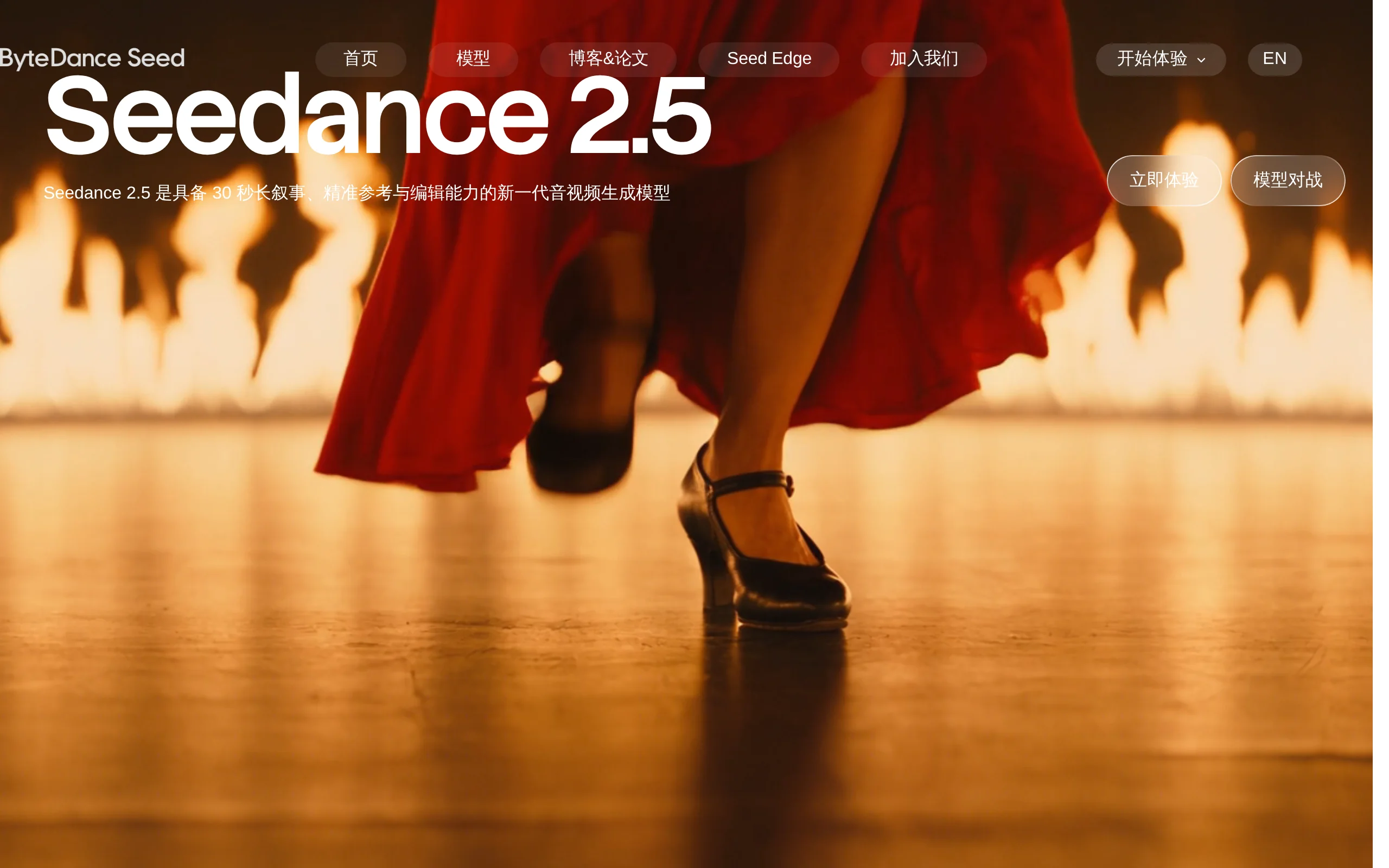
Executive Summary:
Seedance 2.5 4K is a premium version of the Seedance 2.5 base model, launched by Volcano Engine. It is positioned as a professional-grade tool for the film production and commercial advertising sector...
1. What is Seedance 2.5 4K
Seedance 2.5 4K is a premium version of the Seedance 2.5 base model, launched by Volcano Engine. It is positioned as a professional-grade tool for the film production and commercial advertising sectors. This model elevates output resolution to 4K (approximately 3840×2160 pixels) and supports 10-bit color depth (approximately 1.07 billion colors), directly matching the standards for cinema-grade visual quality in terms of detail, texture fidelity, and color depth. Through targeted specialized training, the model has significantly improved its ability to capture subtle facial expressions, fine movements, and the emotional depth of narrative performances. It also enhances the ability to retain source material quality in reference generation and video editing scenarios. Its unique Draft mode allows users to first validate storyboards and cinematography language at a low-cost 480P resolution, then generate the final 4K version once the creative direction is confirmed. This decouples creative exploration from high-definition rendering, effectively reducing the cost of rework.
Technical Positioning and Domain: Seedance 2.5 4K belongs to the high-end niche market of audio-visual joint generation models, focusing on cinema-grade visual output. Unlike general-purpose video generation models, this model emphasizes detail fidelity, color accuracy, and the realistic reproduction of human performance under ultra-high resolution. It serves professional production scenarios with strict visual quality requirements. The combination of 4K resolution and 10-bit color depth represents a high-spec configuration in the current video generation model landscape, with a clear differentiated positioning.
Development Background: This model was developed by Volcano Engine based on the Seedance 2.5 base model, which is the core achievement of ByteDance's Seed team in the field of audio-visual joint generation. Seedance 2.5 was officially released on July 31, 2026, supporting the joint generation of the longest 30-second video and audio, and featuring capabilities for reference images, reference videos, and audio input. As a premium version of this series, Seedance 2.5 4K was first tested by domestic and international film production and post-production companies, reflecting Volcano Engine's technical positioning and ecosystem-building strategy in professional film workflows.
Core Value: Seedance 2.5 4K addresses key pain points of general-purpose video generation models, such as detail loss, color banding, and stiff human performance under ultra-high resolution. The combination of 4K and 10-bit color depth provides the visual quality foundation required for cinema-grade output, while the specialized training that enables the reproduction of subtle facial expressions significantly enhances the emotional expression in narrative scenes. The Draft mode reduces creative trial-and-error costs to the 480P level, and when combined with the consistency mechanisms in reference generation and editing, it offers a complete solution for professional production workflows, from storyboard validation to final output.
2. Key Features
4K Ultra HD Generation: Outputs video with a resolution of approximately 3840×2160 pixels, supporting 10-bit color depth. This expands the color palette from around 16.7 million colors in 8-bit to approximately 1.07 billion colors, preventing color banding in gradient areas and enhancing texture, outlines, and color depth. This specification provides the visual quality needed for large-screen projection and meets the strict requirements of cinematic-grade production.
Draft Sample Mode: Offers the ability to generate low-resolution sample videos at 480P, sharing the same generation mechanism as 4K full-resolution videos. Users can first quickly validate storyboards, cinematography, and narrative pacing at a lower computational cost, refining their creative concepts repeatedly. Once confirmed, the validated timing and visual parameters can be reused in 4K full-resolution video generation, decoupling creative exploration from high-definition rendering and significantly reducing rework costs.
Reference Generation and Video Editing: In scenarios involving reference image generation and video editing, the model injects the visual features of uploaded materials into the generation process. It reproduces these elements through cross-modal feature alignment while maintaining consistency across frames. This mechanism ensures that elements such as text overlays and card visuals remain clear, stable, and non-drifting even after multiple scene transitions, making it particularly suitable for dynamic processing of materials with small text, such as posters and packaging visuals.
Character Performance Enhancement: Based on the Seedance 2.5 foundation, the model undergoes targeted reinforcement training using higher-quality cinematic-grade data. This enables the model to better learn facial expressions, subtle movements, and visual details at high resolutions. In practice, this results in more layered emotional expressions in dialogue scenes, with a significant improvement in the naturalness of micro-expressions and body language details, making it ideal for content requiring nuanced performance.
10-bit Color Depth Visual Pipeline: Color processing capability expands from 16.7 million colors in 8-bit to 1.07 billion colors in 10-bit, effectively avoiding color banding in scenes with sky gradients and light transitions. In practical implementation, the model combines the staged generation of diffusion models with super-resolution post-processing, progressively enhancing and completing high-frequency details while ensuring semantic and compositional accuracy, achieving a balance between color precision and image sharpness.
Enterprise-Level Cinematic Workflow Compatibility: The model was initially tested by domestic and international film production and post-production companies, making it inherently compatible with professional workflows. Its output specifications, reference consistency, and editing capabilities are all designed around professional scenarios such as film PVs and commercial advertisements, supporting the complete production pipeline from storyboard validation to final output, thereby lowering the adoption threshold of AI video generation within professional teams.
3. How to Use
Access and Permission Acquisition: Seedance 2.5 4K is currently available only to select enterprise customers; individual users cannot access it directly at this time. Enterprise users must submit an application through official channels on ByteDance's Volcano Engine platform. After approval, they will receive API access permissions or a dedicated workspace entry. The availability may be expanded gradually in the future, with specifics to be determined by official announcements.
API Integration and Configuration: Once access is granted, developers can integrate with the model service via the APIs provided by Volcano Engine. The official Seedance 2.5 API was officially launched on July 16, 2026. Developers must create an application in the Volcano Engine console and obtain an API key, then configure the relevant calling parameters, including input prompts, reference materials, target resolution, and duration.
Draft Sample Video Verification: It is recommended to first generate a 480P sample video using the Draft mode before proceeding to the final 4K video generation. Users can input storyboards, reference images, or reference videos to quickly verify the visual language, narrative pacing, and composition at a lower cost. Once satisfied with the sample video, the system will retain the verified timing and visual parameters for use in subsequent 4K video generation.
4K Final Video Generation and Editing: After the sample video is verified, switch to 4K output mode and set the 10-bit color depth parameter to generate the final video. If you need to extend or edit existing materials, you can upload the original video or image as a reference. The model will maintain consistency in image quality, color, and fine text details through cross-modal feature alignment, assisting in adding missing shots or extending the visual content.
Parameter Optimization and Quality Control: During the generation process, users can optimize the output quality by adjusting prompt details, reference material quality, and generation parameters (such as duration and motion intensity). For materials containing small text or fine print elements, it is recommended to use high-resolution reference images to improve text clarity. Generated results should be reviewed on a 4K display or professional monitoring equipment to ensure accurate color and detail representation, meeting the standards for cinema-grade playback.
4. Pros and Cons Analysis
| Pros |
|---|
| Leading 4K+10-bit Color Depth Specifications: Outputs a resolution of approximately 3840×2160 and supports over 1.07 billion colors, providing rich textures, contours, and color gradations. The visual quality directly meets cinema projection standards, making it a high-end configuration among existing video generation models. |
| Draft Sample Mode Reduces Trial and Error Costs: The 480P sample and 4K final video share the same generation mechanism, allowing users to cost-effectively test storyboards and creative ideas. Once confirmed, they can generate high-definition final videos, decoupling creative exploration from rendering and significantly reducing rework and computational waste. |
| Outstanding Nuance in Character Performance: Through specialized training on cinematic-grade data, the model better reproduces subtle expressions and movements, delivering layered emotional performances in dialogue-driven content. It shows clear advantages in narrative-driven and performance-driven content. |
| Strong Reference Consistency: When generating reference content and during video editing, the model preserves the source material's quality, color, and fine details well. Text overlays and card visuals remain clear and stable even after multiple camera cuts, making it suitable for commercial materials with strict fidelity requirements. |
5. Comparative Analysis with Similar Tools
| Comparison Dimension | Seedance 2.5 4K (Volcano Engine) | Keling 3.0 (Kuaishou) | Vidu Q3 Turbo (Shengshu Tech) |
|---|---|---|---|
| Output Specifications | 4K resolution + 10-bit color depth, approximately 3840×2160 pixels | Primarily high-definition, up to 1080P level | Fixed 5-second 720P clips |
| Visual Quality Positioning | Clearly targets cinematic-grade video quality, aligned with professional projection standards | Focuses on general high-quality video generation, suitable for multiple scenarios | Emphasizes generation speed and stability, aimed at rapid creation |
| Special Workflow | Draft sample mode: 480P for storyboard verification → 4K for final output, decoupling creativity and rendering | Standard direct output mode, no sample tiered workflow | Fixed duration rapid generation, suitable for batch production |
| Character Performance | Specialized training enhances micro-expressions and narrative details, offering rich performance layers | Strong in action and physical realism, with natural dynamic effects | Character movement is smooth, with standard detail reproduction |
| Reference Image/Edit | Strong consistency, retains small text and packaging details well, with cross-modal feature alignment | Supports image-to-video generation and editing, with relatively standard detail fidelity | Supports reference input, but editing capabilities are limited |
| Openness | Available only to a limited number of enterprise clients, primarily for B-end professional markets | Widely accessible to C-end users and creators | Open to both C-end and B-end users, register and use immediately |
| Typical Use Cases | Film PVs, movie trailers, commercial production | Short videos, social media content, general creation | Rapid creative validation, batch content generation |
Selection Recommendations: For professional teams with strict quality requirements, such as film production companies and advertising agencies, Seedance 2.5 4K offers a complete solution from creative validation to final output, with its 4K resolution, 10-bit color depth, and Draft sample workflow. It is particularly suitable for large-screen projection and high-end commercial advertising scenarios. Its reference generation and editing consistency mechanism excels in handling materials with small text and detailed packaging, effectively reducing the need for rework.
For lightweight use cases such as short video creators and social media operators, Keling 3.0 and Vidu Q3 Turbo offer higher openness and lower usage barriers, with balanced performance in high-definition output and rapid generation, making them more suitable for high-frequency, fast-paced content production needs. If the project involves complex multi-modal semantic understanding and video editing, the general-purpose base model capabilities of SkyReels V4 are worth considering. Overall, the choice of which model to use depends on a comprehensive balance of the project's requirements for visual quality specifications, workflow complexity, and openness.
6. Editor's Summary
The technical innovation of Seedance 2.5 4K lies in integrating 4K resolution and 10-bit color depth into a video generation model, and building a complete technical stack tailored for cinematic-grade production scenarios. From an architectural perspective, the model has undergone targeted reinforcement training on the Seedance 2.5 base, utilizing high-quality cinematic data to optimize the fidelity of high-frequency textures and the naturalness of subtle facial expressions. This technical approach establishes a clear differentiated positioning within the current landscape of video generation models. Its Draft sample mode's "prior then refine" workflow design decouples creative exploration from high-definition rendering, effectively addressing the engineering challenge of balancing high-resolution generation costs with the need for frequent creative iterations, offering substantial practical value.
From a practical value standpoint, the model has invested significant technical resources into maintaining consistency mechanisms for reference generation and video editing scenarios. By leveraging cross-modal feature alignment, it ensures stable preservation of material quality, color, and fine details, a capability that holds clear application value in scenarios with strict requirements for detail fidelity, such as commercial advertising and packaging design validation. Its enterprise-level cinematic positioning and the composition of its initial pilot teams also indicate that ByteDance's Volcano Engine aims to deeply integrate AI video generation capabilities into professional production workflows, rather than merely停留在通用创作工具层面.
In terms of target users, Seedance 2.5 4K is primarily aimed at professional teams such as film production companies, advertising agencies, and post-production studios. Its feature configuration and output specifications are all designed with these scenarios in mind. For individual creators and small teams, the current limited availability and potential computational costs present certain usage barriers. Looking ahead, as the openness expands gradually and pricing becomes clearer, this model is expected to establish a stable application ecosystem in specialized professional fields such as movie trailers, commercial advertising, and IP animation. Its technical accumulation in 4K quality and character performance also provides a clear direction for future iterations.
7. Application Scenarios
Movie Trailers and PV Production: Ideal for high-quality content creation such as movie trailers and animation PVs, where visual fidelity and performance are critical. Taking the PVs for Yang Jian and Hualong Ji as examples, creators can utilize 4K resolution to showcase the intricate layers of character performance and scene details. The 10-bit color depth ensures smooth color transitions without banding, meeting the visual quality standards required for cinema screening.
Commercial Advertising Shorts: Designed for brand advertising scenarios with high demands on product packaging and textual details. In the case of a retro chocolate advertisement, the model can preserve small text and fine textures on the packaging during reference generation and video editing, ensuring that text remains clear and stable across multiple shots. This is particularly suitable for the visual presentation of high-end consumer products.
Post-Production and Material Expansion: In film post-production, the reference generation and video editing features help maintain the original material's visual quality and color consistency. This supports supplementary filming, visual extension, or repairing visual flaws, reducing the cost of reshoots and enhancing the flexibility and efficiency of post-production workflows.
Poster and Packaging Design Validation: Designers can upload flat design materials containing small text and fine print, and the model can generate dynamic display videos to validate the visual effects under motion. The text on packaging is clearly legible, and the color reproduction is accurate, helping brand owners more intuitively assess the dynamic performance of the final product during the design phase.
IP Animation and Character Shorts: Suitable for series content creation that requires high consistency in character portrayal and visual quality. In the case of Otter is Nobody 2, the model's capabilities in enhancing character performance and maintaining reference consistency ensure that the character maintains a unified image across multiple shots and scenes, with coherent and natural micro-expressions and action details.
8. FAQ
Q: What is the difference between Seedance 2.5 4K and the standard version of Seedance 2.5?
A: Seedance 2.5 4K is a high-end version launched by ByteDance's Volcano Engine based on the Seedance 2.5 base model. The core difference lies in output specifications and specialized training. The 4K version increases the resolution to approximately 3840×2160 pixels and supports 10-bit color depth. It also includes enhanced training on human expressions and subtle movements on the 2.5 base model, along with the Draft sample mode. The standard version focuses more on general-purpose audio-visual joint generation capabilities.
Q: How exactly does the workflow for the Draft sample mode and 4K final video generation work?
A: Users first generate a sample video at 480P resolution to verify storyboards, cinematography, and narrative pacing. This process requires low computational resources and produces results quickly. Once the sample is confirmed to be satisfactory, the system will reuse the validated timeline and visual parameters in the 4K final video generation, ensuring consistency in the creative aspects between the sample and the final video, while avoiding the high computational costs associated with repeated trial and error.
Q: Which users is Seedance 2.5 4K currently available to? Can individual creators use it?
A: Seedance 2.5 4K is currently only available to select enterprise customers, with initial trials conducted by domestic and international film production and post-production companies. Individual creators and small teams cannot use it directly at this time. However, Volcano Engine has indicated that it may gradually expand access in the future, with specific timing and conditions to be determined by official announcements.
Q: How does the model ensure the clarity of small text and packaging details during reference generation and video editing?
A: The model uses a cross-modal feature alignment mechanism, injecting the visual features of uploaded materials into the generation process as conditions. These elements are then reproduced in the output and maintained consistently across frames. This mechanism ensures that elements such as packaging text and card visuals remain clear, stable, and non-drifting even after multiple camera cuts, effectively preserving the quality and detail of the source material.
Q: What input methods does Seedance 2.5 4K support? Can it accept audio input?
A: The Seedance 2.5 base model supports images, videos, and audio files as reference inputs, and allows editing of individual segments to generate videos up to 30 seconds long. Seedance 2.5 4K, as the high-end version, inherits these input capabilities. However, specific available modes, durations, and resolution options must be confirmed within the generator.
9. Project Links
- Seedance 2.5 Product Page (Chinese): https://seed.bytedance.com/zh/seedance2_5
- Seedance 2.5 Product Page (English): https://seed.bytedance.com/en/seedance2_5
- Seedance 2.5 Official Experience Entry (Dreamina): https://dreamina.capcut.com/seedance/seedance-2-5
- Seedance 2.5 Introduction Page (Chinese): https://www.seedance.tv/zh/seedance-2-5
- Seedance 2.5 Introduction Page (English): https://www.seedance.tv/seedance-2-5
- Seedance 2.5 API Documentation (GitHub): https://github.com/ZeroLu/seedance2.5-API
Related
Hy-Nomas – Tencent HunYuan Team's Open-Source Interactive Video World Generation Model
Hy-Nomas is an open-source interactive video world generation model developed by the Tencent HunYuan team. It generates videos using a segmented autoregressive approach, supporting seamless switching ...

In-Depth Review of iFLYTEK's SparkAudio 1.0: A Starry Fire Audio Foundation Model Powered by Fully Domestic Compute Resources
SparkAudio 1.0 is the Starry Fire Audio Foundation Model released by iFLYTEK on October 22, 2026, during the Global 1024 Developer Festival. Trained using fully domestic compute resources, this model ...
BaoCut – Open-Source AI Video Agent Tool with Multilingual Dubbing Support
BaoCut is an open-source AI video Agent tool developed by JimLiu. Its core positioning is to use an "editable timeline" as an intermediate state, enabling human creators and AI Agents to collaborate w...
Ming-3.0: In-Depth Evaluation of Ant Bailing's Open-Source Full-Stack Speech Model Family
Ming-3.0 is a full-stack speech model series open-sourced by Ant Group's Bailing Large Model Team. It introduces five models focused on three core tasks: text-to-speech (TTS), audio understanding and ...
© All Rights Reserved. Some content on this site is partially generated by AI with human review.