
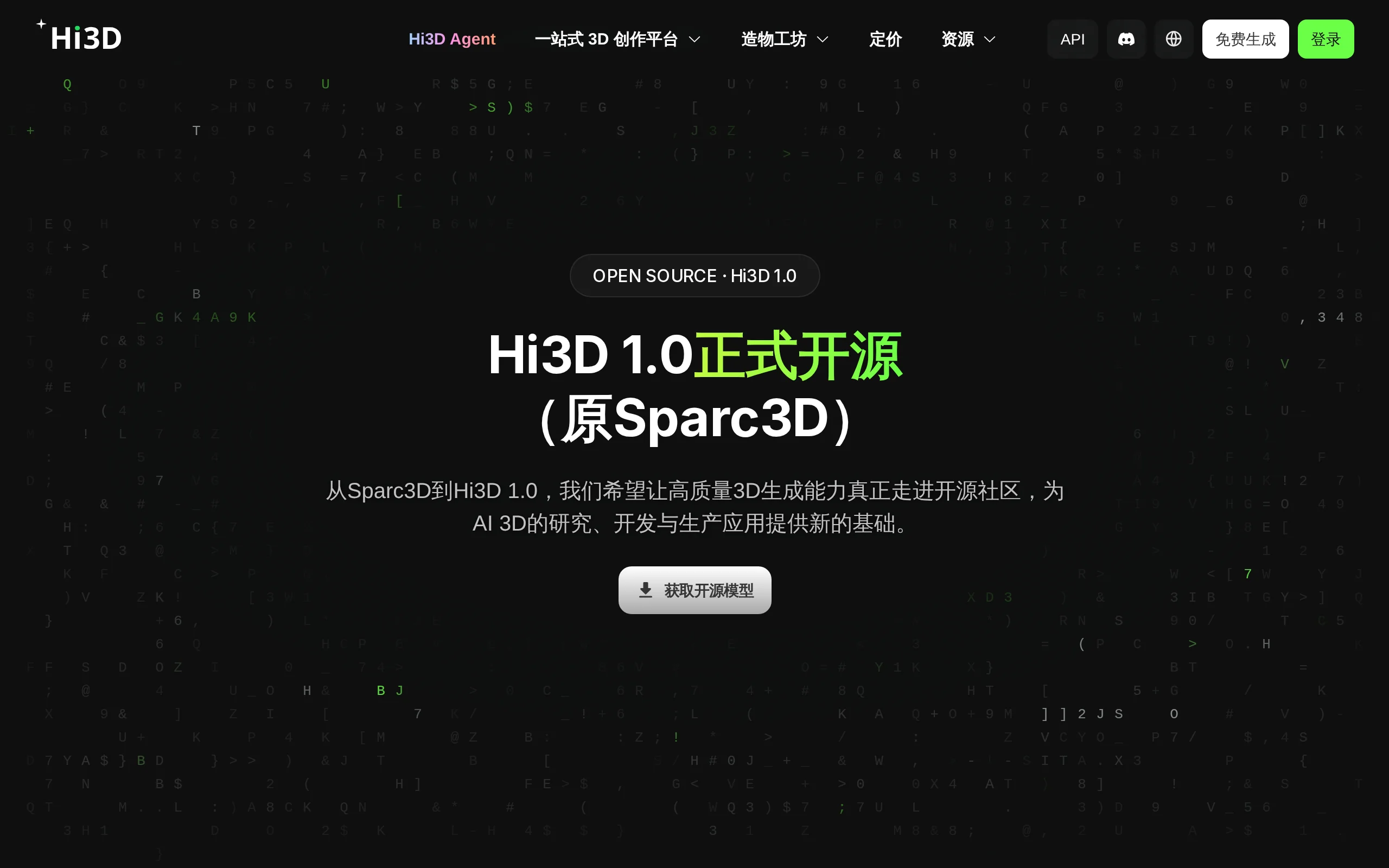
Hi3D 1.0 – Math Magic Open-Source Professional AI 3D Generation Model
Executive Summary:
Hi3D 1.0 is an open-source domestic AI 3D generation model developed by the Math Magic team, based on the Sparc3D architecture introduced in the NeurIPS 2025 paper. This model is trained on approximat...

1. What is Hi3D 1.0
Hi3D 1.0 is an open-source domestic AI 3D generation model developed by the Math Magic team, based on the Sparc3D architecture introduced in the NeurIPS 2025 paper. This model is trained on approximately 2 million curated 3D assets and employs a sparse geometric refinement architecture. It supports progressive resolution refinement from 512³ to 1024³ and then to 1536³, enabling the generation of high-resolution watertight meshes from a single image. It achieves the highest multi-view fidelity and detail richness among similar methods, with a slicing success rate of up to 90%. The generated models can be directly used in 3D printing workflows.
Technical Positioning and Domain: Hi3D 1.0 belongs to the intersection of 3D vision and generative AI, focusing on the task of automatically reconstructing high-precision 3D models from a single image. Its unique positioning lies in generating production-grade 3D assets with limited computational resources through sparse geometric representations and progressive refinement strategies, distinguishing it from traditional implicit neural field methods that face bottlenecks in memory and inference efficiency.
Development Background: This model was developed by the Math Magic team, transforming the theoretical framework from the Sparc3D paper into an engineering product. The motivation behind its development stems from the fact that most AI-generated 3D models today remain in the stage of visual demonstrations, failing to meet the mesh quality requirements of practical production processes such as 3D printing and game development. Therefore, the team focused on optimizing watertightness, detail fidelity, and compatibility with downstream toolchains.
Core Value: Hi3D 1.0 bridges the gap between AI-generated models and printable physical entities. Through true watertight mesh output, a 90% slicing success rate, and full workflow support, it advances AI 3D generation from experimental research into industrial applications, providing creators with a practical solution for physical manufacturing.
Technical Features: The model uses the Sparcubes sparse voxel representation and a self-pruning VAE architecture, retaining only effective voxels near the object's surface to significantly reduce memory usage at high resolutions. Combined with a progressive multi-level refinement strategy, it first determines the overall shape and then gradually adds fine details, ensuring geometric accuracy while maintaining computational efficiency.
2. Key Features
Complete 3D Model Generation from a Single Image: Input a single reference image to generate a full 3D model. The system can reasonably infer and complete areas not visible in the image, such as the back and occluded regions, without requiring multi-view shooting or manual modeling, significantly lowering the barrier to entry for 3D content creation.
High-Resolution Geometric Refinement: Supports a three-tier resolution refinement process from 512³ to 1024³ to 1536³. After extracting the mesh at each level, it serves as the foundation for the next refinement stage. Fine structures such as feathers and tire treads can be clearly reconstructed, with geometric detail performance surpassing that of similar methods.
Integrated 3D Printing Workflow: Outputs watertight meshes directly compatible with slicing software, achieving a 90% slicing success rate. Transitioning from a digital model to a physical print requires no tedious modeling fixes. The system also supports automatic part separation, structural connection design, and color scheme generation, covering all preparatory steps before printing.
Agent-Assisted Natural Language Editing: Adjust the model's shape, local structure, texture, and mesh quality through natural language dialogue. The system can automatically repair overhanging structures and connection errors, and optimize the model specifically for different target scenarios such as printing, gaming, and animation, reducing the technical complexity of 3D editing.
End-to-End Application Delivery Capabilities: Generated models can be freely downloaded and imported into professional software such as Blender and game engines for further processing. It supports skeletal binding, facial expressions, and animation creation, enabling further transformation into physical products like figurines and collectibles, forming a complete "generate–edit–apply" creative workflow.
Open Integration and Private Deployment: The model's code and weights are fully open-sourced, supporting private deployment for enterprises. It provides an MCP interface for external Agent systems to call generation tasks, and comes with Hi3D Agent pre-installed to directly serve creators, balancing developer ecosystems with end-user experiences.
3. How to Use
Environment Requirements: Local deployment requires an NVIDIA GPU for computational acceleration, with a recommended video memory of at least 16GB to ensure a smooth inference experience. The operating system supports Linux and Windows, and you must have Python 3.8+ environment and the PyTorch deep learning framework pre-installed.
Online Free Experience: Visit the Hugging Face Space platform (https://huggingface.co/spaces/ilcve21/Sparc3D) or the official open-source page (https://www.hi3d.ai/hi3d-1-0-open-source), upload a reference image of the target object, and the system will automatically complete the progressive refinement process from a coarse mesh to 512³ → 1024³ → 1536³. You can view the multi-angle generation results online.
Open-Source Model Local Deployment: Clone the project code from the GitHub repository (https://github.com/hi3d-official/Hi3Dv1.0) and download the pre-trained model weights from Hugging Face. After installing the project's dependencies, load the self-pruned VAE and sparse refinement model, and prepare the GPU inference environment.
Inference and Mesh Extraction: Call the inference interface, inputting the reference image and the coarse mesh generated by the upstream model, and perform sparse geometric refinement. The generated mesh can be stopped at any resolution level for extraction, and the output from each level can serve as input for the next round of refinement. The final watertight mesh file can be imported into Blender, game engines, or slicing software for further processing.
Notes: For objects with complex structures or severe occlusions, it is recommended to provide clear, evenly lit reference images to achieve better generation results. When deploying locally, ensure sufficient disk space is reserved for storing model weights and temporary data, and pay attention to the balance between GPU memory usage and resolution settings.
4. Pros and Cons Analysis
| Pros |
|---|
| Production-grade geometric accuracy: The output resolution of 1536³ is leading among similar methods, with multi-view fidelity reaching 0.75 and detail richness reaching 0.841. It has strong capabilities in reconstructing small structures and meets practical production standards. |
| Watertight mesh output: The slicing success rate is as high as 90%, and the output mesh can directly enter the 3D printing process without additional repairs, greatly reducing the number of intermediate steps and time costs from generation to physical output. |
| Open-source and commercial-use license: The model's code and weights are fully open, validated through real production workflows. Enterprises can freely deploy it privately and perform secondary development, reducing legal risks and technical barriers for commercial applications. |
| Mature Agent ecosystem: Provides an MCP interface for external Agent systems to call, while also embedding the Hi3D Agent service for regular users, establishing a dual-layer service system for developers and end-users. |
5. Comparative Analysis with Similar Tools
| Comparison Dimension | Hi3D 1.0 | TRELLIS 2 | Meshy AI |
|---|---|---|---|
| Output Resolution | 1536³ (latest version in the series reaches 2048³) | 1024³ | Medium resolution reconstruction |
| ULIP-2 Score | 48.07 | 49.32 | Not disclosed |
| Multi-View Fidelity (MVF) | 0.75 | 0.74 | Excellent |
| Detail Richness (DR) | 0.841 | 0.677 | Medium |
| Slice Success Rate (SSR) | 90% | 17% | Partial model support for printing |
| Geometric Representation | Sparcubes sparse representation + self-pruning VAE | Structured latent representation | Implicit neural field |
| Open Source License | Open source and commercial use allowed | Open source (MIT) | Commercial closed source |
| Agent Ecosystem | Hi3D Agent + MCP interface available | No native Agent | Limited API support |
| Positioning | Production-grade AI 3D infrastructure | General-purpose 3D generation base | Design assistance tool |
Selection Recommendations: For teams that need to directly use AI-generated models in physical production scenarios such as 3D printing or figure manufacturing, Hi3D 1.0 offers a significant advantage in slice success rate and pixel-level detail expressiveness. Its open source license also supports deeper customization. TRELLIS 2, on the other hand, has a broader coverage of general object categories and leads in ULIP-2 scores, making it suitable for projects requiring diverse generation but with less stringent printing requirements.
For creative professionals prioritizing generation speed and ease of use, the cloud platforms of Meshy and Tripo AI provide simpler operation interfaces and lower hardware barriers. However, they fall short of Hi3D 1.0's engineering validation in terms of output quality controllability and production readiness. Enterprise users should also consider the friendliness of the open source license for commercial scenarios and the flexibility of secondary development.
6. Editor's Summary
The open-source release of Hi3D 1.0 marks a significant shift in AI 3D generation from research demonstrations to production tools. From a technological innovation perspective, this model has conducted large-scale engineering validation of Sparc3D's sparse geometry refinement theoretical framework: the training data has expanded from 500,000 assets in the paper phase to approximately 2 million filtered samples, providing more robust data support for the model's ability to complete complex structures; the combination of self-pruning VAE and progressive multi-level refinement strategies achieves pixel-level output precision of 1536³ while keeping memory usage under control. The model achieves a slicing success rate of 90%, and quantitative metrics such as multi-view fidelity of 0.75 and detail richness of 0.841 provide objective benchmarks for cross-comparison.
In terms of practical value, Hi3D 1.0 bridges the critical gap between generation and manufacturing: watertight meshes directly meet the requirements of slicing software, while automated part separation, structural design for connections, and color coordination cover all preparatory steps before printing. The natural language modification mechanism assisted by an Agent effectively reduces the professional barriers of 3D editing. The open MCP interface provides a standard protocol for external Agent systems to integrate generation capabilities at the technical level. This combination of features covers the complete workflow from digital content creation to physical manufacturing.
In terms of target users, this model is most suitable for handcrafted figure production teams, game art outsourcing service providers, e-commerce entities with 3D display requirements, and enterprise developers with technical capabilities. The future development potential lies in the continuous iteration of the model series; it is known that the latest version of the series has already advanced to a resolution of 2048³. Additionally, the open-source license reserves ample space for community contributions and domain-specific fine-tuning. As training data accumulates further and the Agent ecosystem matures, the Hi3D series is expected to become a crucial component of the 3D content production infrastructure.
7. Application Scenarios
3D Printing and Collectible Figure Manufacturing: Users upload design sketches or concept reference images, and Hi3D 1.0 automatically generates watertight meshes, performs part decomposition, connection structure design, and color scheme planning. The generated models can be directly imported into 3D printers for physical production. The entire process from concept to physical product can be compressed into a few hours, making it ideal for small-batch customized figure production.
Game Development and Asset Production: Game teams input character concept art or prop sketches, and Hi3D 1.0 rapidly generates usable 3D model assets. These assets can be imported into engines such as Unity and Unreal to advance to a playable demo stage. This significantly reduces modeling time during the project's prototyping phase, allowing teams to focus their efforts on gameplay design and system optimization.
Animation Production and Real-Time Content Generation: Animation studios perform skeletal binding and skinning on the generated static characters, and combine them with facial expression capture systems to produce motion data, enabling AI-generated digital characters to enter the animation pipeline or real-time rendering process. This provides a fast character production solution for real-time content scenarios such as short videos and virtual streamers.
Post-Production in Film and Digital Sculpting Assistance: In film projects, Hi3D 1.0 enables high-resolution reconstruction and upscaling of complex sculptural models, preserving fine details such as feathers, armor textures, and mechanical structures. These models can be used as base models for digital sculpting, allowing digital artists to refine and apply artistic treatments on top, thereby improving the efficiency of sculptural creation.
Enterprise-Specific Vertical Applications: E-commerce platforms can deploy open-source models on internal servers to build an automated workflow for generating 3D product displays; educational institutions can use it to generate interactive 3D teaching models required for course materials; industrial enterprises can explore rapid part modeling solutions based on reference images, enabling the accumulation and reuse of customized knowledge assets.
8. FAQ
Q: What is the main difference between Hi3D 1.0 and regular AI 3D generation tools?
A: The core difference lies in output quality and production readiness. Hi3D 1.0 employs a sparse geometry refinement architecture, supporting progressive resolution refinement up to 1536³, and outputs watertight meshes with a slicing success rate of 90%. These models can be directly used in 3D printing or downstream application processes without requiring any repairs. In contrast, most generation tools only produce outputs suitable for visualization, which require extensive post-processing before they can be used in production.
Q: What hardware configuration is required to use Hi3D 1.0?
A: The official recommendation is to use an NVIDIA GPU with at least 16GB of VRAM for computational acceleration. To fully execute all refinement levels (512³→1024³→1536³), sufficient VRAM resources are necessary. It is advised to have at least 32GB of system memory and to reserve enough disk space to store model weight files and generated mesh data.
Q: Is Hi3D 1.0 suitable for commercial use? What is the scope of the open-source license?
A: The code and model weights of Hi3D 1.0 are fully open-sourced under a commercial-use license. Enterprises can freely deploy the system privately and perform secondary development. This license has been validated through real production workflows, minimizing legal risks in commercial scenarios. For specific terms, please refer to the open-source license file in the project repository.
Q: Can the generated models be used directly for 3D printing? Is the process complicated?
A: Yes, they can be used directly. Hi3D 1.0 outputs watertight meshes with a slicing success rate of 90%, allowing the generated results to be imported into mainstream slicing software without any mesh repair. For large models requiring disassembly, the system supports automatic segmentation and connection structure design. Combined with the coloring feature, all pre-printing preparations can be completed seamlessly.
Q: How to integrate Hi3D 1.0 with an external Agent system to utilize its generation capabilities?
A: Hi3D 1.0 provides a standard MCP interface, through which external Agent systems can invoke model generation tasks using standard protocols. Developers can integrate the model's capabilities into their own toolchain or intelligent agent systems by deploying a local service and configuring the MCP endpoint, enabling an automated 3D asset generation pipeline.
9. Project Links
- Product Official Website: https://www.hi3d.ai/zh/hi3d-1-0-open-source
- Online Experience Entry: https://huggingface.co/spaces/ilcve21/Sparc3D
- GitHub Repository: https://github.com/hi3d-official/Hi3Dv1.0
- Hugging Face Model Library: https://huggingface.co/spaces/ilcve21/Sparc3D
Related

Review of Seedance 2.5 4K: Volcano Engine Enters the High-End Video Generation Market with 4K and 10-bit Color Depth
Seedance 2.5 4K is a premium version of the Seedance 2.5 base model, launched by Volcano Engine. It is positioned as a professional-grade tool for the film production and commercial advertising sector...

Sage-A1.5 – A Scientific Agent from the Shanghai AI Lab with General and Specialized Capabilities
Sage-A1.5 is a 35B-scale scientific agent with general and specialized capabilities, developed by the Shanghai Artificial Intelligence Laboratory. It is built upon the long-range task capabilities of ...
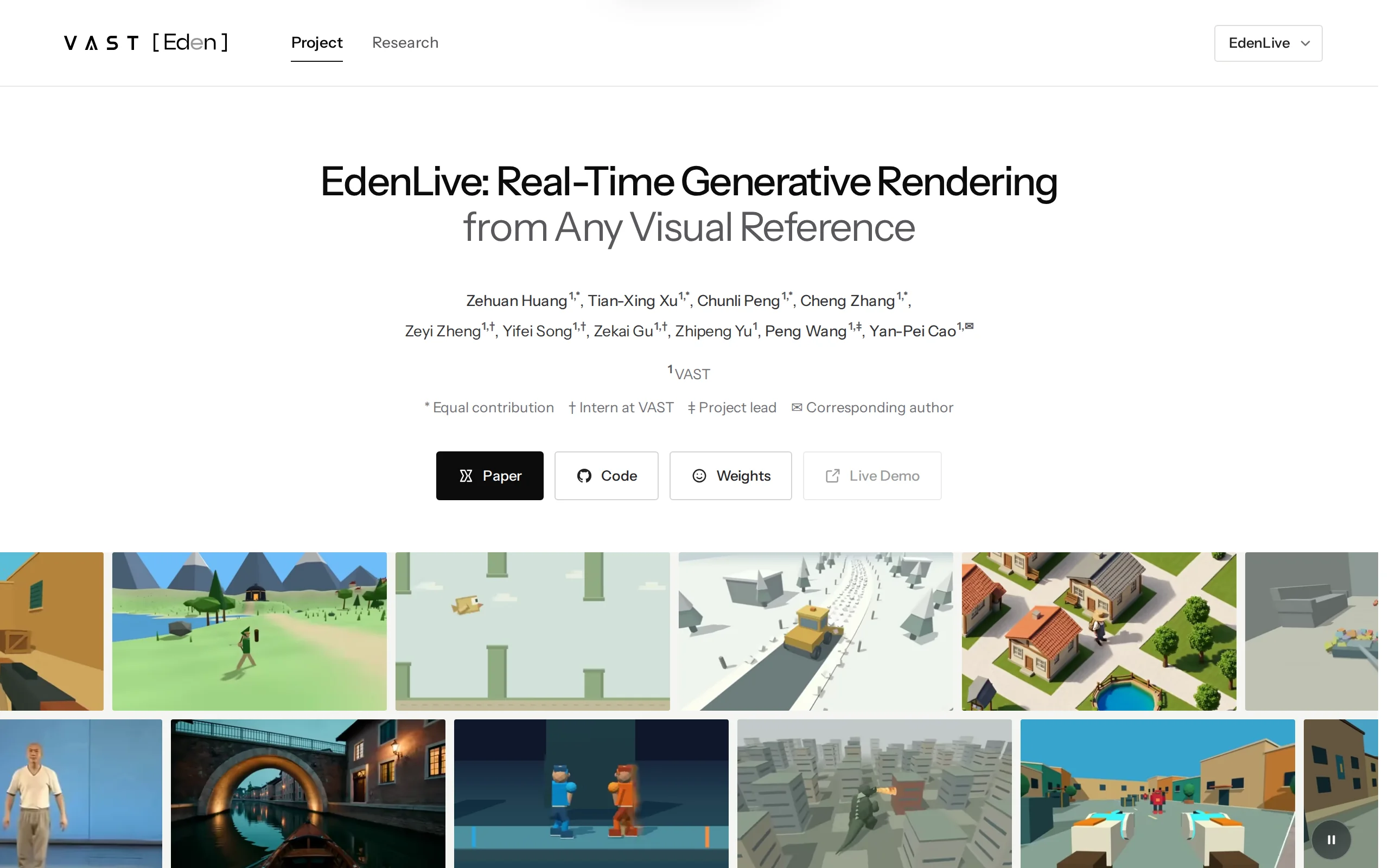
EdenLive – VAST's Real-time Generative Renderer, Redefining the Paradigm of World Model Rendering
EdenLive is a real-time generative renderer launched by VAST, and a milestone achievement in its world model project, Project Eden. This tool uses a Proxy as the control signal to simplify the image o...

Review of DeepSeek-V4.1-Flash-1017: Dual Optimization of Performance and Cost in Lightweight Models
DeepSeek-V4.1-Flash-1017 is an iterative version of DeepSeek's lightweight model, now available across the web, APP, and API. The new version is trained using self-supervised reinforcement learning, s...
© All Rights Reserved. Some content on this site is partially generated by AI with human review.