
Wenxin 5.5 Flash Base: Efficiency Innovation and Technical Analysis of Baidu's Open-Source Foundation Model
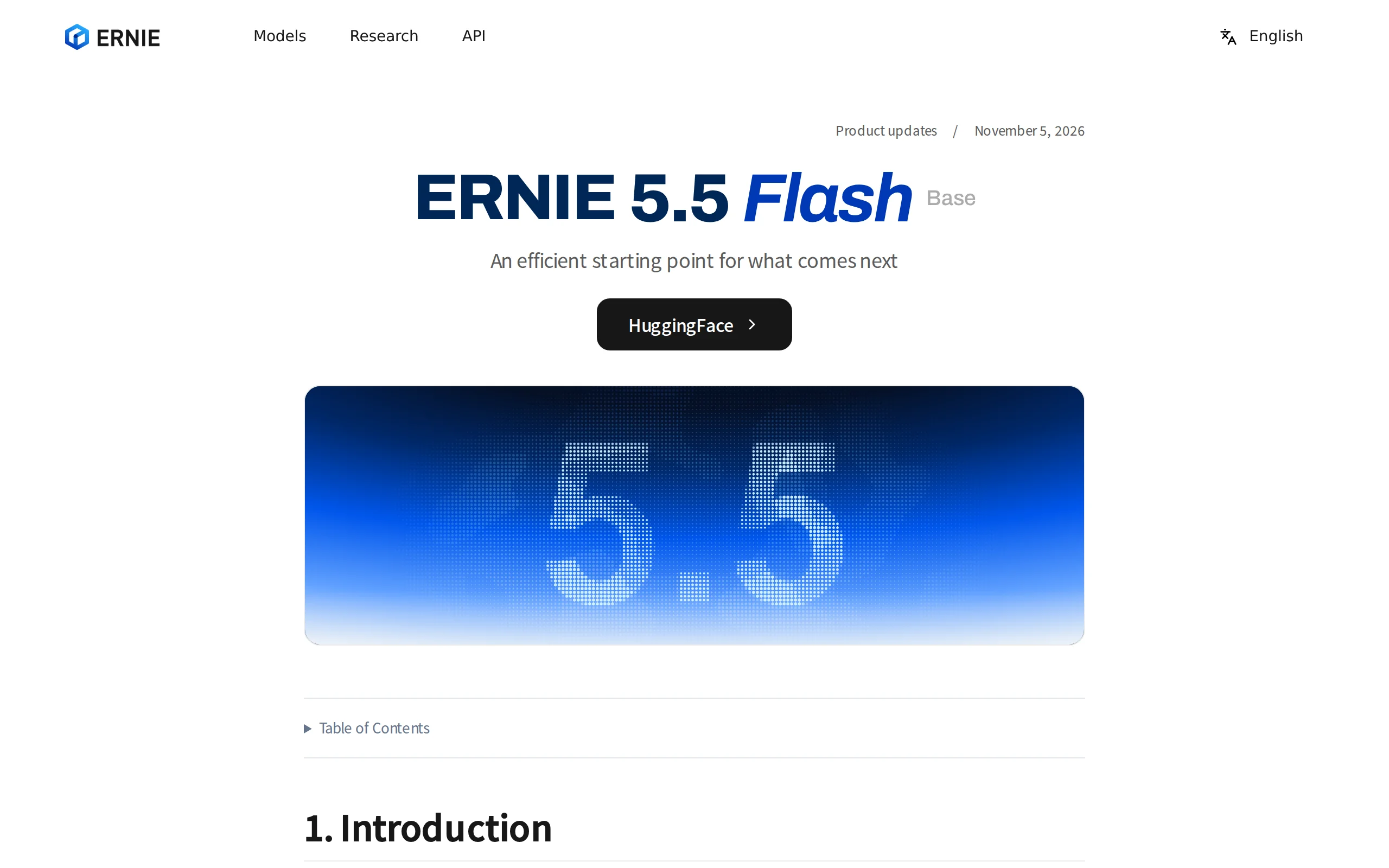
Executive Summary:
Wenxin 5.5 Flash Base is Baidu's latest open-source foundation model, built using a sparse MoE architecture. It has a total of 280 billion parameters, with 140 billion parameters activated per token, ...
1. What is Wenxin 5.5 Flash Base
Wenxin 5.5 Flash Base is Baidu's latest open-source foundation model, built using a sparse MoE architecture. It has a total of 280 billion parameters, with 140 billion parameters activated per token, and has been pre-trained on 33.5 trillion tokens. It supports the longest context of up to 1 million tokens. This model emphasizes efficiency innovation, achieving state-of-the-art results on 30 benchmarks across knowledge, reasoning, mathematics, code, multilingual support, and long context through collaborative optimization in three areas: Latent-Gated sparse attention, multi-router MoE, and the ECHO training objective. It is now available on HuggingFace, offering both FP8 and BF16 versions of weights.
Technical positioning and domain: It belongs to the domain of large-scale pre-trained language models in natural language processing. It is positioned as an open-source foundation model that has not undergone post-training, targeting developers and enterprise users who require deep customization and domain-specific fine-tuning. Its unique feature lies in its design philosophy of "efficiency first," achieving a balance between ultra-large model capacity and inference cost, distinguishing it from similar models that merely focus on stacking parameter sizes.
Development background: Developed by Baidu, based on the technical accumulation of the Wenxin large model series. Baidu has continuously invested in sparse attention, MoE routing optimization, and distributed training systems. This open-source release fully discloses the self-developed Latent-Gated attention architecture, multi-router MoE, and ECHO training objective, and is accompanied by the vLLM plugin, SGLang Cookbook, and Megatron-Bridge fine-tuning examples, building a complete open-source toolchain from training to inference.
Core value: It addresses the issues of high costs in local deployment of ultra-large models and long context inference. With only 140 billion parameters activated out of a total of 280 billion, the FP8 quantized weights are approximately 280GB, making it feasible to run on high-end multi-GPU servers. The combination of 1 million token context and sparse attention significantly reduces KV Cache overhead, providing a viable open-source solution for scenarios such as long document processing and codebase analysis.
Technical features: Three innovations form the core of its competitiveness—Latent-Gated sparse attention combines heavy compression attention (HCA) and multi-head latent attention (MLA) for collaborative division of labor, with low-rank gating reducing the projection parameters by 75%; multi-router MoE improves the correlation between routing scores and the actual utility of experts; ECHO reuses the final layer of the main trunk to predict subsequent tokens, while also serving as a draft model for speculative decoding, with draft quality surpassing that of the auxiliary MTP module.
2. Key Features
High-Performance Text Foundation: A sparse MoE architecture with a total of 280 billion parameters, activating only 140 billion parameters per token, enabling ultra-large model capacity at approximately 1/20 of the computational cost. Official evaluations show that the model achieves the best performance among models of the same size on 30 benchmarks, including knowledge, reasoning, mathematics, coding, multilingual support, and long context processing, offering comprehensive general text capabilities.
Extended Context Support: Pre-training context length of 128K, with support for up to 1 million tokens during fine-tuning and inference. The Latent-Gated sparse attention architecture processes historical information across 37 layers on compressed sequences of 128 times, while only 6 layers are responsible for fine-grained retrieval, significantly reducing KV Cache overhead in long context scenarios and making million-token-level processing feasible in terms of resource consumption.
Systematic Efficiency Innovations: Optimized across three key components—attention, routing, and training objectives. The Latent-Gated attention mechanism reduces the number of gating projection parameters by 75% using low-rank gating while improving performance; the multi-router MoE employs multiple independent routers for expert selection, enhancing the correlation between routing scores and actual expert utility; the ECHO training objective reuses the final layer of the backbone to predict subsequent tokens, improving reasoning and coding capabilities.
Open Source and Customizable: FP8 and BF16 weight versions are available on HuggingFace, allowing developers to choose the precision level as needed. As an unpost-trained base model, enterprises can perform domain-specific continued pre-training or SFT using their own industry data to build specialized models in fields such as law, finance, and healthcare, offering significant customization potential.
Complete Inference Ecosystem: The official vLLM plugin (baidu/vLLM-ERNIE) is provided to support the sparse attention architecture, along with the SGLang Cookbook and Megatron-Bridge fine-tuning examples. After starting the inference service, an OpenAI-compatible interface is exposed, enabling smooth integration into existing application systems and reducing integration costs.
Large-Scale Training Infrastructure: The distributed Muon optimizer merges cross-machine communication for Dense and MoE parameters into a single collective communication, combined with FP8 mixed precision to enhance large-scale training efficiency; the self-developed FlashMask-4 attention operator, based on CuTe-DSL, supports SM90/SM100 architectures and a maximum head dimension of 576, directly aligning with the wide-head computation requirements of the HCA layer.
3. Application Scenarios
Long Document Deep Processing: Leveraging the longest 1,000,000 token context, the model can process entire legal contracts, corporate financial reports, academic paper collections, or large code repositories in one go, performing full-text summarization, cross-chapter Q&A, and information extraction tasks. Compared to the segmented processing approach, it avoids information loss caused by fragmented context, making it suitable for document-intensive industries such as law, finance, and research.
Code Development Assistance: With its strong code capabilities and ultra-long context window, the model can understand the structure and dependencies of an entire repository, enabling code generation, refactoring suggestions, and cross-file defect analysis. The ECHO training objective enhances the model's reasoning capabilities, resulting in more stable performance in complex logical deduction and code generation scenarios.
Domain-Specific Model Customization: As an open-source foundation model that has not undergone post-training, enterprises can perform domain-specific pre-training or SFT based on internal corpora. The FP8 version reduces hardware requirements, and combined with the official Megatron-Bridge fine-tuning examples, it allows for the construction of specialized models with vertical domain knowledge at a reasonable cost, applicable to scenarios such as legal consulting, financial risk control, and medical assistance.
Multilingual Content Processing: Multilingual capabilities reach the state-of-the-art (SOTA) level for models of the same size, suitable for cross-language document translation, international content review, and global knowledge base Q&A. Combined with long context capabilities, it enables comprehensive understanding and processing of multilingual mixed documents, meeting the global business needs of multinational corporations.
4. How to Use
Hardware Environment Preparation: The model has a total of 280 billion parameters, with FP8 quantized weights occupying approximately 280GB. A multi-GPU high-end server is required. It is recommended to use GPUs that support the SM90/SM100 architecture, such as the H series. A single GPU cannot hold the full model, so deployment must be done using multiple GPUs in parallel.
Download Model Weights: Pull the official repository from HuggingFace and choose the FP8 version (baidu/ERNIE-5.5-Flash-Base) or the BF16 version as needed. Use the command:
huggingface-cli download baidu/ERNIE-5.5-Flash-Base --local-dir ./ernie-base.Install Inference Framework: Deploy the official Baidu vLLM plugin (baidu/vLLM-ERNIE) to support its sparse attention architecture, or use the official SGLang Cookbook solution. It is not recommended to use a generic inference framework that is not adapted, as it will not be able to leverage the efficiency advantages of sparse attention.
Start Inference Service: Run
vllm servepointing to the local weight path, set--tensor-parallel-sizeaccording to the number of GPUs, and enable--enable-expert-parallelto activate expert parallelism. After the service starts, it exposes an OpenAI-compatible interface, making it convenient for application systems to integrate and call.Initiate Calls and Configuration: Send requests to the local port using the standard OpenAI API format. You can adjust the
--max-model-lenparameter based on the GPU memory availability. The maximum context length that can be configured is 1 million tokens, but this requires sufficient GPU memory to support the KV Cache overhead.Fine-tuning and Customization: Perform domain-specific continued pre-training or SFT based on the official Megatron-Bridge example. It is recommended to first validate the training configuration on a small dataset and then gradually scale up to the full dataset to control training costs and debugging complexity.
5. Pros and Cons Analysis
| Pros |
|---|
| Exceptional Inference Efficiency: The sparse MoE architecture with a total of 280 billion parameters activates only 140 billion parameters per token, enabling ultra-large model capacity with extremely low computational cost. Inference overhead is approximately a fraction of that of a similarly sized dense model. |
| Superior Long-Context Capability: Pre-trained with 128K context length, and supporting up to 1 million tokens during fine-tuning and inference. The Latent-Gated sparse attention mechanism processes historical information on a 128-times compressed sequence using 37 layers, significantly reducing resource costs for long-text processing. |
| Systematic Efficiency Innovations: Latent-Gated sparse attention, multi-router MoE, and the ECHO training objective collaboratively optimize the attention, routing, and training objective stages. Low-rank gating reduces the gating projection parameters by 75%, offering a relatively comprehensive innovation across dimensions. |
| Robust Engineering Infrastructure: The distributed Muon optimizer merges communication for Dense and MoE parameters into a single collective communication. The FlashMask-4 operator supports the SM90/SM100 architecture and a maximum head dim of 576, providing a relatively complete training and inference toolchain. |
6. Comparative Analysis with Similar Tools
| Comparison Dimension | Wenxin 5.5 Flash Base (Baidu) | DeepSeek-V4-Flash-Base | DeepSeek-V3.2-Exp |
|---|---|---|---|
| Total Parameters/Active Parameters | 280B / 140B (per token) | 2840B / 130B | 671B / 37B |
| Pre-training Data Volume | 33.5 trillion tokens | 32 trillion+ tokens | Not fully disclosed by the official |
| Context Length | Pre-training 128K, fine-tuning/inference up to 1M | Native 1M | Native 128K, expandable to 256K |
| Core Architecture | Latent-Gated sparse attention (HCA+MLA combination, low-rank gating, VHA) + multi-router MoE + ECHO training objective | CSA+HCA hybrid sparse attention + mHC hyper-connection (manifold-constrained residual) | DeepSeekMoE + MLA, hybrid inference mode (chain-of-thought and non-chain-of-thought) |
| Precision Format | Dual versions of FP8 and BF16 | FP4+FP8 mixed precision, weights approximately 159.6GB | FP8 mixed precision |
| Distribution Channels | HuggingFace + official vLLM plugin/SGLang/Megatron-Bridge | HuggingFace + ModelScope | HuggingFace + ModelScope, open source license |
Selection Recommendations: If the primary requirement is ultra-high inference efficiency and support for ultra-long context, and you have access to a multi-GPU high-end cluster, Wenxin 5.5 Flash Base is a viable option to consider. Its Latent-Gated sparse attention and multi-router MoE provide differentiated advantages in scenarios involving long document processing and code analysis. The FP8 version combined with the official vLLM plugin can achieve context inference at the million-token level at a reasonable cost.
If community ecosystem maturity and the richness of third-party toolchains are more important, the DeepSeek series offers broader developer support and third-party compatibility experience. DeepSeek-V3.2-Exp has a unique design in its hybrid inference mode, making it suitable for scenarios that require both chain-of-thought reasoning and general-purpose tasks. DeepSeek-V4-Flash-Base, with its smaller weight size (approximately 159.6GB), reduces the deployment threshold.
If you prefer plug-and-play solutions and want to avoid the operational burden of building your own infrastructure, commercial API services like Qwen3-Max are more straightforward choices. Commercial APIs eliminate the need to consider hardware procurement, framework compatibility, and model alignment issues, making them ideal for quickly validating business scenarios or applications with lower data compliance requirements. However, long-term usage costs and customization flexibility should be evaluated comprehensively.
7. Editor's Summary
Wenxin 5.5 Flash Base demonstrates Baidu's systematic approach to efficiency optimization in large-scale language models. Unlike paths that solely pursue parameter scale, this model innovates collaboratively across three levels: attention mechanisms, routing strategies, and training objectives. The Latent-Gated sparse attention compresses the long-context KV Cache overhead significantly through the division of labor between HCA and MLA, while low-rank gating achieves stronger gating effects with fewer parameters. The multi-router MoE improves the correlation between routing scores and the actual utility of experts. The ECHO training objective reuses the output from the final layer of the main trunk to predict subsequent tokens, enhancing inference capabilities while maintaining speculative decoding efficiency. This integrated solution exhibits a high degree of engineering completeness, with FlashMask-4 operators and the distributed Muon optimizer reflecting Baidu's investment in training infrastructure.
In terms of practical value, the design of 280 billion total parameters and 140 billion activated parameters achieves a pragmatic balance between capacity and cost. After FP8 quantization, the weight volume is approximately 280GB, making it feasible to deploy on high-end multi-GPU servers. The combination of 1 million token context with sparse attention provides a viable open-source solution for scenarios such as long document processing and codebase analysis. The official release of the vLLM plugin, SGLang Cookbook, and Megatron-Bridge toolchain lowers the deployment and customization barriers for developers.
The primary target audience for this model includes: enterprise R&D teams with multi-GPU infrastructure who require deep customization of domain-specific models; technical researchers focused on long-context processing and inference efficiency optimization; and developers aiming to build vertical applications on top of an open-source foundation. It is important to note that, as a base model without post-training, dialogue alignment and safety capabilities must be implemented by the users themselves, requiring the team to have relevant model fine-tuning experience.
Overall, the release of Wenxin 5.5 Flash Base provides the open-source large model ecosystem with a foundational option that offers valuable insights into efficiency design. Its engineering practices in sparse attention and MoE routing, along with the completeness of its accompanying toolchain, will influence the practical deployment effectiveness of the model, making it worth continued attention.
8. FAQ
Q: What is the relationship between Wenxin 5.5 Flash Base and the full version of Wenxin 5.5?
A: Wenxin 5.5 Flash Base is the base model open-sourced by Baidu, which has not undergone post-training (such as SFT and RLHF), and therefore lacks direct dialogue interaction capabilities. The full version of Wenxin 5.5 is a dialogue model that has completed alignment training on top of the base model. The value of the base model lies in providing developers with a starting point for free customization, allowing enterprises to fine-tune it into specialized models tailored for specific domains.
Q: What hardware configuration is required to deploy Wenxin 5.5 Flash Base?
A: The model has a total of 280 billion parameters, with FP8 quantized weights occupying approximately 280GB and the BF16 version approximately 560GB. It is recommended to use a multi-GPU high-end server, such as models from NVIDIA H100/H200 that support the SM90/SM100 architecture, and to enable multi-GPU parallelism using --tensor-parallel-size and --enable-expert-parallel. A single GPU cannot hold the full model; at least 8 GPUs with 80GB VRAM are required.
Q: How to choose between the FP8 version and the BF16 version?
A: The FP8 version has a weight size of approximately 280GB, with lower VRAM usage and faster inference speed, making it suitable for production environments sensitive to deployment costs. The BF16 version offers higher numerical precision, which is suitable for scenarios with strict output quality requirements or further fine-tuning training needs. It is recommended to use the BF16 version during fine-tuning to ensure gradient update accuracy, and then switch to the FP8 version during the inference phase to reduce resource consumption.
Q: How can a context length of 1 million tokens be achieved?
A: The model was pre-trained with a context length of 128K, and during fine-tuning and inference, it supports up to 1 million tokens. When deploying, the context length can be configured using the --max-model-len parameter. However, the actual maximum usable length is limited by the GPU VRAM size, as the KV Cache grows with the sequence length. The Latent-Gated sparse attention mechanism has significantly reduced the KV Cache overhead, but very long contexts still require sufficient VRAM support.
Q: Can the base model be used directly for dialogue or question-answering?
A: No. Wenxin 5.5 Flash Base is an unpost-trained base model and does not have instruction-following or dialogue interaction capabilities. Direct invocation will generate text that is a continuation rather than a response to user instructions. To enable dialogue capabilities, SFT and RLHF alignment training must be performed on this base model, or the fully aligned version of Wenxin 5.5 provided by Baidu must be used.
Q: How to perform domain-specific fine-tuning based on Wenxin 5.5 Flash Base?
A: The official documentation provides a Megatron-Bridge fine-tuning example, supporting two paths: domain continuation pre-training and SFT. It is recommended to first validate the training configuration and hyperparameters on a small-scale domain dataset, and then gradually scale up the data size. During fine-tuning, attention should be paid to the VRAM usage of the BF16 version, and batch size and gradient accumulation steps should be adjusted according to hardware conditions.
9. Project Links
- Project Website: https://ernie.baidu.com/zh/release/ernie-5-5-flash-base/
- HuggingFace Model Library: https://huggingface.co/baidu/ERNIE-5.5-Flash-Base
Related
SandBase – AI Agent Infrastructure Platform, One-Stop Agent Runtime Foundation
SandBase is an AI Agent infrastructure platform designed for developers, positioned as a one-stop runtime foundation for agents. The platform enables unified access to over 2000 model and data APIs vi...

Qoduck – The Anonymous Coding Model Launched by Alibaba, Now Available for Free on Qoder
Qoduck is an anonymous coding model launched by Alibaba's AI coding platform Qoder on November 7, 2026. The official has not disclosed its identity or parameters, and the community generally speculate...
Orca Review: Orchestrate a Fleet of Coding Agents (stablyai)
If you use both Claude Code and Codex for different tasks and want them running in parallel in their own working directories, Orca is worth a look. This open-source orchestration tool from stablyai is...
WeVisOne-VL Evaluation: WeChat's Vision Team Explores Unified Vision-Language Modeling with a Single Token Prediction Architecture
WeVisOne-VL is an open-source dual-version vision-language foundation model developed by Tencent's WeChat Vision Team, built upon the Qwen3-VL architecture, and offers two parameter scales: 2B and 4B....
© All Rights Reserved. Some content on this site is partially generated by AI with human review.