
Gemini Omni 1.2 Flash: Google's Mainstream Model for Enterprise-Level Video Generation
Executive Summary:
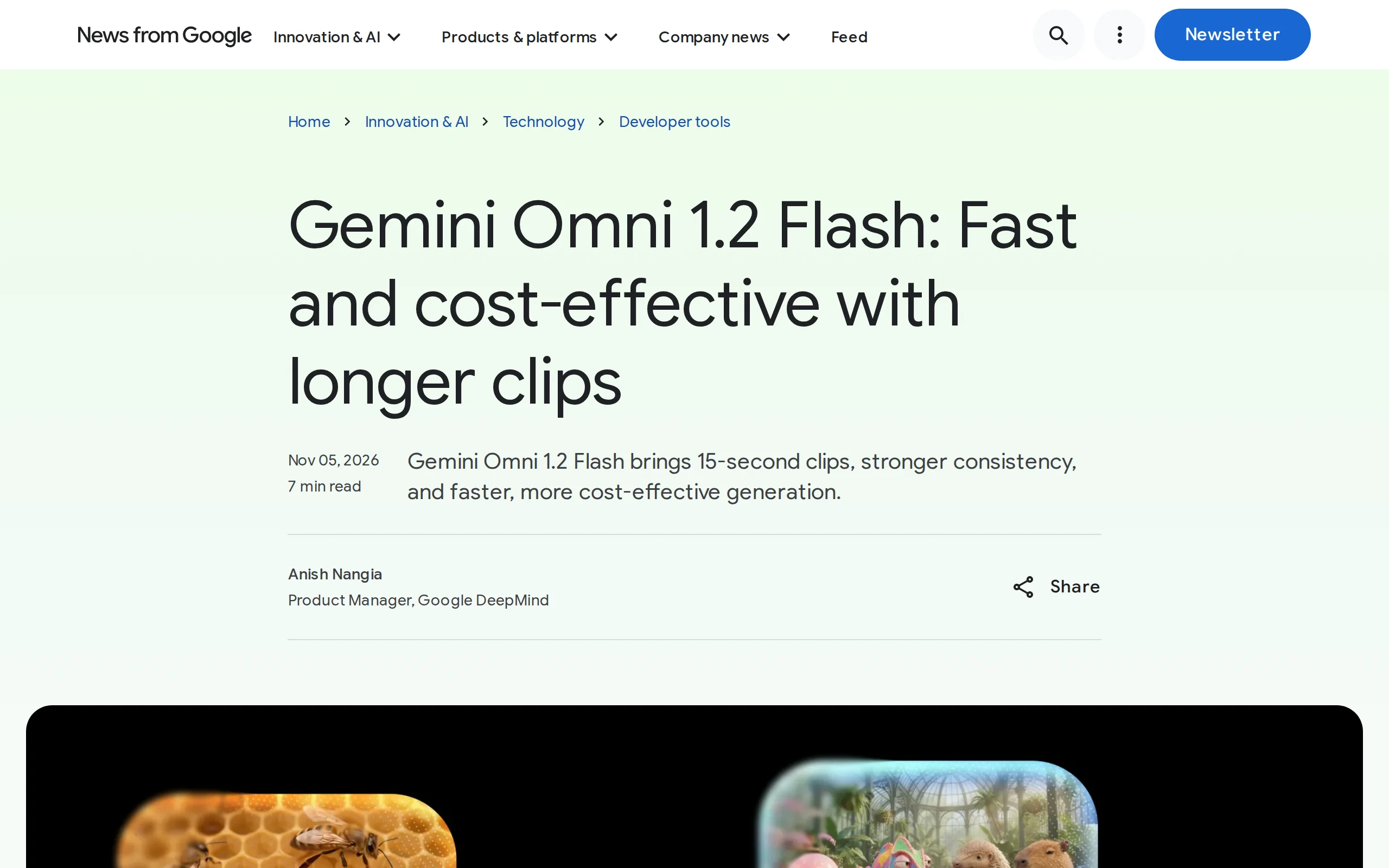
Gemini Omni 1.2 Flash is a video generation model launched by Google DeepMind, now fully commercialized. This model can generate videos up to 15 seconds in length, supporting the specification of dura...
1. What is Gemini Omni 1.2 Flash
Gemini Omni 1.2 Flash is a video generation model launched by Google DeepMind, now fully commercialized. This model can generate videos up to 15 seconds in length, supporting the specification of duration on a per-second basis between 3 to 15 seconds. It also features conversational multi-round editing, reference image-based character consistency preservation, interpolation between the first and last frames, and native synchronized audio capabilities. In terms of pricing, the cost per second for generating 720p resolution videos is $0.07, a 30% reduction compared to the previous generation. The model has been integrated into channels such as Gemini API, Vids, Gemini App, and Google Ads, with its core target scenarios focusing on the bulk production of e-commerce content and advertising clips.
Technical Positioning and Domain: It belongs to the video generation (Video Generation) direction within the field of generative artificial intelligence, together with text generation and image generation forming the technical landscape of multimodal content creation. The unique positioning of Gemini Omni 1.2 Flash lies in its deep integration of conversational editing capabilities with video generation, shifting video creation from a "one-time generation" model to an "iterative creation" model. This represents a differentiated capability in the current landscape of video generation models.
Development Background: Developed by the Google DeepMind team, this model extends the technical foundation of the Gemini series large models into the video modality. Google has been intensively iterating on its video generation models between 2024 and 2025, evolving from the Veo series to the Gemini Omni series, gradually integrating video generation capabilities into a unified Gemini ecosystem. The newly launched 1.2 Flash version focuses on two key areas: "cost reduction" and "editing efficiency," reflecting Google's clear roadmap for the commercialization of video generation.
Core Value: It addresses the key challenge of transitioning video generation from "usable" to "user-friendly." On one hand, by allowing per-second duration specification and conversational multi-round editing, it reduces the cost of video modifications from "re-generating entire segments" to "localized edits." On the other hand, through multimodal reference constraints (character images, product images, action clips, audio cues), it effectively mitigates common issues in video generation such as identity drift and inconsistent styles. Additionally, the token-based pricing model charged per second and the low-resolution draft workflow provide a controllable cost structure for bulk production scenarios.
Technical Features: The core technical advantages are reflected in three areas: first, reference condition injection and spatiotemporal attention mechanisms, enabling identity consistency across different shots; second, simultaneous audio-visual generation, significantly improving the synchronization accuracy of lip movements during dialogue; third, a state preservation mechanism for conversational editing, modeling multi-round modifications as a conditional regeneration process rather than starting from scratch.
2. Key Features
15-Second Native Generation: Generate videos up to 15 seconds in length, with the duration specified second by second between 3 and 15 seconds. This duration covers the typical length of a complete social media ad or product demonstration, and the second-by-second control allows creators to precisely tailor the video to the requirements of the ad placement, avoiding quality degradation from post-generation editing.
Conversational Multi-Round Editing: Change the background, adjust lighting, and modify the aspect ratio of the same video in multiple rounds without regenerating it. This feature treats editing instructions as new context inputs within the same generation session. The model retains the original performance, lighting, and composition while only reconstructing the specified elements. This significantly reduces the time cost of video editing, making A/B testing and version iteration more efficient.
Multimodal Reference Following: Combine character images, product images, action clips, and audio cues as generation conditions, maintaining consistency in facial features, clothing, packaging fonts, and brand colors across different shots. Reference conditions are encoded as conditional information, which, together with text prompts, constrains the generation process. Spatial attention handles composition details on a per-frame basis, while temporal attention ensures identity and motion continuity across frames.
Start and End Frame Interpolation: Automatically generate continuous shots between the first and last frames, ensuring no drift in objects or environments frame by frame. This feature is ideal for scenarios requiring precise control over the starting and ending frames, such as product rotation displays or scene transitions, ensuring geometric consistency and motion plausibility during generation.
Native Synchronized Audio: Achieves higher precision in lip-syncing for dialogue, and in multi-character scenarios, different sampled voices can be routed to corresponding characters. Audio and video are output in the same forward generation pass, with the model inferring dialogue, sound effects, and ambient noise based on the visual content. The newly added multi-speaker condition in version 1.2 allows sampled voices to be assigned to specific characters and drive lip-syncing accordingly.
Cinematic Camera Movement: Significantly reduces the jump-cut phenomenon in complex camera movements such as FPV traversal, circling, and sudden zoom-outs. The model's attention mechanism along the temporal dimension provides stronger constraints on camera motion trajectories, resulting in camera movements that more closely resemble those of professional cinematography equipment, reducing the common "jumpiness" of AI-generated videos.
Tiered Cost-Reduction Workflow: Supports generating drafts at 360p or 720p resolution first, modifying only the unsatisfactory segments, and then upgrading to 1080p or 4K resolution once the effect is confirmed. This workflow decouples cost from quality, significantly reducing generation expenses during the exploration phase without compromising the final output quality.
Enterprise-Grade Integration: Output content carries SynthID invisible watermarking and supports Provisioned Throughput reservation, meeting enterprise needs for content traceability and computational resource guarantees. This integration enables the model to be deployed in commercial production environments with strict requirements for compliance and stability.
3. Application Scenarios
E-commerce Content Batch Production: After merchants upload product reference images, they can generate multiple versions of 15-second short videos with different backgrounds, lighting, and aspect ratios through conversational instructions. These videos are directly compatible with various ad placements (such as feed streams, product detail pages, and live stream traffic generation). The multi-round editing capability allows the same product content to quickly generate dozens of variations, significantly shortening the content production cycle.
Ad Variant Deployment and A/B Testing: Starting from a single source video, multiple versions can be generated in bulk based on target audiences and distribution channels. Each round of modification only requires a natural language description of the desired changes (e.g., "switch to night scene," "convert to vertical format," "highlight product packaging"). The model performs localized reconstruction while preserving core content, reducing the cost of A/B testing content preparation by an order of magnitude.
Virtual Try-On and Product Demonstration: By using reference images to lock in the model's identity and clothing details, the model can generate 360-degree turns and outfit sequences. Whering has already integrated this model into its real-time try-on feature, allowing users to see dynamic effects of different clothing items on the same model, providing a near-in-person experience for fashion e-commerce.
Social Short Video Creation: A regular Google account can generate 15-second clips for free in Vids, enabling individual creators to produce videos at a low cost without paying fees. Conversational editing lowers the technical barrier for video creation, allowing non-experts to complete complex video adjustments through natural language.
Film Previsualization and VFX Rough Cuts: Film teams first use low-resolution drafts to confirm complex camera movements and visual language. Once satisfied, they can upgrade to 4K for delivery. Monks has already integrated the model into its visual effects pipeline, using it for previsualization and rapid validation of VFX shots, reducing the human and time resources traditionally required in previsualization workflows.
4. How to Use
Select Access Point: Developers can try it without coding through Google AI Studio, enterprise users can integrate via Google Cloud Console, and regular users can use consumer-grade products such as Flow, Vids, or the Gemini App. Different access points are tailored for different user groups, with variations in feature permissions and billing methods.
Enable Permissions: Usage of API and AI Studio requires a paid account. The 15-second generation feature in the Gemini App is currently available only to AI Ultra subscribers. It is recommended that developers confirm their account's billing status and quota limits before officially integrating, to avoid service interruptions.
Compose Prompts: Input textual descriptions of the scene. When maintaining consistency with a character or product, upload a reference image and a maximum 3-second action or audio clip. Prompts should include elements such as subject, action, environment, lighting, and camera movement. The clarity of reference materials directly affects the generation quality.
Set Duration and Specifications: Specify the video duration second by second, between 3 and 15 seconds. For initial use, it is recommended to choose 360p or 720p resolution to control costs. Generation costs are billed per second, and selecting a lower resolution during the draft phase can significantly reduce budget.
Generate and Review Drafts: First, review the low-resolution draft to check the overall effect and confirm whether the composition, actions, and camera movements meet expectations. The output includes a default SynthID watermark, used for content traceability and authenticity verification.
Iterative Refinement: Adjust unsatisfactory aspects using natural language in iterative rounds, such as changing the background, adjusting lighting, modifying weather, or aspect ratio. Each round of modification only rebuilds the specified elements, while the rest of the video content remains unchanged.
Upgrade and Export: After confirming the draft quality, increase the resolution to 1080p or 4K. The final export is billed based on the chosen resolution and duration. The video quality after upscaling is comparable to directly generating at high resolution, but the cost during the exploration phase has been reduced through the draft process.
Integration and Deployment: Developers can integrate video generation capabilities into their own workflows using the Gemini API, and combine it with Provisioned Throughput to ensure stability in production environments. It is recommended to standardize prompt templates and reference materials before integration to improve the efficiency of batch generation.
5. Pros and Cons Analysis
| Pros |
|---|
| Flexible duration specifications: Native generation of 15-second videos with support for specifying each second individually, covering the full scale of social media ads or product demonstrations, providing creators with precise control over video length. |
| High efficiency in conversational editing: Multi-round editing covers the entire 15-second video, allowing changes to background, lighting, and aspect ratio without needing to redo entire segments, drastically reducing version iteration costs compared to traditional methods. |
| Maintains multimodal consistency: Combines reference images, action clips, and audio cues to ensure consistency in facial features, clothing, and packaging fonts across different shots, solving the common issue of identity inconsistency in video generation. |
| Synchronized audio and video generation: Audio and video are generated in a single pass, ensuring accurate lip-syncing for dialogue. In multi-character scenarios, it automatically assigns sampled voices and drives lip movements, reducing the need for post-production voice-over and lip-sync alignment. |
6. Comparative Analysis with Similar Tools
| Comparison Dimension | Gemini Omni 1.2 Flash | Seedance 2.5 |
|---|---|---|
| Single Generation Duration | 15 seconds, with per-second specification from 3–15 seconds | Up to 30 seconds, with longer single shot durations |
| Maximum Resolution | 4K (upscaled) | Native 4K |
| Reference Input Types | Image + longest 3-second action clip + audio cues | Up to 50 multimodal reference inputs |
| Audio Capabilities | Simultaneous video and audio generation, multi-speaker voice routing | Supports sound effects and dialogue generation |
| API Unit Price (720p) | $0.07 per second | Approximately $0.225 per second |
| Conversational Editing | Multi-round editing without re-generation, officially promoted workflow | Primarily single-generation and first/last frame editing |
| Openness | Closed-source, distributed via API + Google ecosystem | Closed-source, distributed via API + domestic channels like Jiumeng AI |
| Distribution Channels | API, AI Studio, Flow, Vids, Gemini App, Google Ads | ByteDance's Volcano Engine API, Jiumeng AI |
| Core Positioning | Enterprise-level bulk material production, excelling in cost reduction and editing efficiency | Extreme single shot specifications, excelling in duration and reference input capacity |
Selection Recommendations: For enterprise users requiring bulk production of advertising materials and e-commerce videos, Gemini Omni 1.2 Flash's conversational editing and tiered cost reduction workflow offer clear advantages, especially for teams already deeply integrated into the Google ecosystem (Google Ads, Vids), as the integration cost is lower. If the project demands longer single shot durations and a larger number of reference inputs, such as in cinematic long shot previsualization or complex multi-character scenes, Seedance 2.5's 30-second generation capability and support for up to 50 multimodal reference inputs are more appealing, though it comes with approximately three times the API cost per second.
For domestic teams or creators requiring localized services, Kling AI has a natural advantage in distribution channels and understanding of Chinese prompts, with pricing between the two. Overall, the three models each emphasize different technical metrics, and the choice should be made based on a comprehensive evaluation of specific scenario requirements, budget constraints, and ecosystem preferences.
7. Editor's Summary
The release of Gemini Omni 1.2 Flash marks a shift in video generation models from "single-shot generation tools" to "iterative creation platforms." Its core technological value lies in deeply integrating conversational editing with video generation, achieving partial modifications rather than full re-generation through a state retention mechanism. This capability directly addresses a key pain point in the commercialization of video generation—excessively high modification costs. From a technical implementation perspective, the combination of conditional injection and spatiotemporal attention effectively mitigates identity drift issues, while simultaneous audio-visual generation addresses the long-standing challenge of lip-sync accuracy. These two breakthroughs significantly enhance the practical usability of video generation.
In terms of practical value, the pricing of $0.07 per second for 720p video, combined with a tiered cost-reduction workflow, provides a controllable cost structure for bulk content production in e-commerce and advertising industries. The token-based per-second billing model decouples cost from visual quality, allowing enterprises to use low-resolution drafts during the exploration phase and upgrade to high-definition versions during delivery. This cost control strategy is worth adopting across the industry. Additionally, the inclusion of SynthID invisible watermarking and Provisioned Throughput reserved bandwidth highlights Google's emphasis on compliance and stability requirements in enterprise environments.
In terms of target users, this model is most suitable for e-commerce operations teams, advertising campaign managers, social media content creators, and film pre-visualization teams. For individual creators, the free generation quota in Vids offers a low-cost entry point for experimentation. For enterprise users, the availability of APIs and reserved throughput ensures reliability in production environments. It is important to note, however, that the closed-source ecosystem and Google's bundled distribution strategy limit the model's flexibility, and teams should evaluate the risks associated with vendor lock-in when making their selection.
Looking ahead, the integration of conversational editing with video generation represents a significant evolutionary direction for the field. As multi-modal reference capabilities continue to improve and costs decrease further, video generation is likely to transition from an auxiliary tool to a mainstream content production process. Google's approach to integrating video capabilities within the Gemini ecosystem also provides a reference model for the platformization of model capabilities in the industry.
8. FAQ
Q: What is the relationship between Gemini Omni 1.2 Flash and the Veo series?
A: Gemini Omni 1.2 Flash is Google DeepMind's main commercial model in the video generation field, and it belongs to the same video generation technology system as the Veo series. The 1.2 Flash version focuses more on cost control and editing efficiency, targeting bulk production scenarios for e-commerce materials and short advertisements, while the Veo series has a higher positioning in some technical specifications.
Q: Can free users use Gemini Omni 1.2 Flash?
A: A regular Google account can generate 15-second video clips for free in Vids, but functionality may be limited. Usage of API and AI Studio requires a paid account. The 15-second video generation feature in Gemini App is currently available only to AI Ultra subscribers.
Q: What is the fundamental difference between conversational multi-round editing and re-generation?
A: Conversational multi-round editing treats each modification instruction as new context input into the same generation session. The model retains the original performance, lighting, and composition, and only rebuilds the specified elements. In contrast, re-generation starts from scratch and cannot retain existing content. The editing method clearly offers advantages in cost, time, and consistency.
Q: How can we ensure consistency of characters and products in the generated videos?
A: Upload clear reference images (character images or product images), and optionally attach the longest 3-second action clip or audio cues. The model uses reference condition injection and spatiotemporal attention mechanisms to enforce consistency of facial features, clothing, packaging fonts, and brand colors across different shots during the generation process.
Q: What are the specific rules for per-second billing?
A: Generation costs are calculated based on the final output resolution and duration of the video. At 720p resolution, the cost is $0.07 per second, with higher prices for 1080p and 4K. It is recommended to first generate a draft at 360p or 720p, confirm the results, and then upgrade to higher resolutions to control costs during the exploratory phase.
Q: Do the generated videos include watermarks?
A: The output includes a default SynthID invisible watermark for content traceability and authenticity verification. This is part of Google's compliance measures for enterprise-level use and does not affect the normal use or distribution of the video.
9. Project Links
- Google Cloud Console (Enterprise Access): https://console.cloud.google.com/
- Project Website: https://blog.google/innovation-and-ai/technology/developers-tools/introducing-gemini-omni-1-2-flash/ (Official announcement)
- Google AI Studio (No-code trial): https://aistudio.google.com/
- Gemini App: https://gemini.google.com/
- Gemini API Documentation: https://ai.google.dev/gemini-api/docs
Related
AI Open Source Project Weekly – Featured Projects: TV to Desktop, AI Dubbing, and More
VoiceStudio is a localized desktop tool focused on text-to-speech synthesis and audio processing, integrating voice generation, voice cloning, video dubbing, and speech transcription into a unified wo...
Muse Ember Review: Meta Redefines the Efficiency Boundaries of Lightweight Models
Muse Ember is Meta's smallest parameter-scale AI model introduced in mid-2026, specifically designed for high-frequency, repetitive tasks in agents. According to official benchmark data, this model ac...
In-Depth Review of Sophon-Realtime v1: A Technical Breakthrough and Engineering Practice in Open-Source Full-Duplex Speech Models
Sophon-Realtime v1 is an open-source full-duplex speech dialogue model developed by Adventists AI. Designed with a 32B parameter scale, it enables complete conversational capabilities, including real-...
ComfyTV – Open-Source ComfyUI Plugin, Local Infinite Canvas Media Workbench
ComfyTV is an open-source ComfyUI plugin that operates entirely locally, transforming ComfyUI into an infinite canvas-style media workbench similar to TapNow and LibTV. Each operation on the canvas is...
© All Rights Reserved. Some content on this site is partially generated by AI with human review.