
Wenxin 5.5 Flash Preview – Baidu's Most Fundamental Model
Executive Summary:
Wenxin 5.5 Flash Preview (ERNIE 5.5 Flash Preview) is the latest foundational model officially released by Baidu on November 11, 2026. It is also the first post-training version of the previously open...
1. What is Wenxin 5.5 Flash Preview
Wenxin 5.5 Flash Preview (ERNIE 5.5 Flash Preview) is the latest foundational model officially released by Baidu on November 11, 2026. It is also the first post-training version of the previously open-sourced ERNIE 5.5 Flash Base model. This model employs a sparse mixture-of-experts (MoE) architecture, with a total parameter scale of 280B, activating only 14B parameters per Token. It supports a super-long context window of 1M while maintaining efficient inference. The model demonstrates strong task execution capabilities in scenarios such as programming, 3D modeling, knowledge work, and content creation, achieving competitive scores in multiple benchmark tests while maintaining extremely fast decoding speeds. The model's API is now available on Baidu's Qianfan platform, and the weights are planned to be released to the global open-source community by November 25, 2026.
Technical positioning and domain: Belongs to the large-scale language model direction in the natural language processing field, positioned as a lightweight foundational model that balances performance and efficiency. Its MoE architecture design significantly reduces inference computational costs while ensuring model capacity, making it suitable for production environments requiring long context processing, complex task execution, and efficient response.
Development background: Developed by the Wenxin team at Baidu, based on the post-training optimization of the ERNIE 5.5 Flash Base model open-sourced on November 5, 2026. The Base model achieved new state-of-the-art (SOTA) results in 30 benchmark evaluations across knowledge, reasoning, mathematics, code, multilingual support, and long context processing, laying a solid foundation for the enhanced capabilities of the Preview version.
Core value: Addresses the pain point of large models where "capability" and "efficiency" are difficult to balance in practical applications. Through post-training enhancement, the model demonstrates continuous planning, execution, and iteration capabilities in long-range complex tasks such as programming and game development, capable of completing development tasks spanning up to 11 hours end-to-end, while maintaining a decoding speed of dozens of Tokens per second, significantly reducing the overall cost of enterprise-level applications.
Technical features: The core advantages are reflected in three aspects: first, through systematic optimization of the attention mechanism, expert routing, and training objectives based on the Base version, the model exhibits stronger knowledge integration and reasoning capabilities; second, specialized training and deep adaptation for game engines, 3D modeling tools, and others, forming a unique Agent workflow execution capability; third, the introduction of deterministic simulation and automated validation loops compensates for the shortcomings of pure text models that cannot directly observe runtime effects.
2. Key Features
Game Development Deep Integration: The model is specifically optimized for mainstream game engines such as Unreal Engine, Unity, Godot, and Cocos, enabling it to understand the development paradigms and resource pipelines of each engine. It supports the full workflow from code repository fixes and iterative improvements to the complete construction of complex applications, delivering end-to-end playable games. Developers only need to provide a design plan, and the model can autonomously complete tasks such as game mechanics implementation, logic orchestration, state management, and scene construction.
3D Modeling and Design Capabilities: Through specialized training, the model has become proficient in using parametric modeling tools like Blender and FreeCAD. It can accurately infer shapes and spatial relationships from textual descriptions, generating precise and editable 3D models and scenes. The model also supports the integration of external licensed assets, transforming natural language descriptions into directly usable 3D assets via a programmatic modeling pipeline.
Knowledge Work Automation: Targeting professional fields such as finance and law, the model can consolidate fragmented, multi-source materials into structured tables, professional documents, and presentations, independently completing the full process from data cleaning and analysis to report delivery. This capability significantly reduces manual processing costs in knowledge-intensive industries and enhances the efficiency of information integration and analysis.
End-to-End Video Creation: Covers the entire workflow from creative idea generation, scriptwriting, storyboard design, visual asset production, and voiceover. The model can even drive the creation of animated short films purely through code, automatically aligning music and editing. It can arrange assets and adjust pacing, ultimately producing a complete final video, greatly simplifying the video production process.
Agent Long-Range Task Execution: The model possesses strong capabilities in long-range task decomposition and collaboration, driven by an Agent framework that breaks down complex tasks into multiple subtasks that progress independently yet cooperatively. It can complete complex development tasks of up to 11 hours in an end-to-end manner, demonstrating continuous planning, execution, and iteration capabilities, suitable for large-scale software engineering and comprehensive project delivery.
Automatic Verification and Deterministic Simulation: In scenarios such as game development, the model separates the rule layer from the presentation layer to build a deterministic simulation environment. It automatically checks playability and numerical balance through robot gameplay, state space search, and level replay, using an automated "self-verification" loop to compensate for the limitations of text-based models in directly observing runtime effects.
1M+ Long Context Support: The model supports a context window of up to 1 million Tokens, enabling it to handle large-scale code repositories, massive documents, and other long-input tasks in one go. This provides ample technical support for global understanding and cross-file operations in complex projects, avoiding information loss caused by context truncation.
3. Application Scenarios
Game Development: Developers can leverage the complete planning framework to generate mobile games with fully integrated gameplay mechanics, visuals, and audio effects using the model's end-to-end capabilities. The model can also handle long-term development and iteration tasks for large-scale games built on UE or Unity engines. With a deep understanding of the development paradigms of these engines, the model significantly reduces the time required to transition from a game prototype to a finished product.
3D Modeling and Design: Designers can generate parameterized, editable 3D models using natural language descriptions with tools like Blender and CAD. The model can also integrate external assets to create detailed and rich scenes. This application is suitable for various specialized fields, including industrial design, architectural visualization, and film prop creation.
Industry Research and Report Writing: For researchers in fields such as finance and law, the model automatically integrates materials from multiple sources to complete data cleaning, analysis, and cross-verification, enabling the rapid delivery of professional research reports or presentations. This is ideal for knowledge-intensive tasks such as market analysis, compliance reviews, and due diligence.
Video and Animation Production: Creators can use the model to cover the entire workflow of creative generation, scriptwriting, storyboard design, visual production, and voiceover. The model can also arrange materials and adjust pacing to produce the final video. It is particularly well-suited for producing stylized animation shorts, product promotional videos, and educational training content.
4. How to Use
Access the Platform: Visit the Baidu Smart Cloud Qianfan Large Model Platform (qianfan.cloud.baidu.com), where the API for ERNIE 5.5 Flash Preview is officially available. Users must ensure their network environment can access Baidu Smart Cloud services normally.
Enable the Service: Register or log in to your Baidu Smart Cloud account, and locate the ERNIE 5.5 Flash Preview model in the Qianfan console. Read and agree to the service terms to activate the calling permissions. Real-name authentication is required for first-time use, and enterprise users can apply for higher quotas.
Obtain Credentials: Create a new application instance under the "Application Management" section in the Qianfan console. The system will automatically generate an API Key and Secret Key. Please keep the credential information secure. It is recommended to store the keys in server-side environment variables to avoid exposing them in frontend code.
Call the API: Refer to the API documentation provided by the Qianfan platform and send an HTTP request or use the official SDK (supporting Python, Java, Go, etc.), specifying the model name "ernie-5.5-flash-preview", prompt, temperature, and other parameters to obtain model responses. The API pricing is 2 RMB per million input tokens during peak hours and 1 RMB during off-peak hours, and 8 RMB per million output tokens during peak hours and 4 RMB during off-peak hours. Currently, there is a limited-time 50% discount.
Configure Model Parameters: Adjust the inference parameters based on the task type. For tasks with long context, set max_tokens to a higher value. For programming and game development scenarios, it is recommended to use the Agent framework's long-task workflow, breaking the task into multiple subtasks and executing them step by step.
Select Usage Based on Scenario: Choose the appropriate usage method based on your specific needs: for programming/game development, use the Agent framework's long-task workflow; for 3D modeling, integrate with external tools such as Blender or FreeCAD; for knowledge work and video creation, achieve end-to-end delivery through multi-step Agent tasks.
Notes: The current API only supports text input and output. Image generation must be combined with external tools. For scenarios requiring offline deployment, please pay attention to the weight open-source plan before November 25, 2026, and evaluate the hardware requirements for local deployment (recommended to use a GPU cluster with multiple A100/H100-level cards).
5. Pros and Cons Analysis
| Pros |
|---|
| Efficiency and Capability Combined: The MoE architecture with a total of 280B parameters and 14B active parameters achieves competitive scores on multiple benchmarks while maintaining extremely fast decoding speeds, effectively balancing model capability with computational resource consumption. |
| Support for Ultra-long Context: A 1M context window enables processing of large codebases and long documents, making it particularly suitable for large projects requiring global understanding, significantly expanding the model's application boundaries. |
| Strong Execution for Long-term Tasks: The model can end-to-end complete complex development tasks spanning up to 11 hours, demonstrating stable performance in continuous planning, execution, and iteration, making it suitable for real-world production environments requiring long-running operations. |
| Deep Optimization for Vertical Scenarios: Specifically trained on professional software such as game engines and 3D modeling tools, the model has developed scenario adaptation capabilities that are not present in general-purpose models, creating a unique technical barrier. |
| Innovative Self-verification Mechanism: An automated verification loop is built using deterministic simulation and code testing, compensating for the limitations of pure text models in directly perceiving runtime results, thereby enhancing the reliability of generated content. |
6. Comparative Analysis with Similar Tools
| Comparison Dimension | Wenxin 5.5 Flash Preview | DeepSeek-V4-Flash |
|---|---|---|
| Model Positioning | The first post-training (Preview) version built upon the Base model, not yet officially released | The lightweight version of the V4 series, officially released |
| Core Architecture | Sparse MoE, total parameters 280B / activated 14B, 43 layers, hidden 4096 | Sparse MoE, total parameters 284B / activated 13B |
| Context Length | 1M Token | 1M Token |
| Base Model Benchmark Performance | Base version: MMLU 93.3, MMLU-Pro 78.4, GPQA 60.2, HumanEval+ 82.3, SOTA for the same size | MMLU 89.4, MMLU-Pro 69.2, GPQA 55.9, HumanEval+ 69.5, most projects lag behind |
| Post-training Version Benchmark | Officially stated as "competitive on multiple benchmarks," detailed scores not yet published | Official evaluation of programming experience comparable to Claude Sonnet 4.5, with a large amount of formal version data publicly available |
| API/Deployment Channels | Baidu Smart Cloud Qianfan platform, pricing at 2 RMB per million input tokens and 8 RMB per million output tokens (50% discount for a limited time) | DeepSeek official API, multiple channels including Huawei Cloud, with significantly reduced inference cost per million tokens |
| Specialized Scenarios | Specialized reinforcement for vertical scenarios such as game development (deep compatibility with UE/Unity/Godot), 3D modeling (Blender/CAD), and video creation | General-purpose programming and reasoning, with notable cost control for long context processing |
Selection Recommendations: For teams with strong vertical scenario demands such as game development, 3D modeling, and video creation, Wenxin 5.5 Flash Preview offers unique advantages through its specialized training and Agent workflow capabilities. Particularly in projects requiring deep integration with professional toolchains like Unreal Engine and Unity, the model can directly understand engine development paradigms and provide end-to-end outputs, which is difficult for general-purpose models to achieve. It is recommended to first conduct small-scale testing via the Qianfan platform API, and then evaluate the feasibility of large-scale integration after verifying the overall performance.
For developers prioritizing low inference costs and general-purpose programming capabilities, DeepSeek-V4-Flash stands out in cost control for long context processing at the million-token level. It has already been officially released with a substantial amount of evaluation data made public, making it suitable for budget-sensitive or high-concurrency scenarios. If a team plans to perform secondary fine-tuning and vertical domain customization based on the model, they should pay attention to the open-source weights of Wenxin 5.5 Flash Base (baidu/ERNIE-5.5-Flash-Base on Hugging Face), leveraging its SOTA base model performance for domain-specific adaptation training.
7. Editor's Summary
The release of Wenxin 5.5 Flash Preview marks a significant step forward for Baidu along its "efficiency-first" route in large model development. From a technical architecture perspective, the combination of a 280B parameter MoE with a 14B activation parameter configuration is not a first in the industry, but the achievement of state-of-the-art (SOTA) benchmarks on the same scale in the Base version demonstrates Baidu's systematic optimization capabilities in core areas such as attention mechanisms, expert routing, and training objectives. Particularly noteworthy is the model's deep adaptation to vertical scenarios such as game development and 3D modeling—this is not simply achieved through prompt engineering, but through an engineering breakthrough accomplished by constructing high-quality specialized training data and a corresponding evaluation system, reflecting Baidu's product strategy of embedding large model capabilities into specific industry workflows.
From a practical value standpoint, the model's greatest highlight is its long-range task execution capability and the construction of an automated validation feedback loop. By decomposing complex tasks through an Agent framework and replacing visual feedback with measurable code testing to drive iteration, this design effectively addresses the fundamental shortcoming of pure text models in real engineering environments: the lack of feedback signals. Support for a 1M-length context enables the model to handle large-scale codebases and cross-file operations, which holds practical significance for software engineering and comprehensive content production scenarios.
In terms of target users, this model is primarily aimed at three categories: first, game developers and 3D modeling designers who can leverage the model's specialized capabilities to accelerate content creation; second, knowledge workers in fields such as finance and law who can enhance efficiency through automated report generation; and third, AI application developers requiring long-context processing capabilities, who can quickly integrate the model using its API. For small and medium-sized teams, it is recommended to first evaluate the model through the Qianfan platform's limited-time 50% off API. After the model weights are open-sourced on November 25, 2026, local deployment plans can be considered.
Looking ahead, with the open-sourcing of model weights and the gradual establishment of a community ecosystem, Wenxin 5.5 Flash Preview is expected to develop differentiated competitive advantages in the field of vertical scenario Agent applications. The release of its subsequent official version and the publication of technical reports will further enhance the external understanding of its technical details and also help attract more developers to innovate in specific scenarios based on this model.
8. FAQ
Q: What is the difference between the Wenxin 5.5 Flash Preview and the Wenxin 5.5 Flash Base versions?
A: The Base version is a foundational pre-trained model, which was open-sourced on November 5, 2026, and is intended for developers to perform further fine-tuning and continued training. The Preview version is the first post-training version of the Base model, enhanced through post-training techniques such as instruction fine-tuning and human feedback alignment, focusing on practical task execution capabilities out-of-the-box. Both versions have a total parameter count of 280B and an active parameter count of 14B, but they differ in benchmark performance and scenario adaptation focus.
Q: When will the model weights be open-sourced? How can they be obtained?
A: According to the official announcement from Baidu, the model weights for Wenxin 5.5 Flash Preview will be officially released to the global open-source community before November 25, 2026. The Base version weights are already hosted in the baidu/ERNIE-5.5-Flash-Base repository on the Hugging Face platform, including safetensors format files in both FP8 and BF16 precision. After open-sourcing, the Preview version is expected to be distributed through the same channels. It is recommended to follow the official Wenxin release page for the latest updates.
Q: How is the API call cost calculated? Are there any time-limited discounts?
A: The API pricing is 2 RMB per million input tokens during peak hours and 1 RMB during off-peak hours, and 8 RMB per million output tokens during peak hours and 4 RMB during off-peak hours. There is currently a time-limited 50% discount. Actual costs are calculated based on the number of input and output tokens used by the model. The Qianfan console provides a feature for querying detailed cost information. For high-frequency calling scenarios, it is recommended to evaluate usage volume and compare call costs across different time periods.
Q: Which programming languages and frameworks does the model support?
A: The model has broad coverage in programming scenarios, supporting code generation and debugging for mainstream programming languages. It is deeply compatible with development paradigms for game engines such as Unreal Engine, Unity, Godot, and Cocos, as well as 3D modeling tools like Blender and FreeCAD. In the Agent workflow, the model can understand the development patterns of each engine and generate corresponding high-quality code.
Q: What calling methods does the Qianfan platform API support?
A: The Qianfan platform supports two calling methods: HTTP requests and the official SDK. The SDK covers mainstream development languages such as Python, Java, and Go. Developers must first create an application in the console to obtain an API Key and Secret Key, and then refer to the API documentation to call the model service by passing the model name "ernie-5.5-flash-preview", prompt, and other inference parameters.
9. Project Links
- Product Official Website: https://ernie.baidu.com/zh/release/ernie-5-5-flash-preview/
- Official Experience Platform: https://qianfan.cloud.baidu.com/ (Baidu Intelligent Cloud Qianfan Large Model Platform, model API is now available)
- Model Weight Repository: https://huggingface.co/baidu/ERNIE-5.5-Flash-Base (Base version weights are open-sourced, Preview version weights are planned to be released before November 25, 2026, subject to official announcements)
Related
Hyra 2.0 – AI Research Agent Launched by Tencent Huyan
Hyra 2.0 is an AI research agent launched by Tencent Huyan, an upgraded version of Hyra 1.0. Its core positioning has shifted from automatic problem-solving to research tool development. This agent ca...
MiniCPM-OCR – OpenBMB's Open-Source OCR Series Model
MiniCPM-OCR is a new series of open-source OCR models released by OpenBMB, including the document parsing-specific model MiniCPM-OCR 1.0 (1.3B) and the industry's first parsing result discriminative m...
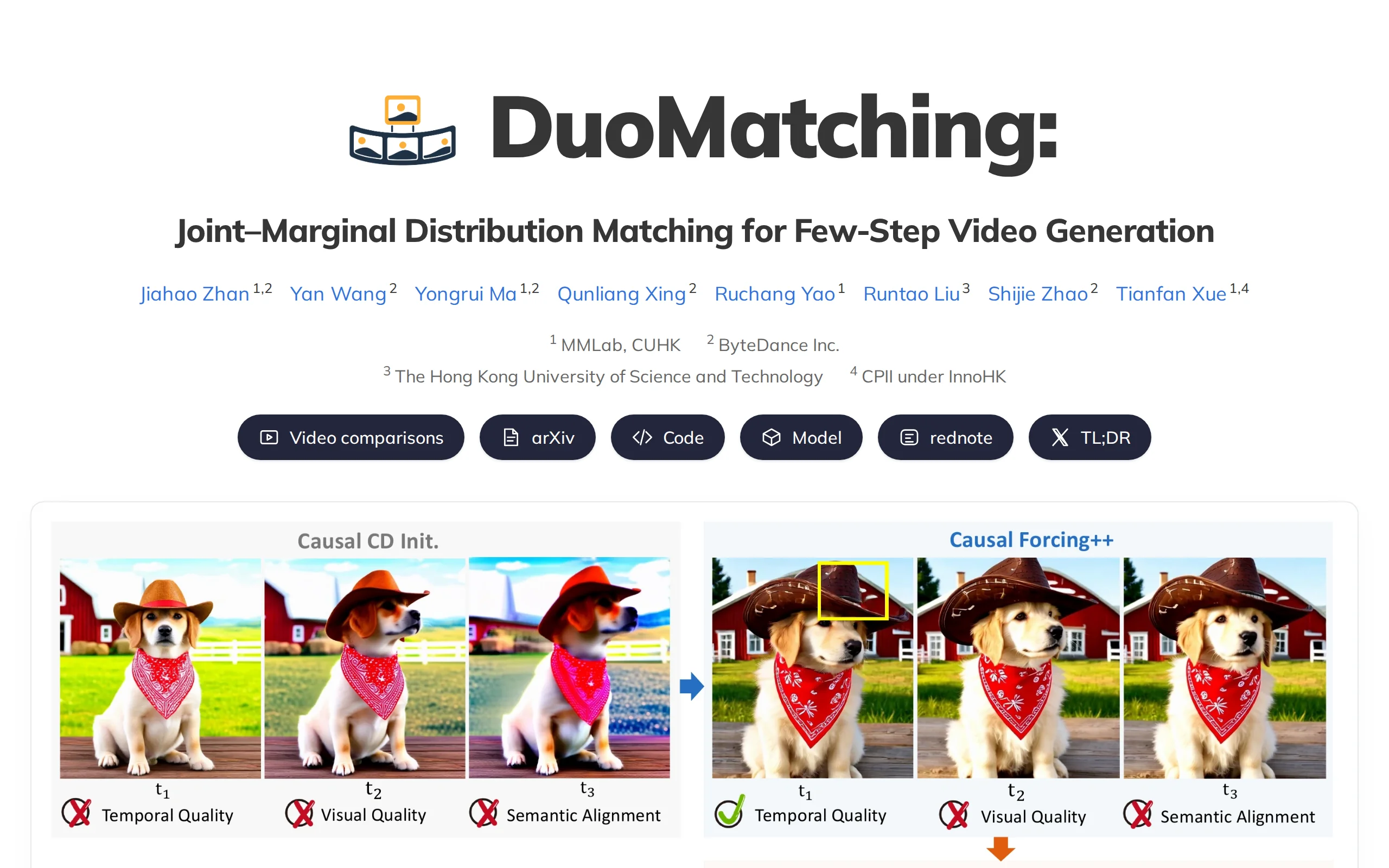
DuoMatching – A Video Generation Distillation Framework Jointly Open-Sourced by CUHK and ByteDance
DuoMatching is a low-step video generation distillation framework jointly developed by the MMLab at the Chinese University of Hong Kong and ByteDance. Its core objective is to address the issues of si...

Hy-Nomas – Tencent HunYuan Team's Open-Source Interactive Video World Generation Model
Hy-Nomas is an open-source interactive video world generation model developed by the Tencent HunYuan team. It generates videos using a segmented autoregressive approach, supporting seamless switching ...
© All Rights Reserved. Some content on this site is partially generated by AI with human review.