
DuoMatching – A Video Generation Distillation Framework Jointly Open-Sourced by CUHK and ByteDance
Executive Summary:
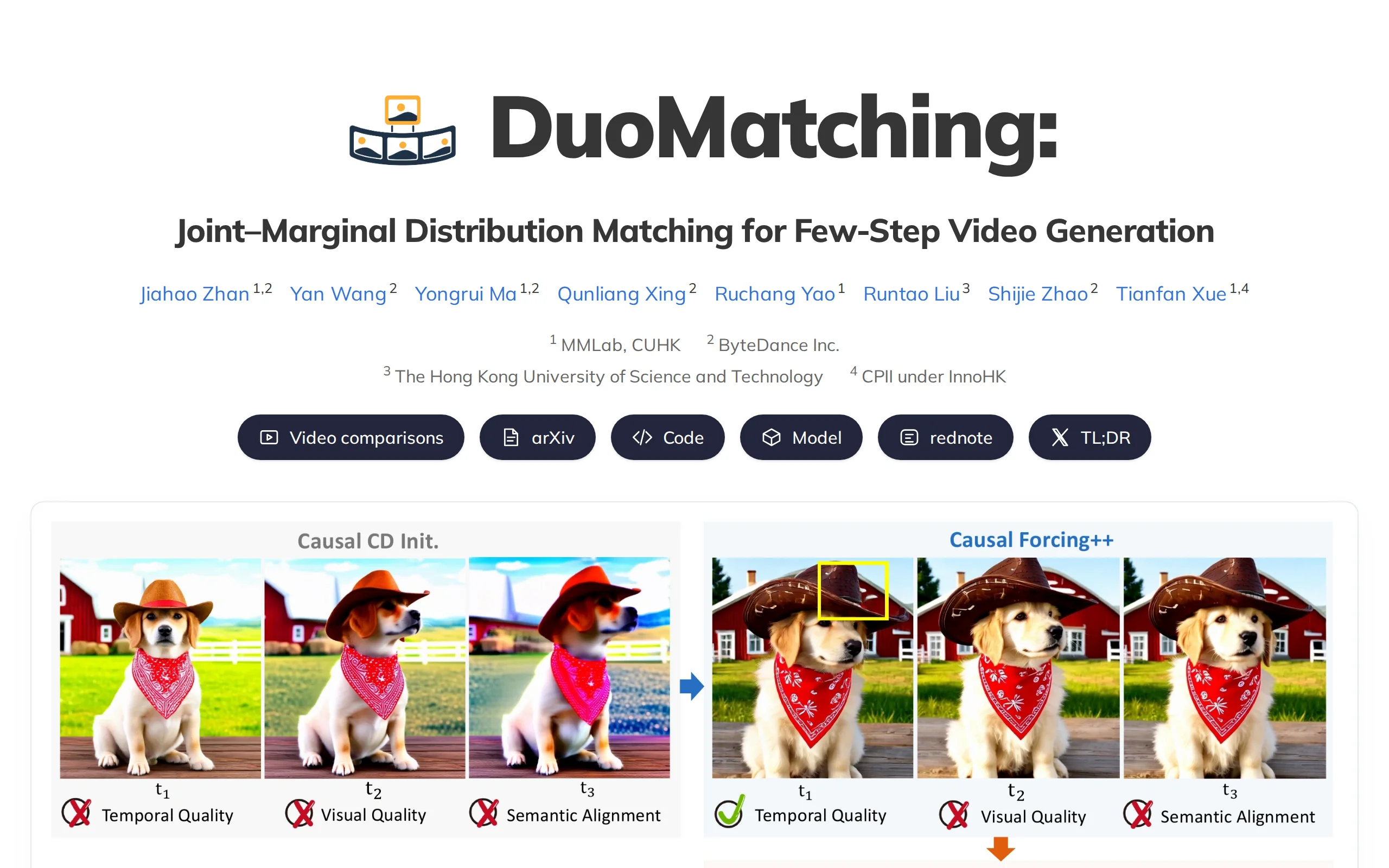
DuoMatching is a low-step video generation distillation framework jointly developed by the MMLab at the Chinese University of Hong Kong and ByteDance. Its core objective is to address the issues of si...

1. What is DuoMatching
DuoMatching is a low-step video generation distillation framework jointly developed by the MMLab at the Chinese University of Hong Kong and ByteDance. Its core objective is to address the issues of single-frame quality degradation and semantic drift that arise when reducing the sampling steps in low-step diffusion models. The framework decouples the two major tasks of temporal consistency and single-frame quality optimization in the video generation process. It introduces a frozen image model as a frame-level supervisory signal and leverages the LatentBridge module to achieve efficient mapping between video and image latent spaces. This allows the framework to maintain the coherence of motion across frames while significantly improving detail fidelity and instruction-following capabilities. The framework has been fully open-sourced and supports high-quality video generation with low-latency configurations such as 2-step or 4-step sampling.
Technical positioning and domain: DuoMatching belongs to the intersection of diffusion model distillation and video generation, focusing on exploring technical approaches that ensure both spatiotemporal consistency and single-frame visual quality under low-step sampling conditions. Its core innovation lies in combining traditional joint distribution distillation with marginal distribution distillation, forming a dual distribution matching mechanism that enables the video teacher model and image teacher model to separately handle temporal quality and frame-level quality.
Development background: This framework was jointly launched by the Multimedia Lab (MMLab) at the Chinese University of Hong Kong and ByteDance. MMLab has deep technical expertise in video understanding and generation, while ByteDance provides practical experience in engineering deployment. The team aims to overcome known limitations in existing low-step distillation methods, such as loss of visual details and semantic deviation.
Core value: During training, DuoMatching introduces an image teacher model to provide marginal distribution supervision while preserving the temporal constraint capabilities of the video teacher model. The student model requires no additional computation during deployment and can achieve a total score of 83.53 on the VBench benchmark under 2-step generation conditions, effectively balancing generation speed, cost, and output quality.
Technical features: Introduces a LatentBridge module with 10.75 million parameters to bridge the latent spaces of video and images, enabling the transmission of supervisory signals without decoding into the RGB domain; designs a Latent Variation Sampling (LVS) strategy that dynamically allocates frame-level supervisory budget based on the intensity of latent space variations, avoiding over-concentration of supervisory resources on static frames.
2. Key Features
Dual Distribution Matching Distillation: Introduces a marginal distribution matching (marginal DMD) mechanism in addition to the traditional joint distribution matching (joint DMD). The video teacher is responsible for fitting the joint distribution across the entire video to maintain temporal coherence, while the image teacher imposes constraints on the marginal distribution of sampled frames to enhance the visual quality of individual frames. The marginal loss weight defaults to 0.4 and can be adjusted according to task requirements.
LatentBridge Latent Space Mapping: To address the incompatibility of latent structures between video VAE and image VAE, a conversion module with approximately 10.75 million parameters is trained. This module directly maps video latent slices into a latent space that the image teacher can understand. The module is pre-trained using L1 reconstruction loss and performs all computations within the latent space, effectively avoiding the high memory cost associated with decoding to RGB and re-encoding.
LVS Frame-Level Supervised Sampling: Latent Variation Sampling segments the video based on the intensity of changes between adjacent latent slices, then selects supervised frames from each segment. By default, four slices are sampled each time. Compared to random sampling, this strategy focuses the limited frame-level supervision budget on regions with rich dynamic content, preventing resource waste from over-supervising static frames.
Few-Step Low Latency Generation: Supports low-step inference configurations such as 2-step and 4-step. After distillation, the student model is capable of rapid response, meeting the strict latency requirements of real-time interactive applications while maintaining visual quality comparable to that of high-step models.
Zero Additional Inference Overhead: The image teacher model only participates in supervision during the training phase. Once deployed, the student model does not include any inference path from the image model. As a result, the generation latency and computational cost are identical to those of equivalent-scale few-step models, without increasing server load due to improved visual quality.
Plug-and-Play Model Upgrade Path: The framework decouples the selection of the image teacher from the training of the LatentBridge module. When replacing with a stronger image supervision model, only the corresponding LatentBridge module needs to be retrained, without modifying the main architecture of the student model. This design provides a flexible expansion channel for future continuous performance improvements.
3. How to Use
Environment Setup: Requires an NVIDIA GPU with CUDA support and a memory capacity of at least 16GB (the official example is based on A100 training). The operating system should support mainstream platforms, primarily Linux, and the Python version must be 3.10. Additionally, ensure that the CUDA driver is compatible with the PyTorch version.
Project Installation: Clone the official GitHub repository of DuoMatching, then install PyTorch, FlashAttention, and other project dependencies in sequence. This operation is recommended to be performed within a dedicated conda virtual environment to avoid dependency conflicts with the existing environment.
Model Weight Download: Obtain the Wan2.1-T2V-1.3B base model components and the distilled weights officially released by DuoMatching. Model files must be placed according to the default directory structure of the repository. Specific path requirements are outlined in the official repository documentation; missing or misplaced files may lead to loading failures.
Prompt File Organization: Create a UTF-8 encoded text file, with each line containing a single prompt as an independent generation request. The official repository provides a reference file
prompts/demos.txt, which can be used directly or expanded with custom content in the same format.Run Inference: Execute the
inference.pyscript, specifying the inference configuration, teacher/student weight paths, prompt text path, and output directory in the command line arguments. The official example generates 21 video frames by default. The output frame count can be adjusted via parameters, and a random seed can be set to reproduce results and ensure consistent controllability across multiple generations.Result Validation: Generated videos are archived in the output directory. It is recommended to check the semantic alignment of each video against its corresponding prompt. Based on the visual quality, motion intensity, and consistency, adjust hyperparameters such as distilled weights and frame sampling count to achieve better output results.
4. Pros and Cons Analysis
| Pros |
|---|
| Significant improvement in single-frame visual quality: By using an independent frame-level marginal supervision path, it effectively mitigates the loss of high-frequency details such as hair, texture, and material in few-step sampling. It achieved a comprehensive score of 83.53 on the VBench evaluation, with a noticeable enhancement in image precision. |
| Improved semantic alignment accuracy: Leveraging the semantic prior knowledge of the image model significantly reduces common issues in prompt following, such as missing objects, color errors, and compositional deviations, resulting in a clearer consistency between generated outputs and textual descriptions. |
| Zero additional cost during inference: The image teacher is only involved during training; no extra inference steps or model weights are needed during deployment. The service cost and latency are entirely equivalent to those of a standard few-step model. |
| Modular design supports continuous iteration: The image teacher and LatentBridge are loosely coupled, allowing for flexible replacement of supervision signals as more advanced image models are released, without modifying the student model's main structure. This provides good scalability. |
5. Comparative Analysis with Similar Tools
| Comparison Dimension | DuoMatching | Latent-Adversarial Diffusion Distillation (LADD) | SwiftBrush |
|---|---|---|---|
| Core Architecture | Joint DMD + marginal DMD dual distribution matching, image teacher + video teacher collaborative supervision | Latent space adversarial distillation based on SDXL, single-stage generation | One-stage distillation framework from text to video, no teacher model guidance |
| Performance Metrics | VBench total score of 83.53 (2-step generation), balancing temporal coherence and visual quality | High-quality single-step generation on the SDXL base, primarily focused on images | 1–4-step video generation, with good performance consistency with the base model |
| Feature Highlights | LatentBridge latent space bridging + LVS dynamic sampling strategy, specifically designed for cross-domain supervision between video and image | Adversarial distillation without a text encoder, efficient single-step generation | Self-distillation method without a teacher model, reducing training resource requirements |
| Deployment Method | Open-source code + pre-trained weights, local deployment for inference, commercial usage restrictions to be verified | Open-source model weights, inference based on diffusion model ecosystem | Simple inference process, but high training reproduction cost |
| Usability | Relies on the Wan2.1-T2V-1.3B base model, requires placing weights in a specified directory, has some learning curve | Friendly for users of the SDXL ecosystem, with abundant community tutorials | Simple inference process, but high training reproduction cost |
| Open Source License | GitHub repository is open, suitable for academic use, commercial licensing requires further confirmation | Uses a non-commercial license, commercial use requires separate authorization | Open-source for research purposes, commercial use requires contacting the team |
| Community Ecosystem | Recently launched, limited community discussion and third-party extensions | Based on the Stable Diffusion ecosystem, with extensive community resources | Mainly academic community, few industrial application cases |
Selection Recommendations: For applications requiring rapid deployment of short video generation services and prioritizing low latency and cost, DuoMatching offers a practical balance between visual quality and speed, especially suitable for business pipelines based on the Wan2.1 series. If the project requires strict commercial usage licensing or extensive third-party toolchain support, the SDXL ecosystem that LADD is built upon demonstrates greater maturity. Teams focused on academic research and looking to further explore self-distillation or data-efficient pathways may find the technical approaches of SwiftBrush and SnapVideo useful as complementary references.
6. Editor's Summary
DuoMatching provides an innovative paradigm in the field of video generation distillation that balances temporal quality with single-frame visual fidelity. Traditional few-step distillation methods often encounter bottlenecks in detail preservation when reducing the number of sampling steps. In contrast, this framework introduces an independent image teacher model, decoupling the optimization of single-frame visual quality from temporal consistency constraints and establishing a clear functional division. This design demonstrates strong generalizability in technical logic, applicable not only to the current Wan2.1-T2V-1.3B foundation model but also offering a methodological reference for distillation training of other video diffusion models. The efficient latent space mapping of the LatentBridge module and the dynamic sampling strategy of LVS address practical challenges of cross-domain supervision and computational efficiency at the engineering level, showcasing the research team's deep understanding of training process details.
In terms of practical value, DuoMatching is most directly beneficial in high-concurrency, low-latency video generation services. Its "enhanced during training, zero cost during deployment" characteristic makes it a well-suited solution that balances service quality with operational costs. For content creation platforms, real-time interactive applications, and teams requiring rapid generation of visual materials, this framework offers a high potential for real-world implementation. However, the framework does require certain GPU memory resources, and as a newly open-sourced project, its community ecosystem and supporting documentation are still in the early stages of development. Early adopters will need to possess a certain level of technical debugging capability.
Overall, DuoMatching offers a solution that combines academic innovation with engineering practicality in the direction of quality optimization for few-step video generation. As the community further validates and refines the LatentBridge module and LVS strategy, this framework is likely to become an important reference implementation in the field of video generation distillation and continue to expand its applicability in future iterations.
7. Application Scenarios
Real-time Interaction and Live Streaming Generation: Targeting digital humans, virtual anchors, and interactive live streaming scenarios, leveraging the low-step, low-latency characteristics to rapidly generate action and expression videos. A 2-step inference configuration can compress waiting time into the real-time feedback range, supporting high-frequency interactive response needs while maintaining basic visual naturalness.
Advertising and E-commerce Content Creation: E-commerce advertisements have high requirements for the presentation of product materials, specific colors, and detailed objects. DuoMatching enhances semantic alignment through an image teacher, effectively reducing inconsistencies between generated ad visuals and creative prompts, thereby lowering the material production costs associated with repeated trials.
Short Films and Animation Previews: During the initial validation phase of script storyboards and dynamic sample clips, creators can use this framework to quickly generate reference videos for character actions and shot designs at a very low cost, verifying the feasibility of shot transitions, motion pacing, and visual style before formal production.
Game and Virtual World Content Generation: Provides rapid prototyping capabilities for game cutscenes, character skill demonstrations, or virtual environment exploration. During the development of interactive content, corresponding dynamic assets can be generated on-the-fly based on the planning script, accelerating design validation and communication efficiency.
High-concurrency Video Generation Services: Platform-level services offering video generation capabilities to end-users, DuoMatching enhances image quality during the training phase, allowing the server to achieve high-quality outputs during inference without additional computation. This makes it suitable for large-scale operations that need to balance generation speed, service costs, and output quality.
8. FAQ
Q: How is the margin loss weight adjusted in DuoMatching?
A: The margin loss weight defaults to 0.4. Increasing this weight strengthens the image teacher's constraint on single-frame visual quality and semantic alignment, but excessively high weights may weaken the video teacher's dominant role in temporal consistency. It is recommended to perform gradient-style tuning within the 0.2–0.6 range based on the target scenario, observing changes in the motion smoothness and detail quality of the generated video.
Q: Does LatentBridge require separate training?
A: Initial use requires pre-training. This module learns to map video latent slices into the image VAE latent space using an L1 reconstruction loss. When switching image teacher models, the corresponding LatentBridge must be retrained. The training computational load is relatively manageable, and after pre-training, it only participates in the forward computation during the training phase.
Q: How to handle blurry or insufficient detail in the generated results?
A: This issue is typically related to the base quality of the Wan2.1-T2V-1.3B model. First, confirm whether the prompt description is specific and includes sufficient attribute constraints. Then, try increasing the number of sampling slices in LVS or fine-tuning the margin loss weight to strengthen frame-level supervision. If the problem persists, re-evaluate the suitability of the base model.
Q: Can the model run inference on a GPU with 16GB of VRAM?
A: When using the official weights for few-step inference, a GPU with 16GB VRAM can complete the basic generation task, but this depends on the output frame count and resolution settings. The official example generates 21 frames by default. If longer or higher-resolution videos are required, adjust the parameter settings based on actual VRAM usage.
Q: Does the inference cost include computations from the image teacher model?
A: No. The image teacher only provides supervision signals during the distillation training phase. The student model in the deployment phase does not include any computational path from the image model. Therefore, the inference latency and computational cost remain consistent with standard few-step video models, which is one of the core design advantages of this framework.
9. Project Links
- Project Website: https://johnzhan2023.github.io/DuoMatching/
- GitHub Repository: https://github.com/JohnZhan2023/DuoMatching
- HuggingFace Model Library: https://huggingface.co/JohnZhan/DuoMatching
- arXiv Technical Paper: https://arxiv.org/pdf/2610.03543
Related

MOSS-Image – A Text-to-Image Model Jointly Open-Sourced by Mosaic and OpenMOSS
MOSS-Image is a text-to-image model jointly open-sourced by Mosaic and the OpenMOSS team. Its core is composed of a single-stream diffusion Transformer (DiT) backbone with 5B parameters, paired with a...
FLUX 3 Max – In-Depth Review of the Video Generation Model from fal and Black Forest Labs
FLUX 3 Max is a post-training video generation model jointly developed by fal Research and Black Forest Labs, based on BFL's self-developed FLUX 3 multimodal foundation model. It supports three workfl...
In-Depth Review of FLUX 3 Image Klein: A New Benchmark for Image Generation with 5.6B Parameters
FLUX 3 Image Klein is an open-source AI image generation model developed by Black Forest Labs. With its lightweight parameter count of just 5.6B, it achieves capabilities that previously required mode...
DMAD – Diffusion Model Adversarial Distillation Framework Jointly Open-Sourced by ByteDance and Texas A&M University
DMAD (Distribution Matching as Adversarial Distillation) is an open-sourced few-step distillation framework jointly developed by ByteDance and Texas A&M University. Its core objective is to significan...
© All Rights Reserved. Some content on this site is partially generated by AI with human review.