
GO-3 Preview: In-depth Evaluation of AgiBot's Embodied AI Model with Full-Chain Scaling Learning
Executive Summary:
GO-3 Preview is an embodied AI model launched by AgiBot, with its core feature being the realization of a full-chain scaling learning loop from pre-training, post-training to deployment. The model emp...
1. What is GO-3 Preview
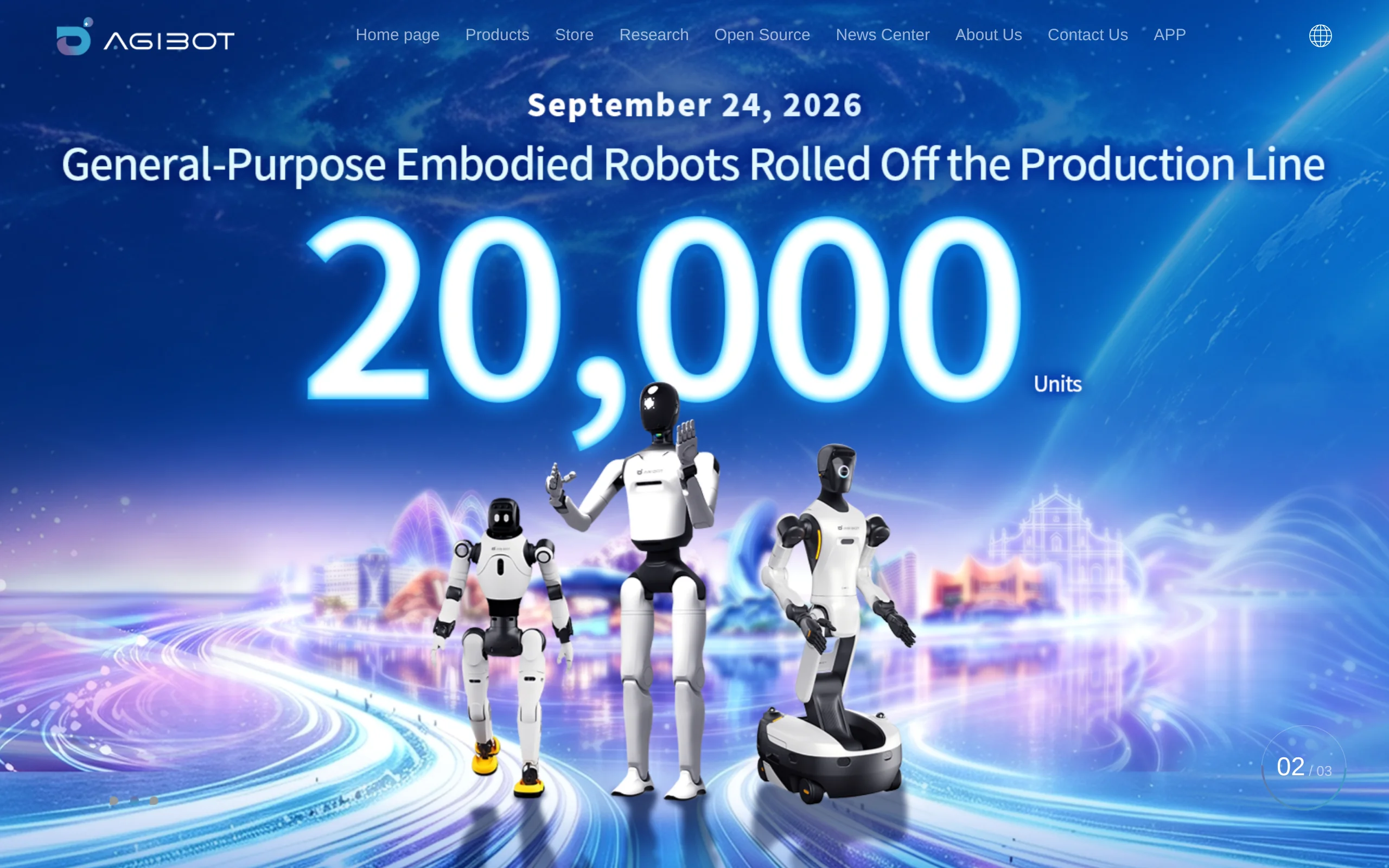
GO-3 Preview is an embodied AI model launched by AgiBot, with its core feature being the realization of a full-chain scaling learning loop from pre-training, post-training to deployment. The model employs the WRAM architecture, learning physical world manipulation skills from first-person human video data; it integrates real-world robots, simulations, and world models through Genie Evolver for mixed reality post-training; and it continues to self-evolve after deployment with the help of Genie Master. GO-3 Preview has achieved first place in three authoritative benchmarks: RoboDojo, RoboTwin, and RoboColiseum, and has been validated in real-world scenarios such as convenience stores. It is planned to be fully open-sourced by the end of 2026.
Technical positioning and domain: Belongs to the field of embodied AI, focusing on enabling robots to perform complex manipulation tasks in the physical world through a unified framework for visual perception, state prediction, and action generation. Its positioning lies between traditional imitation learning and general-purpose robotic brains, emphasizing the acquisition of transferable skill representations from a large volume of human first-person videos.
Development background: Developed by the AgiBot team and validated on the Genie G series robot hardware platform. The motivation for its development stems from three major challenges commonly faced by embodied AI models today: data scarcity, difficulties in transferring from simulation to real-world robots, and the inability to continue evolving after deployment. The goal is to build a complete growth system that allows robots to "see, learn, and do" just like humans.
Core value: Solves the long-standing issue in embodied AI of "understanding but not executing accurately." Through the WRAM architecture, it aligns visual prediction with inverse dynamics-based action generation, and ensures coordinated training between prediction and action using the KASO mechanism. Its CEL (Collective Experience Learning) mechanism significantly enhances learning gains as the number of real robots increases, directly translating hardware scalability into performance improvements.
Technical features: Approximately 90% of the training data comes from first-person human videos, greatly overcoming the scale bottleneck of robot demonstration data. The integration of three types of environments—real robots, simulations, and world models—forms a closed loop of "real-world validation—simulation expansion—world model exploration," balancing data scale, physical realism, and exploration depth.
2. Key Features
Video Pre-training for Skill Learning: Learns the patterns of state changes and operational methods in the physical world from vast amounts of first-person human video data, rather than relying on expensive robot teleoperation data. This mechanism enables GO-3 Preview to have out-of-the-box capabilities for hundreds of tasks, with a task coverage far exceeding traditional robot demonstration learning methods, significantly reducing the cost of skill acquisition.
Future State Prediction (WRAM Architecture): Utilizes the CoAE visual representation module to extract operational information such as object positions, shapes, and their relationships. The SVP single-step visual planner predicts visual states for multiple future moments through a single forward computation. An inverse dynamics model then converts the predicted states into executable actions. This process links "task understanding—future prediction—action generation" into a unified differentiable workflow, enabling the robot to perform proactive planning.
Hybrid Real-Virtual Post-training (Genie Evolver): Integrates three types of interactive environments: real robot clusters, physical simulations, and world models, achieving a triangular closed-loop of "real robot validation—simulation expansion—world model exploration." The world model can trace back to key decision points when actions deviate from the target, predicting the outcomes of different forces and angles, and expanding a single real-world experience into the starting point for exploring multiple candidate actions.
KASO Action Coordination and Selection: In response to the real-world scenario where multiple reasonable ways exist to complete a single task, the KASO mechanism generates multiple candidate future states, evaluates the compatibility of each prediction with actual actions, and selects high-quality samples for joint training. This mechanism effectively prevents interference between the two objectives of visual prediction and action learning, ensuring a coordinated and consistent training process.
Collective Experience Learning (CEL): Designed for parallel training scenarios involving hundreds of real robots, CEL retrieves successful action segments, analyzes failure contexts, and updates shared strategies, aggregating individual trial-and-error experiences into collective knowledge. Experiments show that the success rate for the phone packaging task increases from 50.8% to 98.3% as the number of real robots increases, validating the learning benefits of scaling up.
Task Planning and Anomaly Recovery (Genie Master): Acts as an embodied Agent to orchestrate operational steps and verify execution results. When a task is interrupted, it retains the current progress and replans from the breakpoint. This module also supports feeding anomaly handling experiences back into the model, enabling the robot to autonomously adjust when encountering unexpected situations such as slipping, occlusion, or entanglement during real-world operations.
Cross-Body Operation Transfer: The same model can migrate and execute actions such as grasping, opening doors, and kneeling to pick up objects across different robot bodies, breaking the limitation of being bound to a single hardware platform. This capability stems from the abstract operational knowledge learned during pre-training from human videos, which is independent of specific mechanical structures.
3. Application Scenarios
Convenience Store Retail Replenishment: The Smart Yuan Sprite G2 robot has been deployed and validated in real-world convenience stores, capable of completing the entire process of product identification, replenishment sequence planning, and grasping and placing items. When faced with anomalies such as product slipping or shelf obstructions, the system can autonomously adjust its strategy and resume tasks from the breakpoint, demonstrating the practical value of the task planning and anomaly recovery modules in commercial environments.
Ready-to-Eat Food Packaging and Takeout Preparation: In convenience store scenarios, the robot can perform delicate operations such as ready-to-eat food packaging and takeout bagging. It is able to identify and handle unstructured anomalies, such as water bottles being entangled by carrying straps. Each anomaly recovery experience is fed back into the training data through the Physical RSI mechanism, forming a self-evolving closed-loop of "learning by doing."
Industrial Manufacturing Assembly: In real machine cluster experiments, the success rate of the mobile phone packaging task has reached 98.3%, with the number of failures in multi-stage, long-process tasks decreasing by 92%. This solution is applicable to assembly, inspection, and packaging lines for 3C products. Compared to traditional industrial robots that require manual programming and debugging, this approach can quickly adapt to new processes through natural operational demonstrations.
Exhibition Interaction and Educational Demonstrations: Tasks such as continuous LEGO assembly, table curling competition, and pulling out blocks demonstrate the system's capabilities in delicate operations and long-term decision-making, making it suitable for science museum demonstrations, human-robot interaction experiences, and robotics research and teaching scenarios.
4. How to Use
Open Source Status Confirmation: GO-3 Preview is not yet available for download and is scheduled to be fully open-sourced by the end of 2026. Users must follow the official channels of Zhixuan Robotics to obtain model weights, deployment toolkits, and documentation. Local deployment is not possible before that.
Hardware Environment Preparation: Based on the model's positioning, it is recommended to prepare a GPU server equipped with NVIDIA A100/H100 or high-performance domestic acceleration cards, with a video memory of at least 40GB (the hardware requirements for the lightweight version, GO-3 Nano Preview, are relatively lower). A deep learning framework environment supporting PyTorch 2.0 or higher versions is required.
Physical Robot and Simulation Environment Setup: To reproduce the post-training process, a robot body that supports ROS 2 (such as the Zhixuan Sprite G series) must be equipped, along with a physical simulation environment (such as MuJoCo, Isaac Sim) and a world model inference service. These three components work together to form the foundation of Genie Evolver. Specific version requirements will be based on the open-source documentation.
Task Definition and Data Collection: When deploying to a new scenario, the target task semantics must be defined using natural language or demonstration videos. Human operation videos or physical robot demonstration data should be annotated and organized into a training set according to standard formats. The KASO screening mechanism will automatically filter predicted samples that are incompatible with real actions, reducing the burden of manual data cleaning.
Training and Deployment Process: Use video pre-training weights as the initialization, perform distributed training in the post-training environment, and enable CEL group learning. After training is complete, export the model and deploy it to the target robot body. Enable Genie Master for task planning and anomaly recovery, and configure a Physical RSI data feedback channel to achieve continuous evolution after deployment.
Testing and Iterative Optimization: Conduct generalization testing in the simulation environment with parameters such as friction coefficient, object pose, and collision conditions. Prioritize fixing subtasks with high failure rates. Increase the number of participating robot bodies through a physical robot cluster to achieve higher success rate improvements within the same training time using the CEL mechanism. Specific training hyperparameters and optimization guidelines will be available after the official open-source documentation is released.
5. Pros and Cons Analysis
| Pros |
|---|
| End-to-end native audio modeling architecture: Integrates pre-training, post-training, and deployment phases into a complete growth loop, ranging from "learning skills through video" to "self-evolution after deployment," overcoming the limitations of most models that stop at pre-training or offline fine-tuning. |
| High efficiency in video pre-training: Approximately 90% of the training data comes from first-person human videos, covering a much broader range of scenarios and skills than robot demonstration data, significantly expanding the scope of skill acquisition and reducing data collection costs. |
| Prediction and action coordination (WRAM+KASO): Can quantify predictions of physical state changes while ensuring alignment between predictions and actual actions, addressing the core challenge of embodied intelligence—“understanding but not executing accurately”—at the architectural level. |
| Cost-effective and efficient mixed reality training: The three types of environments—real devices, simulations, and world models—collaborate and divide tasks, expanding the scale of interactive experience while effectively reducing equipment wear and safety risks caused by real-world trial and error. |
| Scalable group learning benefits: The CEL mechanism directly translates an increase in the number of real devices into performance improvements. Experiments show that the success rate for the mobile phone packaging task increases from 50.8% to 98.3% as the number of devices increases, demonstrating the scalability of the learning effectiveness. |
6. Comparative Analysis with Similar Tools
| Comparison Dimension | GO-3 Preview (Zhiyuan) | UnifoLM-WLA-1.0 (Unitree) |
|---|---|---|
| Model Scale | Not disclosed (a lightweight version, GO-3 Nano Preview, is available), with rich capabilities in practical scenarios | 6B parameters, open weights downloadable |
| Training Data | Approximately 90% first-person human video, supplemented with mixed data from real robots, simulations, and world models | Approximately 2,500 hours of high-quality real robot data, including proprietary open-source data and BitRobot-HIW-500 public data |
| Technical Architecture | WRAM World Reasoning Action Model: CoAE visual representation + SVP future state prediction + inverse dynamics action generation | WLA World-Language-Action Fusion: interaction-centric world modeling, unified action space for perception-prediction-action coordination |
| Post-training System | Genie Evolver: mixed environment of real robot clusters, physical simulation, and world models, supporting CEL group experience learning and KASO collaborative screening | Provides fine-tuning toolchain, no mixed environment or world model backtracking mechanism |
| Agent Capabilities | Genie Master includes integrated capabilities for task planning, resuming from breakpoints, anomaly recovery, and experience memory | No built-in Agent framework, relies on external scheduler |
| Post-deployment Learning | Supports Physical RSI, with real-world operational experience fed back into training; closed-loop validation has been conducted in convenience store scenarios | Does not support post-deployment learning; model updates rely on offline iteration |
| Open Source Status | Plans to fully open source by the end of 2026 (the test version is in Preview phase) | Open source weights and toolchain, community can download and fine-tune |
| Evaluation Performance | First in RoboDojo, RoboTwin, and RoboColiseum benchmarks | Multiple embodied reasoning benchmarks have achieved SOTA with open-source models; officially stated to be comparable to top closed-source models |
Selection Recommendations: If a research team needs to reproduce the detailed training process and independently expand the skill library, Unitree's UnifoLM-WLA-1.0 is more suitable as a baseline model for academic research due to its open 6B weights and fine-tuning toolchain; if a company requires a commercial robot system that can continuously evolve and adapt to unstructured on-site anomalies after deployment, the Physical RSI mechanism in GO-3 Preview is a distinctive solution in the current technical framework, although the full toolchain will only be available after it is open-sourced by the end of 2026.
For small to medium-sized teams with limited computing resources who need to quickly validate embodied operation concepts, it is recommended to first use the lightweight version GO-3 Nano Preview (to be open-sourced soon) or Unitree's open-source weights for simulation verification, then gradually transition to full-scale models; for industrial scenarios with high data privacy requirements, solutions with strong post-deployment learning capabilities can reduce the need to transmit sensitive operational data externally, making the GO-3 Preview direction worth continuous tracking.
7. Editor's Summary
GO-3 Preview represents a promising technical approach to embodied intelligence: connecting human video pre-training, mixed reality training, and post-deployment self-evolution into a complete lifecycle, systematically addressing the limitations of previous models that were "fixed after training." Its WRAM architecture integrates task understanding, future state prediction, and action generation into a unified workflow, while the KASO coordination mechanism resolves compatibility issues between prediction and action. This architecture holds greater paradigm significance than simply scaling up data volumes or model parameter counts. Evaluation results show that GO-3 Preview achieved first place in three authoritative benchmarks, including RoboDojo, and its successful deployment in real-world convenience store scenarios confirms that the solution is not merely a demonstration but possesses tangible operational capabilities.
The CEL group experience learning mechanism yields an important quantitative conclusion: within the same training time, the success rate for the mobile phone packaging task increased from 50.8% to 98.3%, demonstrating that learning gains can scale with the number of robots. This characteristic holds direct value for large-scale deployment of embodied agents, but the high hardware requirements for clusters of hundreds of physical robots suggest that its current applications are more suitable for well-funded industrial players than small academic teams. The cross-body operation transfer capability provides flexibility for model reuse across different hardware platforms, while Genie Master's task planning and resume-from-checkpoint functionality addresses a critical weakness in the reliability of the execution layer.
For development teams, the core value of GO-3 Preview lies in validating the feasibility of the "learning by observing—refining by practicing—advancing by doing" pathway. Its commitment to open-sourcing by the end of 2026 is worth noting, as it will allow teams to reproduce the model independently and assess its adaptability to their own scenarios. Enterprise users should focus on its benchmarking effect in the convenience store scenario, using it as a reference solution for automation upgrades in labor-intensive industries such as retail and manufacturing. As world models and real-robot data continue to grow, models with full-chain learning capabilities like GO-3 Preview are expected to deliver quantifiable efficiency advantages in more vertical application scenarios.
8. FAQ
Q: Is GO-3 Preview currently downloadable or available for commercial use?
A: It is currently in the Preview testing phase, and the official has not yet released the model weights or code for download. According to the official announcement, it will be fully open-sourced by the end of 2026, at which time the complete model and deployment toolchain will be available. Commercial licensing terms will be announced together with the open-source release.
Q: What is the fundamental difference between GO-3 Preview and conventional Vision-Language-Action (VLA) models?
A: GO-3 Preview employs the WRAM world reasoning action model. The core difference lies in the explicit inclusion of a "future state prediction" module, which uses the SVP single-step visual planner to predict visual states across multiple future time steps, then converts them into actions via an inverse dynamics model. In contrast, conventional VLA models typically directly learn the "observation-action" mapping, lacking explicit modeling of the physical world's evolution and the KASO collaborative filtering mechanism.
Q: Can the model be deployed on robots from non-Zhuyuan brands?
A: The official claims support for cross-body operation transfer, meaning the same model can perform actions like grasping and opening doors on different robot bodies. After open-sourcing, it is recommended to prioritize bodies with a kinematic structure similar to the Zhuyuan Genie G series for compatibility. For non-structured bodies with significant differences, users must verify the transfer effectiveness themselves.
Q: What hardware configuration is required for training and inference?
A: The official has not disclosed specific computational requirements, but considering the use of a cluster of hundreds of real robots and large-scale video pre-training, the training phase will require high-performance GPU clusters and distributed training infrastructure. The lightweight version, GO-3 Nano Preview, is expected to have a lower configuration threshold, though exact parameter specifications are yet to be announced by the official.
Q: How can GO-3 Preview be deployed in specific vertical scenarios (e.g., factory production lines)?
A: Deployment involves three stages: first, collect human operation videos or real-robot demonstration data from the target scenario, and obtain basic skills through video pre-training or fine-tuning. Second, conduct hybrid training in three types of environments—real robots, simulations, and world models—using the CEL mechanism to call multiple bodies in parallel for trial and error. Third, after deployment, enable Physical RSI data refeeding to allow the system to continuously accumulate experience during real-world operations and periodically update strategies.
Q: How does GO-3 Preview perform when handling long-range complex tasks?
A: Genie Master provides task planning, resuming from breakpoints, and anomaly recovery capabilities. It has been validated to handle anomalies such as slipping, occlusion, and entanglement in multi-step tasks like restocking convenience stores and packaging ready-to-eat food. Evaluation results show a 92% reduction in the number of failures in multi-stage, long-flow tasks. For even longer duration tasks (e.g., cross-hour level), further scenario validation is still required.
9. Project Links
- AGIBOT Official Website: https://www.agibot.com (For product and technical release information, please visit the official website)
Related

WorldSonus: In-Depth Review of the Real-Time Streaming Voiceover Framework Open-Sourced by HKUST and Shanghai Jiao Tong University
WorldSonus is a streaming voiceover framework open-sourced by the Hong Kong University of Science and Technology in collaboration with Noiz AI, MetaX, and Shanghai Jiao Tong University. Its core posit...
Voyager – Open-Source Desktop Creative Agent Covering the Full Production Workflow
Voyager is an open-source desktop creative Agent developed by Nullframe, designed to directly embed AI capabilities into creators' existing professional software workflows through natural language int...
In-Depth Review of GPT-6.1 Terra – OpenAI's High-Efficiency Execution Large Model
GPT-6.1 Terra is a high-efficiency execution large model introduced by OpenAI, designed for office automation and high-frequency Agent task scenarios. It emphasizes enhanced visual understanding, comp...
DuoMatching – A Video Generation Distillation Framework Jointly Open-Sourced by CUHK and ByteDance
DuoMatching is a low-step video generation distillation framework jointly developed by the MMLab at the Chinese University of Hong Kong and ByteDance. Its core objective is to address the issues of si...
© All Rights Reserved. Some content on this site is partially generated by AI with human review.