
Deep Evaluation of Xing4.0-29B-Intent: XingChen Lab's Open-Source Intent Understanding Specialized Model
Executive Summary:
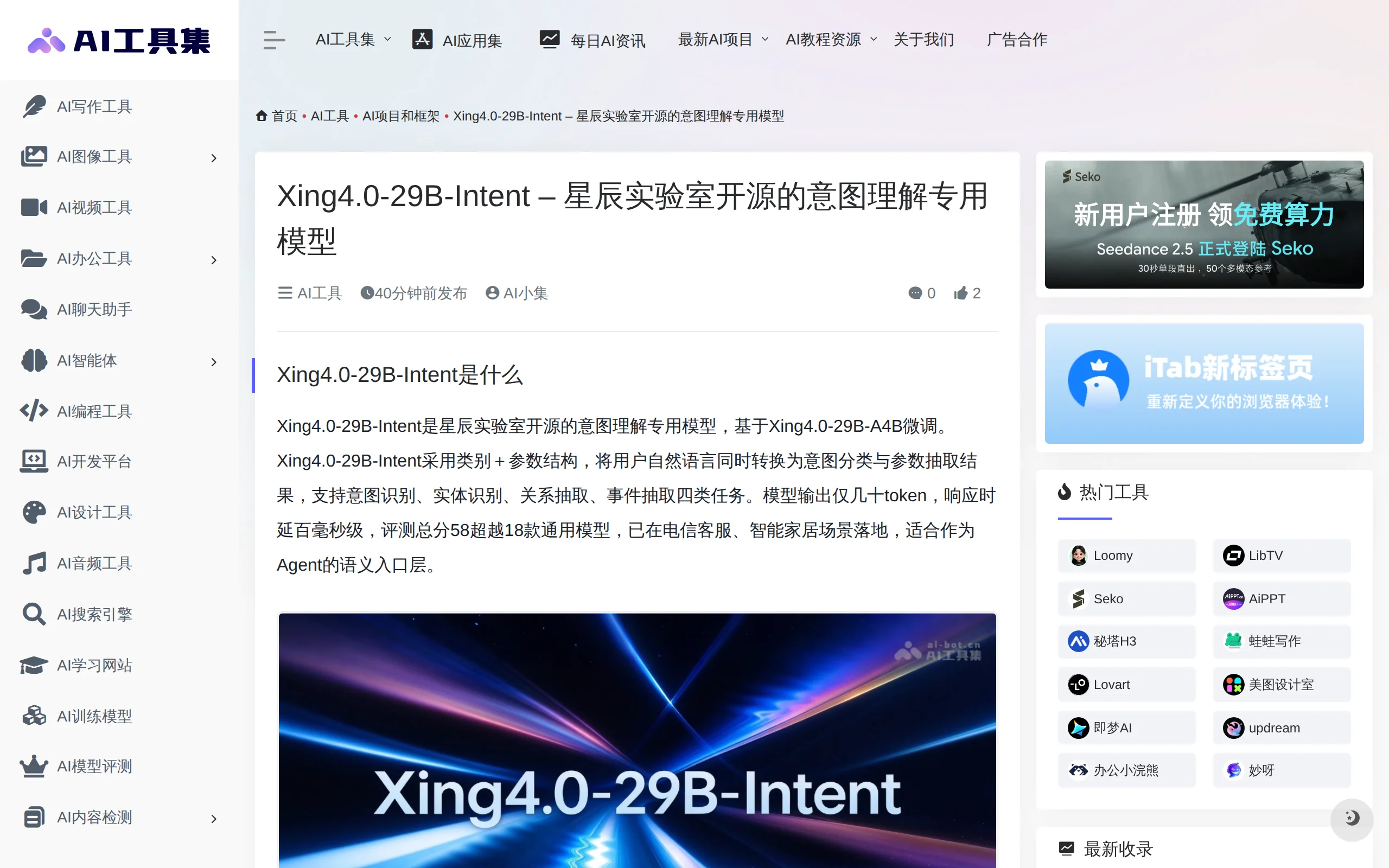
Xing4.0-29B-Intent is an open-source intent understanding specialized model developed by XingChen Lab, fine-tuned from its self-developed Xing4.0-29B-A4B general-purpose base model. This model employs...
1. What is Xing4.0-29B-Intent
Xing4.0-29B-Intent is an open-source intent understanding specialized model developed by XingChen Lab, fine-tuned from its self-developed Xing4.0-29B-A4B general-purpose base model. This model employs a structured output paradigm of "category + parameters," converting user natural language input into both intent classification results and parameter extraction results simultaneously. It supports four core tasks: intent recognition, entity recognition, relation extraction, and event extraction. Leveraging the computational efficiency advantages of the MoE architecture, the model can complete the entire semantic parsing pipeline with an average of just dozens of Tokens, achieving response latency at the sub-100 millisecond level. In evaluations covering 5,606 questions, Xing4.0-29B-Intent scored a total of 70, outperforming 18 general-purpose large models. It has already been deployed in real-world business scenarios such as telecom customer service and smart home systems, and is positioned as a semantic entry component for Agent systems.
Technical positioning and domain: Xing4.0-29B-Intent belongs to the intent understanding and information extraction direction within the field of natural language processing (NLP), focusing on solving the problem of semantic structuring during human-machine interaction. Unlike general-purpose dialogue models that aim for open-ended text generation, this model focuses on "deterministic output," converting natural language into structured data that can be directly consumed by business systems, serving scenarios that require precise instruction parsing such as intelligent customer service, IoT control, and enterprise IM robots.
Development background: The model was developed by XingChen Lab, a team with deep expertise in large models using the MoE architecture. The previously launched Xing4.0-29B-A4B base model provided the foundation for the development of this intent understanding specialized model. The team observed that general-purpose large models face issues such as uncontrollable output, high inference costs, and large response latency in practical business applications. Therefore, they specifically designed the USP (Unified Schema-driven Parsing) framework for intent understanding tasks, achieving a specialized model suitable for production environments through large-scale structured corpus fine-tuning and schema-constrained generation mechanisms.
Core value: This model addresses three core pain points of general-purpose large models in intent understanding scenarios: first, the output structure is uncontrollable, and open-ended text generation is difficult to directly integrate into business processes; second, the inference cost is high, and dense models with full parameter activation are too costly for scenarios with millions of daily calls; third, the response latency does not meet the requirements for real-time interaction. By leveraging the MoE architecture to reduce activated parameters to approximately 4 billion while maintaining a total parameter knowledge capacity of 290 billion, and combining it with the schema-constrained generation mechanism, the model achieves low-cost, low-latency, and highly deterministic semantic parsing capabilities.
Technical features: The model's main technical features are reflected in three aspects: the USP unified schema-driven framework integrates heterogeneous tasks such as intent recognition, entity recognition, relation extraction, and event extraction into a hierarchical JSON output of "category + parameters," eliminating the format adaptation costs between multiple tasks; the schema-driven constraint generation mechanism ensures that outputs are strictly confined within predefined field rules, significantly reducing hallucination rates; and approximately 275,300 specialized supervised fine-tuning samples (reconstructed from 61 public datasets, covering 19 domains and 52 languages) provide ample training support for its structured output capabilities.
2. Key Features
Intent Recognition: Determines the business category of a user's utterance, supporting both single-intent recognition and complex scenarios where a single sentence contains multiple intents. The model matches against predefined candidate intent categories and outputs results that include intent category identifiers and confidence scores, providing clear basis for downstream business routing.
Parameter Extraction: While recognizing intent, the model extracts entity, numerical, and attribute information required to complete tasks. For example, it extracts the time entity from "Move the meeting to Friday afternoon" and the device and temperature value from "Turn on the living room air conditioner to 26 degrees," achieving a direct mapping from natural language to structured parameters.
Unified Structured Output: Organizes all task results in a JSON format that combines "category + parameters." The four types of tasks—intent recognition, entity recognition, relation extraction, and event extraction—share the same input and output format. Downstream systems do not need to separately adapt parsing logic for each task, significantly reducing system integration complexity.
Parallel Multi-Task Parsing: Supports multiple intents, parameters, and entities within a single sentence, returning multiple complete parsing results in a single JSON array. The model can accurately handle complex nested semantics, meeting the practical needs of information-dense and semantically complex real-world conversations.
Schema-Driven Adaptation: Developers can predefine candidate categories, category descriptions, and extractable fields. The model's output is strictly constrained within a predefined business framework. This mechanism ensures field determinism, format verifiability, and effectively suppresses hallucinatory outputs, enabling the model to quickly adapt to business rules across different vertical industries.
Function Calling Semantic Entry Point: Provides intent judgment and function calling parameter extraction capabilities for Agent/intelligent agent applications, bridging natural language input with the execution of business system tools. The model's structured output can be directly mapped to function call parameters, reducing parsing overhead and error rates for intelligent agents.
3. How to Use
Acquire Resources: Download the model weights, code repository, and accompanying dataset from the GitHub repository (github.com/XingChen-AGI/Xing4.0-29B-Intent), or directly pull the model files from the HuggingFace model library (huggingface.co/XingChen-AGI/Xing4.0-29B-Intent). Both channels provide a complete resource package, including inference scripts, SDK, and example configurations.
Prepare the Environment: Deploy the official inference image, or refer to the documentation of the base model Xing4.0-29B-A4B to set up the model service using mainstream inference frameworks such as vLLM and SGLang. Since the model uses a MoE architecture (total parameters 29 billion, activated approximately 4 billion), a single A100 or higher specification GPU is sufficient for inference, making the hardware requirements relatively manageable.
Install the SDK: Access the model service using the Python SDK provided in the repository. The SDK encapsulates basic logic such as request assembly and result parsing, allowing developers to directly call high-level interfaces. Alternatively, teams without GPU resources can use the cloud API via the Tianyi AI Open Platform without deployment, which is ideal for quickly verifying performance.
Define Business Schema: Declare candidate intent categories, category descriptions, and extractable fields for each category. The quality of the Schema definition directly affects recognition performance. It is recommended to provide clear category descriptions and field boundaries to avoid semantic overlap between categories or ambiguous fields.
Assemble Prompts and Initiate Calls: Use the SDK to automatically assemble user input and the Schema into a request that the model can recognize. Send the request to the model service and wait for the response. The model outputs a JSON-structured result of several dozen tokens, with response latency typically maintained at the hundreds of milliseconds level.
Parse Results and Integrate with Business Logic: Read the intent and field values in the "category + parameters" structure. Perform field validation and fallback handling for abnormal outputs. Pass the structured results to downstream systems for execution. Before performing sensitive operations, verify permissions or request secondary confirmation from the user to ensure business security.
4. Pros and Cons Analysis
| Pros |
|---|
| Unified intent recognition and parameter extraction: A single model completes both intent classification and parameter extraction tasks, naturally aligning its output with downstream system requirements and reducing redundant parsing efforts and system complexity. Compared to general-purpose large models that require multiple rounds of dialogue to confirm intent and entities, this model produces a complete structured result in a single inference. |
| Fast response speed: The model outputs only dozens of Tokens on average, leveraging the sparse activation characteristics of the MoE architecture, achieving response latency in the hundreds of milliseconds. Compared to general-purpose large models that require generating hundreds or even thousands of words in response, interaction latency is significantly reduced, making it suitable for high-frequency real-time interaction scenarios. |
| Low invocation cost: With the MoE architecture, only about 4 billion parameters are activated per Token, resulting in significantly lower computational costs compared to dense models of similar scale. When measured against a scenario with an average of one million daily invocations, the inference cost difference compared to general-purpose large models is drastically reduced, significantly lowering the economic threshold for large-scale deployment. |
| Unified format for four types of tasks: Intent understanding, entity recognition, relation extraction, and event extraction all use the same input and output format. Downstream systems only need to adapt to one parsing logic to handle all four tasks, resulting in extremely low migration and integration costs. |
5. Comparative Analysis with Similar Tools
| Comparison Dimension | Xing4.0-29B-Intent | Jev |
|---|---|---|
| Product Positioning | Specialized intent understanding model, integrating intent classification and parameter extraction, also used for information extraction | Lightweight decision model, focusing on single intent classification |
| Model Scale | Total parameters 29B, active ~4B (MoE architecture) | Lightweight small model |
| Intent Classification | Supported, multi-intent parallel recognition, returns JSON array | Supported, N choose 1 or individual yes/no answers |
| Parameter Extraction/Slot Filling | Supported, integrated output with intent recognition | Not supported |
| Information Extraction/NER | Supports entity recognition, relation extraction, event extraction | Not supported |
| Multi-Intent Parsing | Supported, multiple intents in one sentence returned at once | Limited capability |
| Structured Output in Fixed Format | Supported, Schema-constrained JSON format | Supported |
| Overall Decision Score (5606 questions) | 70 | 56 (N choose 1) / 53 (yes/no judgment) |
| Negative Example Anti-Falsification Score | 70 | 35 (N choose 1) / 5 (yes/no judgment) |
| Inference Latency | Millisecond level (<200ms) | Faster (<100ms) |
| Output Length | Average of several dozen Tokens | Shorter |
| Calling Cost | Low, MoE sparse activation | Extremely low |
| Model Weights | Open (GitHub/HuggingFace) | Open |
| Training Corpus | 2.753 million (61 public datasets, 19 domains, 52 languages) | Less |
| Inference Image/SDK | Official image + Python SDK | SDK |
| Applicable Scenarios | Agent semantic entry, customer service routing, terminal interaction, complex information extraction | Single intent classification, ultra-low latency scenarios |
Selection Recommendations: If the business scenario requires both intent recognition and parameter extraction, and involves complex semantics where a single sentence contains multiple intents and parameters, Xing4.0-29B-Intent is currently the appropriate open-source choice. Its unified structured output format can significantly reduce the parsing complexity of downstream systems, and its capabilities align well with scenarios such as telecom customer service, smart home devices, and enterprise IM chatbots.
For lightweight scenarios requiring ultra-low latency and only single intent classification, models like Jev are more suitable. They offer lower inference latency and smaller deployment costs, but lack the ability for parameter extraction and multi-task information extraction, only outputting classification results. Additionally, if the business relies on intent tracking and state management in multi-turn dialogues, attention should be paid to dialogue-level intent understanding solutions like Plexus, but note that its performance in parsing complex semantics in single sentences and preventing false positives in negative examples is relatively limited.
6. Editor's Summary
Xing4.0-29B-Intent has made practical and innovative explorations in the niche area of intent understanding specialized models. From a technical perspective, the USP unified pattern-driven semantic parsing framework addresses the long-standing pain point of heterogeneous output formats across multiple tasks, unifying intent recognition, entity recognition, relation extraction, and event extraction into a hierarchical JSON structure of "category + parameters." This design approach significantly reduces downstream adaptation costs. The application of the MoE architecture allows the model to maintain a knowledge capacity of 29 billion parameters while compressing the activated parameters to approximately 4 billion, achieving a total score of 70 in evaluations and surpassing 18 general-purpose models. This result demonstrates the performance density advantage of large-scale sparse models over general-purpose dense models in specialized tasks.
From a practical value standpoint, the model includes a series of pragmatic designs for production environments: sub-100 millisecond latency aligns with real-time interaction requirements; stable JSON output and Schema constraint mechanisms ensure field determinism and verifiability; and the negative example anti-false positive score of 70 highlights strong discriminative capabilities. These features make the model more than just a technical demonstration—it is a usable component that can directly support real-world applications such as telecom customer service and smart home systems. For teams looking to quickly build the semantic layer of an Agent, this model provides a low-threshold integration solution.
In terms of target users, the model is primarily aimed at three types of developers: developers building Agent/Function Calling architectures, toolchain builders who need to convert natural language instructions into structured calls, and development teams for business systems requiring intent routing capabilities such as intelligent customer service, IoT control, and enterprise IM. For teams without GPU resources, the Tianyi AI Open Platform's cloud-based API offers an integration path that does not require building their own infrastructure.
Looking ahead, intent understanding is becoming increasingly important within the Agent ecosystem, and Xing4.0-29B-Intent's choice to prioritize specialization for determinism shows forward-thinking. If it can continue to accumulate Schema adaptation experience in more vertical domains and expand its evaluation coverage, it has the potential to become a significant open-source option for the semantic entry layer of Agents. Areas that still require continuous optimization include the model's robustness in complex multi-semantic scenarios, stability in cross-language transfer, and Schema adaptability.
7. Application Scenarios
Smart Customer Service/Work Order Routing: Identify customer conversation intent and extract key information to automatically complete work order classification and routing. This scenario has been implemented in the telecom customer service system "WanHao." The model quickly maps user-described issues to corresponding business categories and extracts key parameters such as account information and service type, reducing the time spent by human agents on repetitive questioning and manual data entry.
Terminal Voice Interaction: Applied in voice assistants, smart cockpits, and IoT central control systems, this scenario parses users' spoken commands into structured device control instructions. For example, the command "Set the living room air conditioner to 26 degrees and turn on the humidifier" can be parsed in one go into two device actions, with the output directly driving the device control system without the need for step-by-step intent decomposition.
Enterprise IM Bot: During the early stages of business deployment, enterprises can quickly build intent recognition and question routing capabilities without needing to accumulate massive annotated data. By defining a business Schema, internal employee inquiries, applications, and fault reports can be automatically categorized and key fields extracted, improving internal service response efficiency.
Agent/Function Calling Semantic Entry Layer: Provides agents with low-hallucination intent judgment and function calling parameter extraction capabilities, bridging natural language with tool execution. Developers can define the intent categories and parameter structures corresponding to available tools for the agent, allowing the model to replace the general-purpose parsing module in the agent framework and improve the accuracy of function calls.
Multi-Task Information Extraction: Perform entity recognition, relationship extraction, and event extraction in parallel from a single sentence. For example, "Change the meeting to Friday afternoon and move the location to the third floor" can simultaneously extract two events—time change (Friday afternoon) and location change (third floor)—along with their corresponding parameters, providing structured data input for office automation scenarios.
8. FAQ
Q: What is the core difference between Xing4.0-29B-Intent and general-purpose large models?
A: General-purpose large models excel at open-domain text generation, but their outputs are uncontrollable and have higher latency. Xing4.0-29B-Intent focuses on deterministic structured output, strictly limiting the output to predefined JSON structures through Schema constraints. It can complete intent classification and parameter extraction in a single inference, reducing response latency to the hundreds of milliseconds, making it more suitable for high-frequency real-time calls in production environments.
Q: What hardware requirements does the model have?
A: The model uses a MoE architecture, with a total of 29 billion parameters but only about 4 billion parameters activated per Token. For actual inference, it is recommended to use NVIDIA A100 or equivalent-level GPUs, and a single card is sufficient to meet the requirements. Teams without GPU resources can use the cloud-based API on the Tianyi AI Open Platform without deployment.
Q: How should Schema be defined to achieve better recognition performance?
A: Schema definition should follow three principles: ensure clear semantic boundaries between candidate intent categories to avoid overlap and ambiguity; provide concise and accurate descriptions for each category to help the model understand the category's meaning; clearly define the boundaries and value constraints for extractable fields to prevent the model from outputting extra information outside the fields.
Q: Does the model support languages other than Chinese?
A: Yes. The training data covers 52 languages, reconstructed from 61 publicly available datasets, and has been validated on multilingual intent understanding tasks. However, actual performance may vary depending on the language and domain. It is recommended to conduct small-scale testing on the target language and domain before deploying in production.
Q: How can the model's false positive rate be reduced?
A: First, provide clear descriptions and boundary definitions for each category in the Schema. Second, design a reasonable fallback strategy for "non-target categories," specifying how inputs not belonging to any predefined category should be handled. Additionally, you can use negative example samples for targeted validation. The model scores 70 on negative example misreporting evaluations, but during actual deployment, it is still necessary to adjust thresholds and validation logic based on business-specific characteristics.
Q: Can the model be used for open-domain conversations?
A: No. Xing4.0-29B-Intent is a specialized model designed to output structured JSON results of only a few dozen Tokens. It does not support open-domain conversations, knowledge answering, or long-text generation. In an Agent system, it is recommended to use it as a semantic entry layer component in conjunction with general-purpose conversation models.
9. Project Links
- GitHub repository: https://github.com/XingChen-AGI/Xing4.0-29B-Intent (Model weights, code repository, and accompanying dataset)
- HuggingFace model library: https://huggingface.co/XingChen-AGI/Xing4.0-29B-Intent (Model files and inference examples)
Related

BlenderWorld – Qwen's Open-Source 3D Creation Agent Evaluation Benchmark
BlenderWorld is an evaluation benchmark for 3D creation agents, jointly developed by the Qwen team with Zhejiang University, The Chinese University of Hong Kong, Fudan University, and National Univers...

In-Depth Review of FLUX 3 Image Klein: A New Benchmark for Image Generation with 5.6B Parameters
FLUX 3 Image Klein is an open-source AI image generation model developed by Black Forest Labs. With its lightweight parameter count of just 5.6B, it achieves capabilities that previously required mode...
In-Depth Review of Grok Voice 3.0: SpaceXSI's End-to-End Speech Interaction Model
Grok Voice 3.0 is an end-to-end speech-to-speech model launched by SpaceXSI. It ranks first on the speech synthesis leaderboard by the independent testing agency Artificial Analysis with a score of 86...
MiniCPM-V 4.7 – An Open-Source Edge Multi-Modal Large Model by Skyline AI and Others
MiniCPM-V 4.7 is an open-source edge multi-modal large model series jointly developed by Skyline AI and the OpenBMB community, featuring two versions: 35B-A3B (MoE architecture) and 1B. The flagship 3...
© All Rights Reserved. Some content on this site is partially generated by AI with human review.