
Qwen-Audio-3.1: A Full-Stack Evaluation of the Qwen Audio Large Model Series
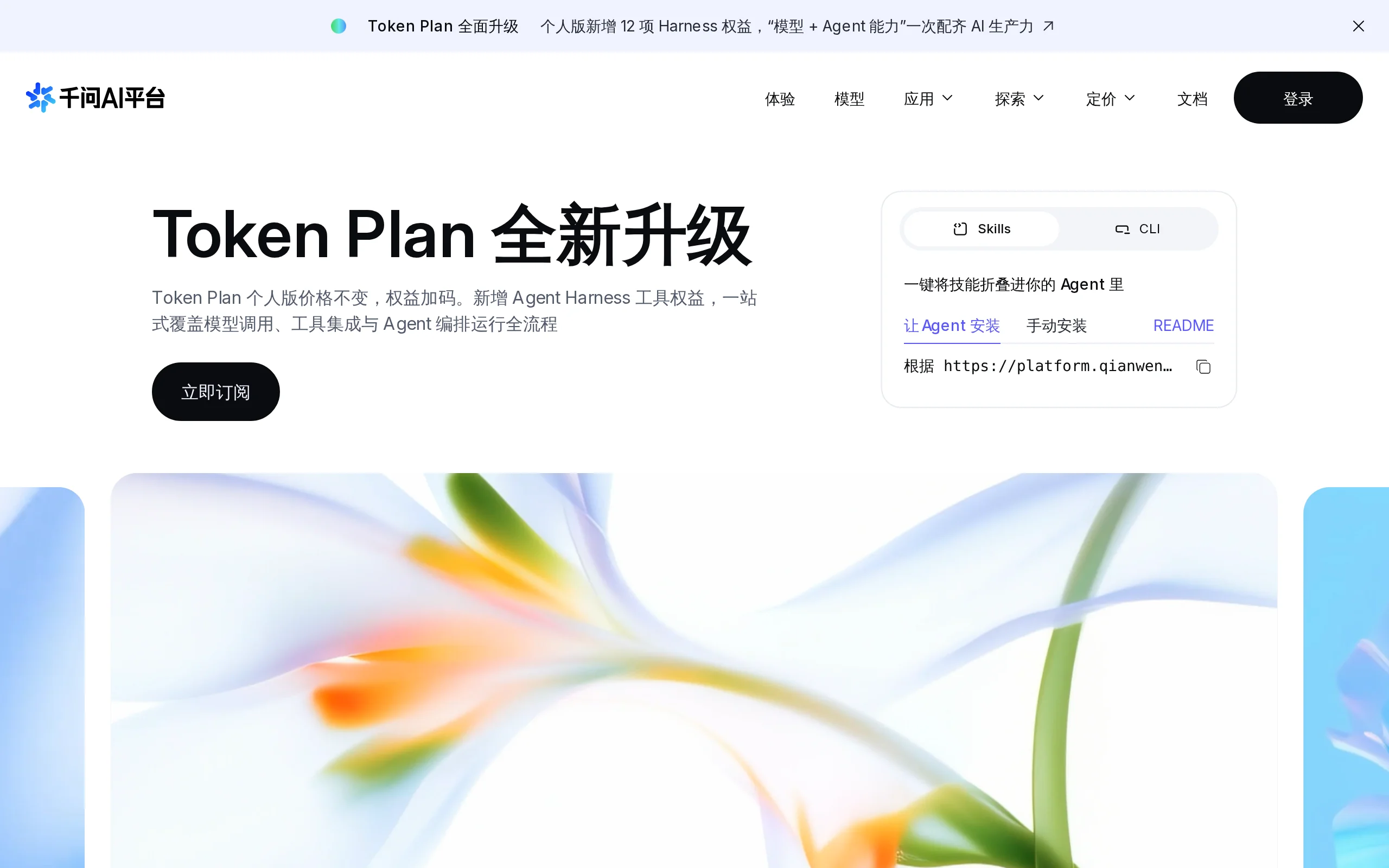
Executive Summary:
Qwen-Audio-3.1 is a series of large audio models launched by Alibaba's Qwen. It consists of five models: ASR speech recognition, ASR-Next audio understanding, TTS speech synthesis, TTS-Next audio crea...
1. What is Qwen-Audio-3.1
Qwen-Audio-3.1 is a series of large audio models launched by Alibaba's Qwen. It consists of five models: ASR speech recognition, ASR-Next audio understanding, TTS speech synthesis, TTS-Next audio creation, and Realtime real-time interaction, covering the complete audio pipeline from "understanding—generation—interaction—creation." This series supports 30 languages and 16 Chinese dialects, featuring role-based transcription, emotion perception, voice style transfer, and full-duplex real-time conversation capabilities. It can also invoke external tools to accomplish tasks, marking a significant evolution in voice AI from a single transcription tool to a full-modal audio understanding and generation platform. Based on an end-to-end joint modeling architecture and a multi-teacher distillation framework, the series has achieved systematic improvements in metrics such as recognition accuracy, synthesis naturalness, and interaction latency, offering developers a ready-to-use full-stack audio solution.
Image source: Official article
Image source: official article
Technical Positioning and Domain: Qwen-Audio-3.1 belongs to the field of voice artificial intelligence, specifically covering five sub-directions: automatic speech recognition (ASR), text-to-speech (TTS), audio understanding, real-time interactive dialogue, and audio content creation. Its uniqueness lies in integrating previously fragmented voice technology stacks into a unified product system and introducing two forward-looking directions: "audio understanding" (ASR-Next) and "audio creation" (TTS-Next). This breaks the limitations of traditional voice tools that only process "text," extending the model's capabilities to the understanding and generation of complete acoustic signals.
Development Background: This series was developed by the Tongyi Lab at Alibaba (the Qwen team), leveraging the technical accumulation of the Qwen large model family and large-scale computing infrastructure. The motivation behind its development was to address the long-standing issue of "model fragmentation" in the voice AI domain—traditional solutions have speech recognition, synthesis, and interaction handled by different vendors or architectures, making it difficult to achieve a cohesive and optimized user experience. Additionally, the demand for scenarios such as Chinese dialect recognition, cross-language voice style transfer, and ultra-low-latency interaction has driven the creation of this new generation of full-stack audio models.
Core Value: This series solves three practical problems: first, the accuracy of recognizing Chinese dialects (including obscure dialects like Wenzhou dialect), achieving an average semantic sentence accuracy of 82.10% for dialect AST; second, the issue of quality consistency in audio content production caused by multiple people working on different parts, where TTS-Next can generate consistent human speech, sound effects, and ambient sounds in one go; third, the user experience fragmentation in real-time voice interaction where "speaking and listening cannot happen simultaneously," which the Realtime model addresses through a full-duplex architecture, enabling natural interruptions and overlapping speech.
Technical Features: The end-to-end joint modeling strategy allows ASR to simultaneously output speaker labels, timestamps, and transcribed text; the multi-teacher distillation architecture ensures that Realtime maintains both reasoning and security capabilities under low-latency conditions; the core differentiating capability of the TTS series is the natural cross-language and cross-dialect voice style transfer. Overall, it adopts a unified input/output paradigm, supports 48kHz high-fidelity output, and achieves a first-character response time of approximately 160 milliseconds in streaming recognition.
2. Key Features
Full-duplex Realtime Conversation: Achieves true full-duplex interaction through a multi-teacher distillation architecture, allowing speaking and listening to occur simultaneously and supporting interruptions at any time. The model understands evolving user needs during continuous conversations, can perceive emotions and intentions, and integrates tool calling capabilities to connect with external APIs, knowledge bases, and business systems to complete tasks. It is suitable for high-realtime scenarios such as voice customer service and intelligent assistants. Language switching occurs seamlessly during the conversation without requiring reinitialization of the session.
Role-based High-precision Transcription (ASR): An end-to-end joint modeling solution that simultaneously outputs speaker labels, timestamps, and transcribed text, preserving details such as short interjections and overlapping speech that are often lost in traditional cascaded systems. It includes built-in capabilities for removing filler words, eliminating repetitions, self-correction, and semantic reorganization. The transcribed results can be directly used for meeting records and dialogue analysis without further cleaning. The average semantic sentence accuracy for dialects reaches 82.10%, with significant optimization for difficult-to-understand dialects such as Wenzhou dialect.
General Audio Understanding (ASR-Next): Expands the processing object from "text in speech" to the full audio signal, enabling the model to understand human emotions, ambient sounds, and mechanical noises. It supports sound event localization, description, and reasoning. Users can perform natural language queries on audio, such as "How many times did the alarm sound appear in this recording?" or "What is the emotional state of the speaker?" This marks the evolution of ASR from a transcription tool to a general-purpose audio understanding model.
Multilingual Voice Style Migration and Synthesis (TTS): Supports synthesis across multiple languages and dialects. The core capability is the natural cross-language and cross-dialect migration of the same voice style — a voice style recorded in Chinese can directly generate content in English, Japanese, or Cantonese, without the need for retraining. Users can control emotion, speaking rate, and expression style through natural language instructions, ensuring the synthesized speech aligns with content and scenario requirements.
Unified Audio Creation (TTS-Next): Centered around three types of input — text, timestamps, and reference audio — it generates a complete audio output consisting of human voice, sound effects, and ambient sounds in one go. It maintains consistent voice styles and emotional states for each role in multi-turn dialogues, supports fine-grained timestamp control, voice cloning, and 48kHz high-fidelity output. This can replace the post-production workflow involving multiple people in scenarios such as podcasts, audiobooks, film, games, and advertisements.
Low-latency Streaming Recognition: The first-character response latency for streaming recognition is approximately 160 milliseconds, meeting the requirements of latency-sensitive applications such as real-time subtitles and voice assistants. The ASR model performs speaker separation and text polishing during the streaming process, rather than waiting until the full audio is received, significantly improving interaction smoothness.
Tool Calling and Task Completion: After the Realtime model understands the user's intent, it can proactively call external tools to complete tasks — such as querying business systems, retrieving knowledge bases, or operating API interfaces. The model dynamically decides when and with what parameters to call tools based on the context, and confirms the execution results through ongoing dialogue. This is applicable for enterprise-level voice interaction applications.
3. How to Use
Access the platform and log in: Open the Qwen AI platform official website at https://www.qianwenai.com/, and log in using your Alibaba Cloud account or Tongyi Qianwen account. Navigate to the "Model Marketplace" page to browse the list of available models.
Select the target model: Choose the appropriate model based on your task requirements—select ASR (Qwen-Audio-3.1-ASR-Flash) for audio transcription, TTS (Qwen-Audio-3.1-TTS-Flash) for speech synthesis, TTS-Next (Qwen-Audio-3.1-TTS-Next) for full audio generation, and Realtime (Qwen-Audio-3.1-Realtime-Plus) for real-time conversations. Each model's detail page provides functional descriptions, API documentation, and usage examples.
Enable the service and obtain an API Key: Enable the corresponding model service in the Qwen AI console and create an API Key for interface authentication. The API Key must be kept secure, as it is involved in cost measurement and access control. It is recommended to create separate Keys for different applications to facilitate individual management of quotas and usage.
API integration and invocation: Refer to the API documentation on the model's detail page and send an HTTP request with the audio file (or URL) and parameters. ASR requests support parameters such as audio format, sampling rate, and whether speaker labels are required; TTS requests require text, voice ID, speech rate, and emotion instructions. Note: The ASR-Next API is not yet available, and you must wait for the official release. For Realtime models, a WebSocket connection must be established to maintain long sessions.
Application integration and testing: After integrating the API into your custom application, Agent, or smart hardware, first validate the recognition/synthesis quality using a small batch of samples, then gradually scale up the traffic. In production environments, it is recommended to configure timeout retry mechanisms and an audio format conversion layer to ensure that audio from different sources is correctly processed by the model.
Key Configuration Notes: For ASR transcription, the language parameter can be used to specify the language/dialect code, and speaker_diarization can be enabled for speaker separation. For TTS synthesis, the emotion and speed parameters control the emotional tone and speech rate, while voice_reference can be used to input a reference audio for voice cloning. For Realtime conversations, it is important to maintain the context window; it is recommended to input a summary of the historical conversation to optimize performance in long dialogues.
Best Practices: For dialect audio, it is recommended to test recognition accuracy with different dialect parameters before proceeding to batch processing; providing clear timestamps and scene descriptions when using TTS-Next can significantly improve audio quality; when integrating Realtime models, design a comprehensive interruption strategy to balance user freedom of expression with task completion efficiency. In terms of cost, each model is billed based on usage volume. For specific pricing details, please refer to the pricing page in the Qwen AI console.
4. Pros and Cons Analysis
| Pros |
|---|
| Full-stack voice capability integration: Five models cover the entire chain of understanding, generation, interaction, and creation. Developers no longer need to piece together solutions across multiple vendors. The unified API interface and data formats significantly reduce integration complexity, making it especially suitable for composite applications requiring multiple voice capabilities. |
| Significant advantage in Chinese dialect recognition: Supports 16 Chinese dialects, with notable optimization for difficult-to-understand dialects such as Wenzhou dialect. The average semantic sentence accuracy of dialect AST is 82.10%, comprehensively outperforming the cascaded system of Fun-ASR, meeting the needs of voice applications in dialect regions within China. |
| TTS-Next audio creation has strong differentiation: Generates complete audio including human voice, sound effects, and ambient sounds in one go. Multi-character voice tone consistency is well maintained. Mainstream voice products on the market have not yet provided equivalent capabilities, making it highly valuable for creation scenarios such as podcasts and audiobooks. |
| Natural full-duplex interaction experience in Realtime: Based on a multi-teacher distillation architecture, it enables simultaneous speaking and listening, supports interruptions and interjections, and can both perceive emotions and call tools. Compared to fast half-duplex solutions, it has a generational advantage in interaction naturalness, making it suitable for voice customer service scenarios. |
| Leading low-latency performance metrics: The first-character response time for streaming recognition is approximately 160 milliseconds. Realtime, based on a multi-teacher distillation architecture, balances low latency with inference capabilities, providing a smooth user experience for scenarios such as real-time subtitles and voice assistants. |
5. Comparative Analysis with Similar Tools
| Comparison Dimension | Qwen-Audio-3.1 (Tongyi, Alibaba) | OpenAI (GPT-Realtime-2 / GPT-Live-1) | Google Gemini Live |
|---|---|---|---|
| Product Form | Full-stack audio solution composed of five models: ASR, ASR-Next, TTS, TTS-Next, Realtime | Focuses on real-time voice interaction: Realtime API (gpt-realtime series) + GPT-Live full-duplex model | Real-time voice assistant for mobile devices, integrated into the Gemini App |
| Interaction Mode | Realtime full-duplex, speaking and listening simultaneously, supports interruptions | GPT-Live is true full-duplex; gpt-realtime is ultra-fast half-duplex (does not support speaking while listening) | Full-duplex conversation, supports interruptions and topic switching |
| Language/Dialect Coverage | Supports 30 languages + 16 Chinese dialects, with significant optimization for difficult dialects such as Wenzhou dialect | gpt-realtime-translate supports over 70 input languages, but no specific commitment to Chinese dialect capabilities | Supports the multilingual capabilities of the Gemini model, with broad coverage in real-time translation scenarios |
| Audio Creation Capability | TTS-Next can generate complete audio with human voice, sound effects, and ambient sounds in one go | No corresponding capability, only speech synthesis and real-time conversation | No integrated audio creation capability |
| ASR Capability | Role-based transcription + timestamps + native polishing, dialect AST average semantic sentence accuracy of 82.10%, comprehensively superior to the Fun-ASR cascaded system | Relies on independent transcription services such as Whisper (e.g., gpt-realtime-whisper, approximately $0.017 per minute) | Relies on internal speech models, transcription is not a core product feature |
| Tool Calling | Can call APIs, knowledge bases, and business systems during real-time conversation, with good integration | Supports Function calling, remote MCP server, and SIP phone, with a more mature ecosystem | Supports integration with Google ecosystem tools, but has limited capability for third-party API calls |
| Deployment Method | Official API cloud service, private deployment options to be announced | Cloud API, billed by Token/duration, with a complete ecosystem of tools | Integrated into the Gemini App or API, deployment methods are constrained by the Google ecosystem |
| Open Source License | Closed-source model, commercial API licensing | Closed-source commercial API | Closed-source commercial API |
| Community Ecosystem | Backed by Alibaba Cloud and the Qwen ecosystem, with rich domestic integration resources | Large global developer community, with abundant third-party libraries and tutorials | Relies on the Google developer ecosystem |
Selection Recommendations: For general real-time voice interaction scenarios, OpenAI's Realtime API still leads in ecosystem maturity and community support, especially suitable for international applications requiring advanced integrations such as Function calling and remote MCP servers. However, if the core user base is domestic and there is a strong demand for Chinese dialect recognition, Qwen-Audio-3.1's specialized dialect optimization and full-stack integration capabilities better align with practical use cases, avoiding compatibility costs from cross-vendor integration. For audio creation applications (podcasts, audiobooks, post-production for film and television), Qwen-Audio-3.1's TTS-Next currently has no direct competitors, making it a key reason for differentiated selection. For organizations with data sensitivity and the need for private deployment, Fun-ASR's open-source solution remains a viable option, though external modules such as speaker separation and text polishing must be addressed independently.
6. Editor's Summary
The core technical innovation of Qwen-Audio-3.1 is manifested in two aspects: first, it replaces the traditional cascaded approach with an end-to-end joint modeling architecture, unifying the output of speaker labels, timestamps, and transcribed text. This fundamentally eliminates issues of error accumulation and information loss in cascaded systems, with clear data support in dialect recognition and overlapping speech preservation (average semantic sentence accuracy of 82.10% for dialect AST). Second, through the introduction of two new model types, TTS-Next and ASR-Next, the scope of voice AI has expanded from "recognition and synthesis" to "understanding and creation." The former unifies the generation of human speech, sound effects, and ambient audio, while the latter upgrades from text transcription to semantic understanding of complete acoustic signals. This represents the technological evolution path of voice large models from "tools" to "platforms."
In terms of practical value, the most scarce capability of this series is the combination of integrated audio creation and full-duplex real-time interaction—very few products on the market can cover both directions simultaneously. For teams developing composite applications that combine voice interaction with audio content generation (such as intelligent podcast creation tools or voice-based social interaction products), Qwen-Audio-3.1 provides the most complete architectural solution available today. The low-latency performance (streaming first-character response latency of approximately 160 milliseconds) and dialect optimization directly address key pain points in the domestic market.
In terms of target users, this series is suitable for three categories of developers: the first is voice application development teams targeting the domestic market, who require strong capabilities in dialect recognition and Chinese optimization; the second is developers of audio content creation tools, who aim to replace multi-person post-production workflows with AI; the third is enterprise-level voice interaction system integrators who need full-duplex conversation and tool calling capabilities but prefer not to piece together solutions across different vendors. For general-purpose voice needs with international applications, a comparison with the OpenAI and Google ecosystems is still recommended before making a decision.
In terms of development potential, the API openness of ASR-Next, the addition of private deployment options, and the accumulation of more third-party evaluation data will be key indicators for assessing its maturity.
7. Application Scenarios
Meeting Minutes and Interview Transcripts: Utilize the role-based transcription and timestamp features of ASR to automatically generate structured records of "who said what at what time." The native polishing capability removes filler words and redundant expressions, producing coherent and logically clear text that can be directly imported into knowledge bases or collaboration tools. Accurate transcription of dialect-based meetings (e.g., Cantonese, Hokkien) significantly improves meeting efficiency and the quality of information retention.
Podcast and Audiobook Production: With TTS-Next, generate complete audio content with multiple character dialogues, sound effects, and ambient noise in one go, maintaining consistent voice and emotional tone across roles. Creators only need to provide scripts and character settings to produce professional-grade audio content, eliminating the need for coordination among hosts, sound designers, and mixers. The 48kHz high-fidelity output meets professional publishing standards, while fine-grained timestamp control enables precise scene transitions.
Real-time Voice Customer Service and Smart Assistants: Leverage Realtime's full-duplex interaction and emotion perception capabilities to build a voice customer service system that can be interrupted and is empathetic. Users can insert new requests at any point during their expression, and the model understands emotional shifts and calls upon business systems to complete tasks such as queries, orders, and after-sales support. The ability to switch between multiple languages allows a single customer service system to serve international clients.
Cross-border Travel and Multilingual Communication: With real-time language switching and cross-language synthesis using the same voice, provide a natural and smooth voice translation experience for travel planning, cross-border e-commerce consultations, and international conferences. Users can use their personal voice to communicate in multiple languages, eliminating the robotic feel of machine translation and enhancing communication friendliness and the accuracy of information delivery.
AI Smart Hardware Integration: Integrated with hardware such as QwenNote and Qwen AI Glasses, users can initiate tasks, add conditions, and track progress without needing to open a computer or smartphone. Realtime's interruption capability aligns with the fragmented interaction patterns of hardware scenarios, making voice a natural entry point for AI hardware, especially suitable for automotive, wearable, and home devices.
8. FAQ
Q: How is the API for Qwen-Audio-3.1 billed? Is there a free tier available?
A: APIs for all models are billed based on usage volume. For specific pricing details, please refer to the pricing page on the Qwen AI Console. New users typically receive a certain amount of free usage credits for testing purposes. For official commercial use, costs should be estimated based on the anticipated usage volume. TTS-Next, which generates complete audio in one go, may have different billing units compared to ASR/TTS. It is recommended to carefully read the billing instructions on the model's detailed page.
Q: How to configure dialect recognition for ASR? Which specific dialects are supported?
A: The ASR model supports 16 major Chinese dialects, including Wu (e.g., Wenzhou, Shanghai), Cantonese, Hokkien, Sichuanese, and others. During configuration, specify the dialect code in the language parameter of the API request. For less common dialects (e.g., Wenzhou), it is advisable to test with a small sample set to verify recognition accuracy before proceeding with batch processing. The model also demonstrates good adaptability to audio containing mixed dialects.
Q: What is the difference between Realtime's full-duplex mode and a regular voice assistant?
A: Regular voice assistants typically operate in half-duplex mode, meaning the system cannot receive and process new instructions while responding to the user. The user must wait for the current response to finish before continuing the interaction. Realtime, on the other hand, is built on a full-duplex architecture, enabling simultaneous speaking and listening. Users can interrupt the AI at any time during its response, and the AI will immediately understand the new instruction and adjust its reply accordingly. This makes the interaction rhythm closer to human conversation and significantly improves the efficiency of handling complex tasks.
Q: Can TTS replicate the voice of a specific person? Does it involve copyright risks?
A: Both TTS and TTS-Next support voice cloning based on reference audio. Users can provide a reference audio sample of the target voice to generate synthesized speech with that voice. Regarding copyright, it is recommended to only clone voices that you own the copyright to or have been authorized to use. Cloning the voice of public figures or others without permission may involve legal risks related to portrait rights and voice rights, and users are responsible for ensuring compliance.
Q: Does Qwen-Audio-3.1 support offline deployment? Is there an open-source version available?
A: Currently, Qwen-Audio-3.1 is only available as an API cloud service. The official has not released an open-source version of the model weights, nor has it made the private deployment plan public. For scenarios with strict data compliance requirements, please keep an eye on official updates. In contrast, Alibaba's open-source Fun-ASR toolkit supports local deployment and can be used as an alternative for private deployment scenarios, although its feature coverage is not as comprehensive as Qwen-Audio-3.1.
9. Project Links
- Qwen AI Platform (Product Official Website): https://www.qianwenai.com/
- Qwen-Audio-3.1-ASR Online Demo: https://www.qianwenai.com/models/qwen-audio-3.1-asr-flash
- Qwen-Audio-3.1-TTS Online Demo: https://www.qianwenai.com/models/qwen-audio-3.1-tts-flash
- Qwen-Audio-3.1-TTS-Next Online Demo: https://www.qianwenai.com/models/qwen-audio-3.1-tts-next
- Qwen-Audio-3.1-Realtime Online Demo: https://www.qianwenai.com/models/qwen-audio-3.1-realtime-plus
Related AI Model Articles
Review of DeepSeek Harness Desktop: How the Official GUI Client Lowers the Bar for Agent Usage
DeepSeek Harness Desktop is the official graphical client launched by DeepSeek, designed to provide a visual interface for the originally command-line-based DeepSeek Harness framework. After users log...
In-Depth Review of Spark-ASR-2.0: A New Paradigm in Speech Recognition with Non-Autoregressive Architecture
Spark-ASR-2.0 is the latest generation speech recognition large model launched by iFLYTEK based on its proprietary Spark-Audio speech foundation model. This model continues the non-autoregressive para...
Qwen3.8-LiveTranslate – A Real-Time Simultaneous Interpretation Model Launched by Alibaba Tongyi
Qwen3.8-LiveTranslate is a real-time simultaneous interpretation large model launched by the Tongyi Qianwen team at Alibaba. Based on the Interleave single-stream architecture, it processes audio and ...
Qwen3.8-Omni-Flash – A Native Multimodal Model Launched by Alibaba Qwen
Qwen3.8-Omni-Flash is a native multimodal model launched by Alibaba Qwen. It jointly models four modalities—text, image, audio, and video—within a single architecture, supporting a context length of u...
© All Rights Reserved. Some content on this site is partially generated by AI with human review.