
Seedream 5.5 – Image Creation Model Launched by ByteDance's Seed Team
Executive Summary:
Seedream 5.5 is the latest generation image creation model launched by ByteDance's Seed team. It has been gradually rolled out on platforms such as Jiumeng, Douyin, Douyin Work, and Huoyan Fangyuan. T...
1. What is Seedream 5.5
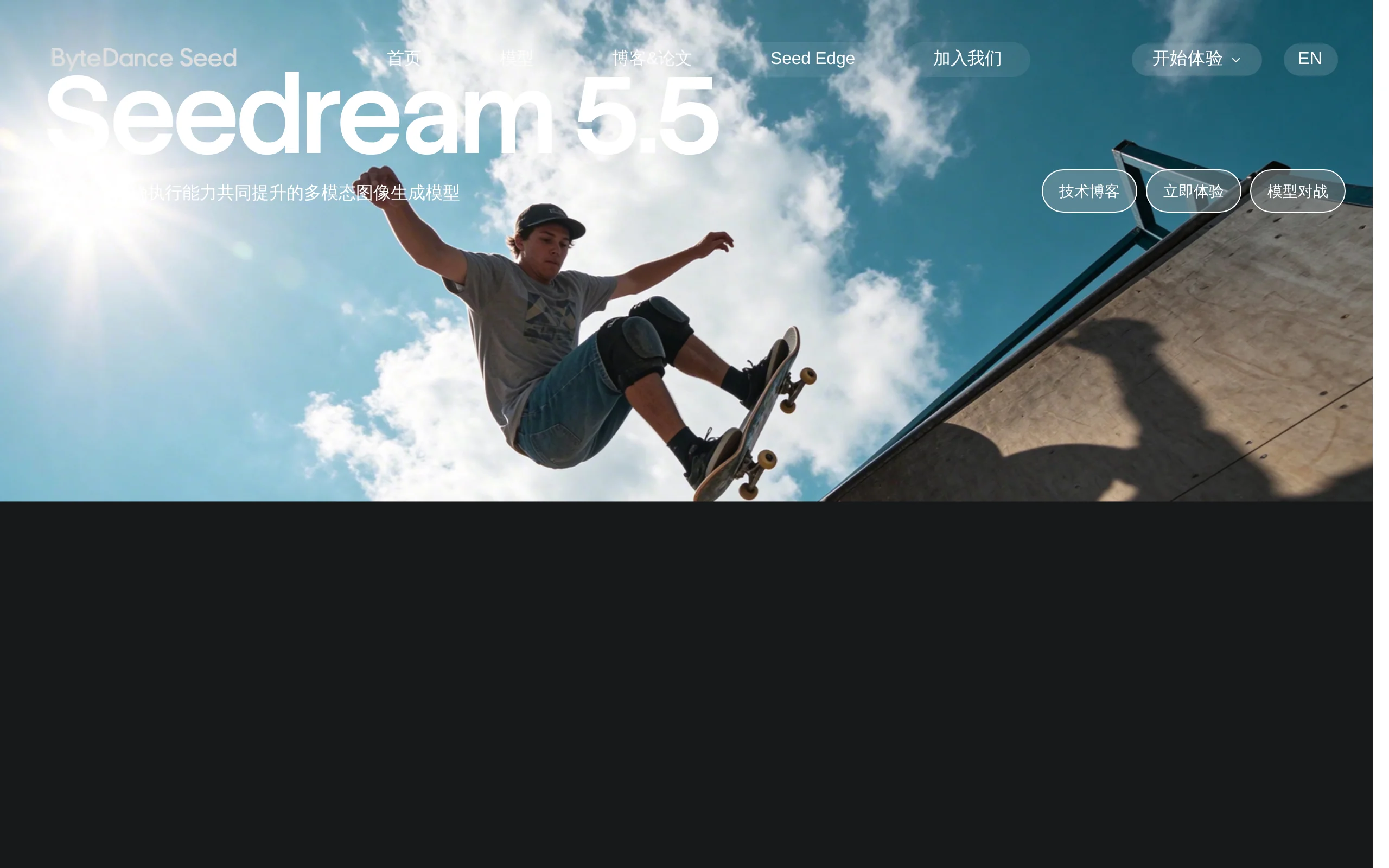
Seedream 5.5 is the latest generation image creation model launched by ByteDance's Seed team. It has been gradually rolled out on platforms such as Jiumeng, Douyin, Douyin Work, and Huoyan Fangyuan. This model emphasizes more stable multi-round editing capabilities, enabling pixel-level preservation of non-edited regions and supporting up to hundreds of continuous modifications around the same piece of work. Additionally, it introduces native RGBA transparent material generation, allowing direct output of images with an Alpha channel and eliminating the need for post-production masking processes. In terms of visual quality, Seedream 5.5 is closer to real photography effects, with more accurate rendering of dense small text, reducing severe text corruption to 0.4%. It demonstrates a leading advantage in the realism of text-to-image generation and the accuracy of text structure representation.
Technical positioning and domain: Seedream 5.5 belongs to the field of generative artificial intelligence, specifically as a text-to-image diffusion model. It covers multiple creative tasks, including image generation, image editing, and transparent material generation. It represents a leap from "image generation" to "continuous creation" within ByteDance's existing image generation technology framework. While focusing on single-generation quality, it emphasizes stability and consistency during multi-round editing processes, which is a differentiated technical direction in the current landscape of image generation models.
Development background: This model was developed by ByteDance's Seed team, which has previously launched a series of image models such as Seedream 3.0 and Seedream 4.0, accumulating rich experience in diffusion model training and productization. The release of Seedream 5.5 continues the team's iterative rhythm in the image generation domain, directly addressing two long-standing pain points: one is the degradation of image quality over multiple editing rounds, and the other is the efficiency loss caused by the separation of transparent images and masking in design material production.
Core value: Seedream 5.5 solves two practical issues. The first is the efficiency problem in professional design workflows—native RGBA output allows transparent materials to directly enter layout and compositing stages, eliminating the cumbersome steps of traditional masking and edge refinement. The second is the stability issue in creative iteration—its capability for continuous editing over hundreds of rounds enables designers to repeatedly refine details on the same piece of work without worrying about disturbances in non-edited regions or image quality degradation. It is reported that in six scenarios—e-commerce, marketing, film, gaming, office, and fashion design—the usability in film and office scenarios has more than doubled compared to the previous version.
Technical features: The core technical advantages of Seedream 5.5 are reflected in three aspects: achieving multi-round editing stability through chained training samples and pixel-level consistency constraints; incorporating the Alpha channel as a prediction target alongside RGB, internalizing the masking process; and enhancing the supervision of character structure and the data ratio of photographic imaging distribution during training, thereby simultaneously improving realism and text rendering accuracy.
2. Key Features
Multi-round Stable Editing: The model treats the input image both as content and as context for editing instructions. By using conditional control mechanisms such as region masks and instruction alignment, it clearly distinguishes between areas to be edited and areas to be preserved. According to official demonstrations, the same image can be modified up to 100 times consecutively without significant loss of detail or degradation in image quality, making it ideal for complex creative tasks that require repeated refinement of the visual content.
Native RGBA Transparent Material Generation: The model treats the Alpha channel as a prediction target on par with RGB. By introducing matte data with transparency annotations (such as foreground segmentation and hair-level annotations) into the training data, the model can directly output four-channel images. Special optimizations have been made for high-frequency edge details such as feathers and lace, resulting in smooth edge transitions and no white or stray edges, eliminating the need for post-processing matte refinement.
Transparent Art Text Creation: The model can incorporate the brushstrokes, colors, and materials from a reference image into a specified font shape, directly generating art text materials with a transparent background. This capability combines text rendering with transparency channel generation, offering a one-step solution for design scenarios such as poster headlines and brand logos.
Cross-scenario Reuse of Character Materials: Using the same set of transparent character materials as a reference, the model can maintain the character's features and texture while quickly generating a series of images with different scenes, actions, and compositions. This feature is particularly useful for creative tasks that require consistent character representation, such as game character design, IP derivative content, and series of illustrations.
Photorealistic Image Generation: By improving the generation training process and adjusting data ratios, the model reduces issues such as plastic-like appearance, overexposure, and oily highlights caused by training distribution bias. The loss design emphasizes high-frequency details such as skin texture and lighting layers. The generated results exhibit more natural lighting, material, and skin texture, closely resembling the quality of real photographs.
High-density Text Rendering: The model enhances shape structure supervision during training and applies data augmentation for complex Chinese characters and high-density small text scenarios, enabling it to learn stroke structure and text layout from "visually similar" to "textually accurate." According to official data, the rate of severe text corruption has dropped to 0.4%, and the rate of minor corruption has dropped to 1.7%, demonstrating strong capabilities in restoring dense small text and complex character structures.
3. Application Scenarios
E-commerce Product Image Creation: Generate highly realistic product images and model wear images with detailed material and lighting effects. The small text annotations are clear and legible, meeting the dual requirements of image quality and textual accuracy for product detail pages. Combined with the ability to generate transparent materials, product assets can be quickly produced and directly integrated into the layout process.
Marketing and Poster Design: Directly output RGBA transparent assets and artistic text, eliminating the need for background removal during layout composition. Designers can drag and drop the generated transparent characters, products, and artistic text directly into design software, significantly shortening the production cycle for marketing materials, suitable for high-frequency design needs such as posters, banners, and social media visuals.
Film and Concept Design: Supports hundreds of consecutive edits around the same piece while maintaining stable visual details, ideal for iterative refinement of concept art, storyboards, and scene proposals. Creative teams can continuously adjust composition, lighting, and details on the same base image without needing to regenerate it each time, improving the efficiency of design iteration.
Game and Character Design: Character assets can be reused across different scenes, maintaining consistent character features while flexibly adjusting actions and composition, enabling efficient production of a series of character visuals. For tasks requiring consistent character portrayal, such as setting illustrations, character portraits, and story inserts, this capability reduces the workload of repetitive drawing and manual corrections.
Office and Apparel Design: Accurately renders complex small text with high editing stability, suitable for office scenarios such as document illustrations and presentation visuals. In apparel and accessory design, it allows for multiple rounds of refinement on style details and outputs transparent background assets directly usable for presentations.
4. How to Use
Seedream Web Version: Visit the Seedream official website and select the Seedream 5.5 model in the "Creation - Generate/Canvas" feature. You can then generate images through text descriptions or perform multi-round edits on existing images. This entry point is ideal for daily creative generation and canvas-style editing.
Doubao App: Switch to the Seedream 5.5 model in the "Image Generation" feature of the Doubao App. Simply describe the scene content using natural language to generate images. The mobile entry point is suitable for quick creation anytime and anywhere, with a low operational barrier.
Doubao Work: A smart assistant platform designed for office scenarios, enabling users to activate Seedream 5.5 through the "Skills" section. Its image generation capabilities can be directly invoked within workflows. This is ideal for users who need to integrate image generation into document writing, presentation creation, and other workflows.
Volcengine Experience Center: Visit the Volcengine Experience Center (https://exp.volcengine.com/), and after logging in, find Doubao-Seedream-5.5 under "Visual Models → Image Generation" to experience it. This entry point is aimed at developers and enterprise users, allowing further integration with API services.
API Integration: Enterprise users can obtain Seedream 5.5 API services through the Volcengine platform and integrate them into their own applications or business systems. For specific integration methods and API parameters, please refer to the official Volcengine documentation. It is recommended to first test the effects through the Experience Center before proceeding with formal integration.
5. Pros and Cons Analysis
| Pros |
|---|
| Hundred-round multi-round editing stability: Non-edited regions are maintained at a pixel level, allowing for 100 consecutive edits without losing details or degrading image quality, providing reliable technical support for continuous refinement of complex creative projects. |
| Native RGBA transparent material output: Directly generates transparent images with an Alpha channel, with precise edge handling, eliminating the need for post-production chroma keying or edge refinement. This allows materials to be independently integrated into design workflows, significantly improving design production efficiency. |
| Realistic image texture: Lighting, material, and skin texture are rendered more naturally, reducing common issues such as oily highlights and overexposure. The generated results are closer to real photographs, making it suitable for commercial scenarios with high visual realism requirements. |
| High-accuracy text rendering: Strong capability in reproducing dense small text and complex character shapes, with a severe text degradation rate of only 0.4%, offering a clear technical advantage in Chinese text rendering scenarios. |
6. Comparative Analysis with Similar Tools
| Dimension | Seedream 5.5 (ByteDance) | Nano Banana 2.1 (Google) |
|---|---|---|
| Multi-round Editing | Maintains non-edited regions at a pixel level; official demo shows 100 rounds without detail loss or quality degradation | Dialog-based multi-round editing, focusing on improving character/object consistency; no published round limit |
| Reference Image Capability | Supports reference image generation for transparent materials and cross-scenario reuse of characters | Up to 14 reference images (4 characters + 10 objects), with multi-image fusion as a strong feature |
| Transparent Materials | Native RGBA output, directly generates images with an Alpha channel | Not provided |
| Text Rendering | Severe text corruption rate of 0.4%, minor of 1.7%; leads in Chinese dense small text rendering | Improved text rendering and infographic layout |
| Realism | Official GSB evaluation states that text-to-image realism leads competitors | Official self-testing shows improvement over previous versions |
| Integration Method | DreamIt, DouBao App, DouBao Work, Volcano Ark (primarily domestic) | Gemini App, AI mode, Flow, and API (global) |
Selection Recommendation: For domestic design teams and professionals in e-commerce and marketing, Seedream 5.5's native RGBA transparent material generation, high-accuracy Chinese small text rendering, and stable editing capability across hundreds of rounds give it a clear advantage in localized design workflows, especially in scenarios requiring extensive Chinese text layout and transparent material compositing. If the workflow heavily relies on the Chinese context and domestic platform ecosystem, Seedream 5.5 is a more suitable choice.
Selection Recommendation: For teams requiring multi-image fusion and global deployment, Nano Banana 2.1's 14 reference image capability and global integration with the Google ecosystem are better suited for complex multi-element compositions and international market applications. Developers seeking ultimate generation quality validated by third-party benchmarks and requiring flexible API integration should pay attention to the Sunburst model of GPT Image 2.6, which excels in image editing coherence and UI/UX design performance. The three are not simple substitutes; the choice should be based on a comprehensive evaluation of specific scenarios' editing depth, text requirements, transparent material needs, and deployment scope.
7. Editor's Summary
Seedream 5.5 has established a clear differentiated position within the competitive landscape of image generation models: rather than solely pursuing visually stunning outputs in single-generation scenarios, it focuses on addressing two real pain points in the creative workflow—stability during multi-round editing and the efficiency of producing transparent materials. From a technical standpoint, incorporating the Alpha channel into the prediction target and suppressing error accumulation through chained training samples all point toward the critical path for image generation to transition from a "toy" to a "productivity tool." Particularly noteworthy is the official disclosure of a severe text corruption rate of 0.4%, indicating that the model has undergone targeted optimization for complex Chinese character shapes and dense small text scenarios, which holds practical value in domestic design contexts.
From a practical value perspective, Seedream 5.5's coverage of six distinct scenarios (e-commerce, marketing, film, gaming, office, and fashion design) demonstrates ByteDance's clear plan for commercializing image generation. The data showing that availability in film and office scenarios is more than double that of the previous version confirms the tangible benefits of the model's enhanced capabilities in multi-round editing stability and text rendering accuracy for professional workflows. For designers needing to frequently produce marketing materials, film and gaming teams requiring repeated refinement of concept proposals, and e-commerce operators needing to quickly generate transparent assets, this model effectively reduces the intermediate steps between creativity and final output.
Of course, Seedream 5.5 is not without its limitations. Its current access channels are primarily focused on domestic platforms, limiting availability for overseas users; the number of reference images and multi-image fusion capabilities still lag behind some competitors; and there is room for improvement in the level of technical detail disclosure. However, in terms of alignment with domestic market demands, Seedream 5.5 has formed a combined advantage in three key areas: Chinese text rendering, transparent material output, and multi-round editing stability. This positions it strongly in scenarios such as e-commerce design, creation of Chinese marketing assets, and series production of character materials. As ByteDance continues to invest in the image generation field, the iteration direction of the Seedream series is worth ongoing attention from the industry.
8. FAQ
Q: What is the maximum number of rounds supported by Seedream 5.5 for multi-round editing?
A: According to official demonstrations, Seedream 5.5 supports up to 100 consecutive edits on the same piece of work, maintaining pixel-level consistency in non-edited regions without significant loss of detail or degradation in image quality. This capability is achieved by constructing a large number of chained samples during training, where the output from the previous round is used as the input for the next, combined with pixel-level consistency constraints.
Q: What is the difference between native RGBA transparency material generation and traditional matting?
A: Traditional matting involves separating the subject from the background using additional segmentation tools after generation, which often requires manual edge refinement and detail adjustments. Seedream 5.5 treats the Alpha channel as a prediction target alongside RGB, directly outputting four-channel images during the generation phase. This results in smooth edge transitions and no white or stray edges, effectively integrating the matting process into the generation itself and eliminating the need for post-processing.
Q: On which platforms can Seedream 5.5 be used?
A: Seedream 5.5 is currently available on several platforms, including Jimo (web version: "Create - Generate/Canvas"), Doubao ("Image Generation" feature), Doubao Work ("Skills" section), and the Huoshan Ark Experience Center (Visual Models → Image Generation: Doubao-Seedream-5.5). Enterprise users can also access API services through Huoshan Ark for integration and use.
Q: How does Seedream 5.5 perform in terms of text rendering capabilities?
A: According to official data, Seedream 5.5 has reduced the rate of severe text corruption to 0.4% and minor text corruption to 1.7%. The model was trained with enhanced supervision on character structure and included data augmentation for complex Chinese characters and dense small text scenarios, resulting in strong performance in reproducing dense small text and complex character shapes. This makes it particularly suitable for high-accuracy text requirements in scenarios such as Chinese posters and e-commerce product detail pages.
Q: What are the unique advantages of Seedream 5.5 compared to other image generation models, such as GPT Image 2.6?
A: Seedream 5.5's differentiating advantages are primarily reflected in three areas: first, native RGBA transparency material output, a feature currently not available in most mainstream models; second, multi-round editing stability at the 100-round level, with pixel-level preservation in non-edited regions; and third, high accuracy in rendering dense small text in Chinese. In contrast, GPT Image 2.6 excels in the number of reference images it can support (up to 14) and its global integration ecosystem.
Q: Is Seedream 5.5 an open-source model?
A: Based on currently available public information, Seedream 5.5 is primarily offered through platforms like Jimo, Doubao, and Huoshan Ark in the form of a service, and there has been no official announcement regarding an open-source plan. Users can experience the model through product interfaces or call APIs on the Huoshan Ark platform, but the model's weights and source code are not publicly available.
9. Project Links
Related
LoopForge – Tencent's Open-Source Cloud-Based AI R&D Collaboration Platform
LoopForge is an open-source, team-level cloud-based AI R&D collaboration platform developed by Tencent, designed to address engineering breakpoints that occur during multi-Agent handover processes. Un...
Claude Fable 5.2 – Anthropic's Flagship AI Model
Claude Fable 5.2 is Anthropic's flagship AI model, sharing a common origin with the security-focused Claude Mythos 5.2. This model is renowned for its capability of autonomous collaboration among thou...
Apollo World – Baidu Apollo's Multimodal World Model, Empowering Autonomous Driving Closed-loop Simulation and Data Flywheel
Apollo World is a multimodal world model driven by intelligent agents, introduced by Baidu Apollo for physical AI. Unlike traditional simulation tools, this system constructs virtual cities based on r...
Qoduck – The Anonymous Coding Model Launched by Alibaba, Now Available for Free on Qoder
Qoduck is an anonymous coding model launched by Alibaba's AI coding platform Qoder on November 7, 2026. The official has not disclosed its identity or parameters, and the community generally speculate...
© All Rights Reserved. Some content on this site is partially generated by AI with human review.